
The thought of moving a home loan to another bank can trigger a wave of anxiety. Paperwork. Timing gaps. The fear of being caught between two lenders with no safety net. That feeling is completely normal.
But switching home loans from one bank to another is not a fringe move. It is mainstream borrower behaviour, and brokers are now central to how Australians arrange finance, handling around 81 percent of new residential mortgages according to ASIC. The savings case is real too. Moneysmart notes that variable home loan rates on the market can differ by more than 2 percent, and with the RBA lifting the cash rate three times in early 2026, the gap between an old rate and a sharper new one has widened.
Most switching guides online are written by a bank trying to win the reader's loan. This one takes the borrower's side, with no product to sell. It is a clear, step by step walkthrough of what happens when a Stryve Finance broker manages a home loan refinance.
What actually happens when you transfer a home loan to another bank
Switching lenders is technically a refinance. The new lender pays out the old loan and sets up a new one in its place. Same property, same borrower, different bank. That is the core of it.
One of the biggest unknowns for anyone weighing up a switch is how long it takes. The honest answer is that a broker managed refinance moves through three clear phases, and most switches settle within four to eight weeks from the day the application is lodged. The graphic below maps the full journey at a glance, from the first loan comparison through to settlement day, so the timeline stops feeling like a black box.
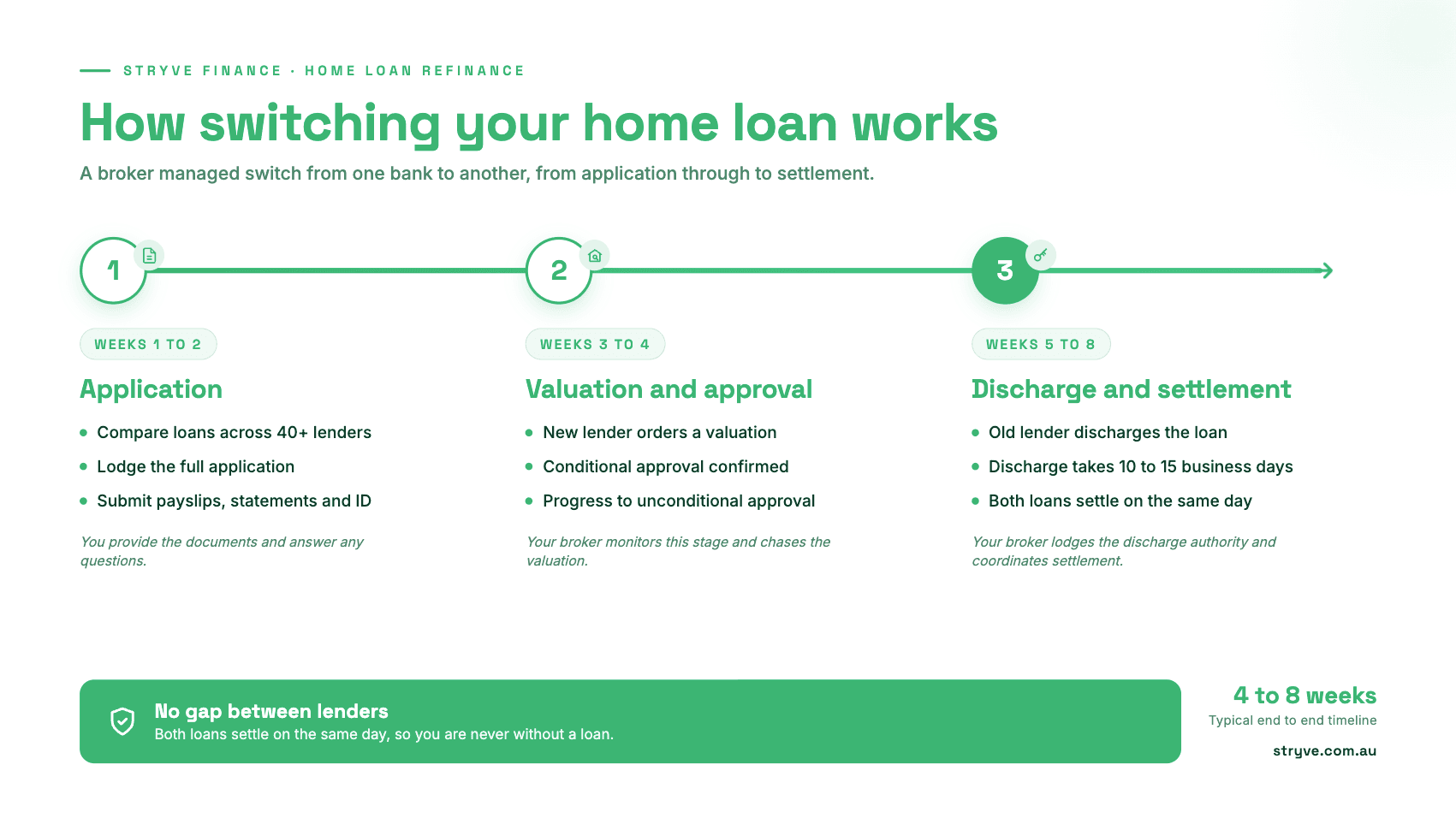
With the shape of the process in view, here is what happens week by week, and exactly who does the work at each stage. In almost every case the borrower's only real job sits at the start, and a Stryve Finance broker carries the load through valuation, approval, discharge and settlement.
The process moves through five phases.
- Comparison and application: The borrower and broker shortlist the right loan and lodge the paperwork.
- Valuation: The new lender orders a valuation of the property.
- Approval: Conditional first, then unconditional once everything checks out.
- Discharge: The old lender processes the release of the existing loan.
- Settlement: The new lender pays out the old one and the switch is complete.
Bank Australia points to equity, the current property value minus the remaining loan balance, as a key factor in refinance eligibility. A new valuation confirms the numbers.
If the broader process is unfamiliar, it helps to understand how the refinance process works before diving into the switching mechanics below.
A week by week timeline for switching home loans
One of the biggest unknowns is how long the switch takes. Here is a realistic week by week breakdown.
Weeks 1 to 2, comparison and document submission. The broker shortlists loans that suit the borrower's situation, then prepares and lodges the full application with supporting documents such as payslips, bank statements, ID, and details of the existing loan. The borrower simply provides the documents and answers any questions. The broker handles the rest.
Weeks 3 to 4, valuation and approval. The new lender orders a property valuation. Once it comes back and the lender is satisfied, the application moves from conditional to unconditional approval. The broker monitors this stage and chases the valuation if it stalls, so the borrower never contacts the new lender directly.
Weeks 5 to 8, discharge and settlement. This is often the longest phase. The old lender must process the discharge of the existing loan, and discharge processing can take 10 to 15 business days depending on the lender. The broker lodges the discharge authority, follows up, and coordinates settlement between both parties.
There is no gap between lenders. The old loan is not discharged until the new one settles on the same day, so the borrower is never without a loan. This is the most common fear, and it is unfounded. The typical end to end timeline is 4 to 8 weeks from application to settlement.
What a broker actually does during the switch
A mortgage broker home loan refinance follows a structured, hands on process that goes well beyond recommending a product. Here is what a Stryve Finance broker handles when managing a transfer to another bank.
- Comparing across 40+ lenders to find the right fit based on the borrower's income, equity, loan features, and goals.
- Preparing and lodging the application so all documentation meets the new lender's requirements.
- Ordering and tracking the valuation, and following up on any delays.
- Managing discharge paperwork with the old lender, including lodging the discharge authority and chasing processing timelines.
- Coordinating settlement between both lenders so everything lands on the same day.
Brokers also carry a legal obligation that a bank selling its own products does not. Since 2021, mortgage brokers must act in the borrower's best interests under a duty enforced by ASIC. Without a broker, the borrower manages two lenders at once, chases discharge timelines alone, and handles paperwork on both sides. It is doable, but it is a lot of moving parts. For a closer look at going direct to a bank versus using a broker, that comparison is worth reading.
A broker is paid by the new lender through a commission, not by the borrower, and that commission is disclosed upfront.
Costs involved in moving your home loan to another bank
Switching is not free, but the costs are predictable and modest next to the potential savings.
- Discharge fee, sometimes called an exit fee, typically $150 to $400, charged by the old lender to release the loan.
- Valuation fee, typically $200 to $600, though some lenders waive it.
- Break costs, which apply only if the existing loan is on a fixed rate and can be significant.
- Application or establishment fees, charged by some new lenders and waived by others.
Moneysmart advises borrowers to ask about all fees before switching, and to compare loans on the comparison rate rather than the headline rate. For the full breakdown, including how to weigh fixed rate break costs, see the costs of switching.
Choosing the right loan before you switch
Before switching, the borrower needs to know what they are switching to. The key things to weigh:
- Comparison rate, which folds in fees and gives a truer picture of cost than the headline rate.
- Loan features like offset accounts, redraw facilities, and penalty free extra repayments.
- Suitability for the borrower's situation, including income type. Self employed applicants, for example, may need specialist lenders that not every bank offers.
The RBA Monetary Policy Board meets eight times a year to set the cash rate, but the cash rate is not the only thing driving home loan rates. A loan that looks competitive today may not stay that way, so features and flexibility matter as much as the rate. For a detailed framework, see how to compare home loan refinance offers, and for help picking the right person to run the process, here is choosing the right broker for a refinance.
What happens to your account details, direct debits, and offset balance
This is where the practical worries live. The loan account number will change because it is a new lender. There is no way around that.
Direct debits tied to the old loan account, such as automatic repayments or salary credits, need to be redirected to the new account. A broker can provide a checklist so nothing slips through.
Offset account balances do not transfer automatically. You must move funds in the old offset account manually to the new one, and timing matters. A broker can advise when to move them to minimise any gap where the money is not offsetting interest.
None of these steps are difficult, but they are easy to forget in the rush of settlement week, and a missed direct debit or a stranded offset balance can cost real money. The checklist below pulls the four account tasks into one place so nothing slips through the cracks between the old bank and the new one.
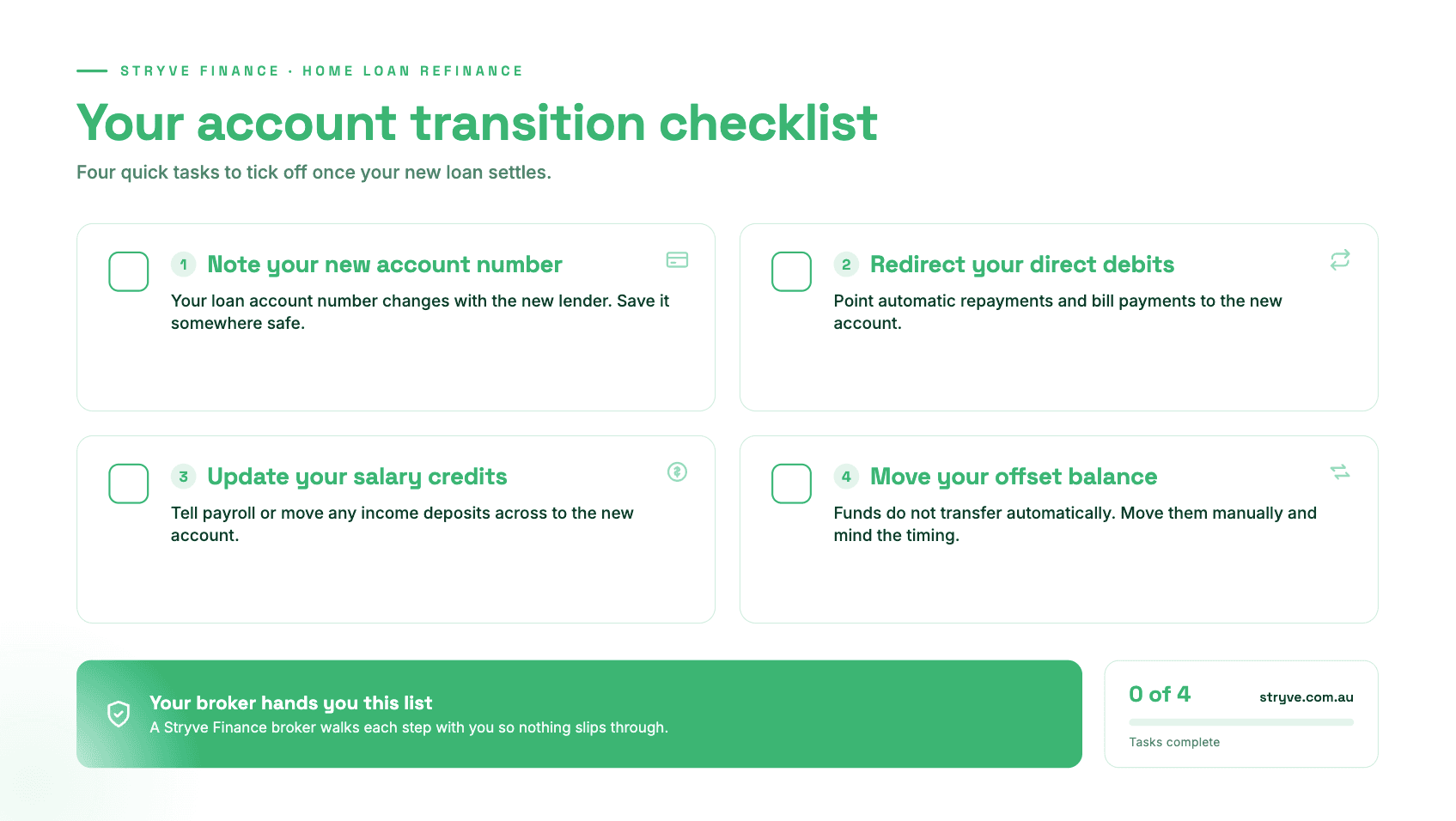
These are small administrative tasks, not obstacles. With a settlement date locked in and each item ticked off, the switch stays clean from start to finish. A Stryve Finance broker can hand over this checklist and walk through every step, so the only thing left to notice is the lower repayment. Download the account transition checklist to keep beside you on settlement day.
Jargon buster for key switching terms
- Discharge fee. The fee the old lender charges to release the loan. Sometimes called an exit fee.
- LVR (loan to value ratio). The loan amount as a percentage of the property value. A $480,000 loan on a $600,000 property is an 80% LVR.
- Comparison rate. A rate that includes the interest rate and most fees, giving a more accurate picture of the loan's true cost.
- Break cost. A fee charged if a fixed rate loan is paid out before the fixed term ends. Can range from minor to very significant.
- Settlement. The day the new lender pays out the old loan. Both sides coordinate to settle together.
- LMI (lenders mortgage insurance). Insurance the lender requires if the LVR is above 80%. It protects the lender, not the borrower. If switching pushes the LVR above 80%, LMI may apply again.
Frequently asked questions about switching home loans
Can you transfer a home loan to another bank?
Yes. Moving a home loan to another bank is a standard refinance. The new lender pays out the existing loan and sets up a new one secured against the same property. The borrower keeps the same home and simply moves the debt to a lender with a better rate or better features.
Should you switch home loans or stay?
Switching is worth it when the savings clearly outweigh the costs. It often isn't worth it when the rate difference is small, fixed-rate break costs are high, or only a few years remain on the loan. If equity is under 20 percent, LMI can apply again and eat into the savings. Running the numbers first, ideally with a broker, settles the question. See when to refinance.
How long does switching home loans take?
The typical timeline is 4 to 8 weeks from application to settlement. The longest phase is usually discharge processing by the old lender, which can take 10 to 15 business days.
Does switching home loans affect your credit score?
A new credit enquiry appears on the borrower's credit file, which can cause a small temporary dip that recovers quickly. The bigger risk is lodging multiple applications, which creates multiple enquiries. A broker avoids this by doing the comparison work upfront and submitting to one chosen lender.
Do you need a new valuation?
Yes. The new lender requires a property valuation to confirm current value and calculate the LVR.
Can you switch if you are on a fixed rate?
Yes, but break costs may apply, and they can be substantial depending on the remaining fixed term and how much rates have moved. Calculate these before committing. See break costs and other switching fees.
Ready to switch? A broker can handle it from start to finish
Switching home loans from one bank to another is a structured process with clear steps and a predictable timeline. Comparison, application, valuation, approval, discharge, settlement. A Stryve Finance broker manages every phase, from comparing across 40+ lenders to coordinating settlement day between both banks. No hidden fees. No gap between lenders. No guesswork.
The next step is a conversation with a broker who can assess the situation, compare options, and manage the whole process. Talk to a Stryve Finance broker about switching your home loan.

Dylan Bertovic is the Director and Senior Finance Broker at Stryve Finance, specialising in non-traditional lending solutions. He helps clients across Australia with tiny home loans, construction finance, equipment and asset lending, refinancing, and investor loans. With deep expertise in self-employed and renovation mortgages, Dylan is known for crafting tailored strategies that get results