



Household Loan
The standard reverse mortgage offering maximum flexibility. Access funds as a lump sum, regular income stream, or cash reserve line of credit. Typical variable rates range from 8.5% to 9.5% p.a.
We compare your rates with 50+ lenders










































A reverse mortgage allows you to access a portion of the equity tied up in your home, without having to sell it or make regular repayments. You continue to live in your home for as long as you want. The amount you borrow is paid to you as a lump sum, regular income, or a line of credit.
Interest is calculated on the amount you've borrowed and compounds over time. This means the interest is added to your loan balance, increasing the total amount you owe. You only repay the loan including all accumulated interest and fees when you choose to sell the property, move into residential aged care, or pass away.
With strong consumer protections, including a "no negative equity guarantee," you can never owe more than the value of your property when it's sold.
Receive cash as a lump sum, income, or line of credit.
No regular repayments while you remain living in your property.
Interest is added to the total balance over time.
Loan is cleared only when you sell, move out, or pass away.
Reverse mortgages in Australia are heavily regulated to ensure you can safely access your home's equity without risking your financial future or your right to live in your home.
By law, you cannot owe more than the market value of your property. If your loan balance exceeds your property's sale price, you will not have to pay the difference out of pocket.
You retain full ownership of your home. You cannot be forced out of your property as long as you meet basic obligations like paying rates and keeping it insured.
To ensure you fully understand the commitment, you are required to obtain independent legal advice before the loan is approved. This guarantees you are making an informed choice.
While no regular repayments are required, you have the flexibility to make voluntary repayments at any time to reduce your loan balance and minimise interest.
Eligibility is primarily based on your age and the value of your property, rather than your income or credit history. This makes it an accessible option for many retirees.
As long as you are above 60 years old you are eligible and We'll be with you at every stage. No need to figure it out alone!
01
Your property must be your primary residence or an investment property, typically a standard home or apartment in an approved postcode. Rural and specialized properties are assessed case by case.
02
Any existing home loan on the property must be paid off using the funds from the reverse mortgage first. The remaining amount is then yours to use as you wish.
03
The percentage of your home's value you can borrow, your Loan to Value Ratio (LVR), increases as you get older. Standard limits generally start at 15% at age 60 and increase by 1% each year.
Age 60
Up to 15%
Age 65
Up to 20%
Age 70
Up to 25%
Age 80+
Up to 35%
*Note: If borrowing jointly, the age of the youngest borrower determines the maximum LVR.
04
Because there are no mandatory ongoing repayments, lenders do not require you to prove an income stream to service the loan.
05
The home must be in a well-maintained and livable condition, as determined by an independent valuer during the application process.
Use our simple online tool to estimate how much equity you might be able to access today.
Find out how much equity you could accessWhether you need a lump sum for a major expense or a regular income stream to enhance your lifestyle, releasing home equity offers flexibility.
Fund accessibility modifications or general upgrades to ensure your home remains comfortable as you age.
Clear a lingering home loan, credit cards, or personal loans to remove the stress of monthly repayments.
Supplement your Age Pension or superannuation with regular tax-free advances to cover everyday living expenses.
Provide an early inheritance to help your children or grandchildren enter the property market.
Cover unexpected healthcare costs, in-home care services, or transitional funding before moving to residential care.
Set up a standby line of credit. You only pay interest on the funds you actually draw down, offering peace of mind.
We partner with leading lenders to offer specialized equity release products.
Rates and features vary based on your specific needs.
The standard reverse mortgage offering maximum flexibility. Access funds as a lump sum, regular income stream, or cash reserve line of credit. Typical variable rates range from 8.5% to 9.5% p.a.
Specifically designed to clear an existing standard home loan. Offers a slightly lower interest rate than standard reverse mortgages, typically 8.2% to 9.2% p.a., but with restrictions on cash-out options.
An Over 55s Repayment-Free Investment Option. Short-term funding designed specifically to pay Refundable Accommodation Deposits (RAD) for aged care while keeping the family home. Maximum term usually 5 years.
Explore more
Jump straight to the topic that matches your next question, from eligibility and rates to lender comparisons and aged-care funding.
Understand repayments, compounding interest, and what triggers the loan to be repaid.
Check the age, property, and borrower requirements lenders use to assess eligibility.
Compare rate ranges, fee structures, and how interest growth affects long-term equity.
See which lenders are active in Australia and how private options compare with the HEAS.
Explore the government-backed alternative and see when HEAS may fit better than a private loan.
Learn how families use home equity to manage RADs, DAPs, and other aged-care funding needs.
Estimate how much equity you may be able to access based on your age and property value.
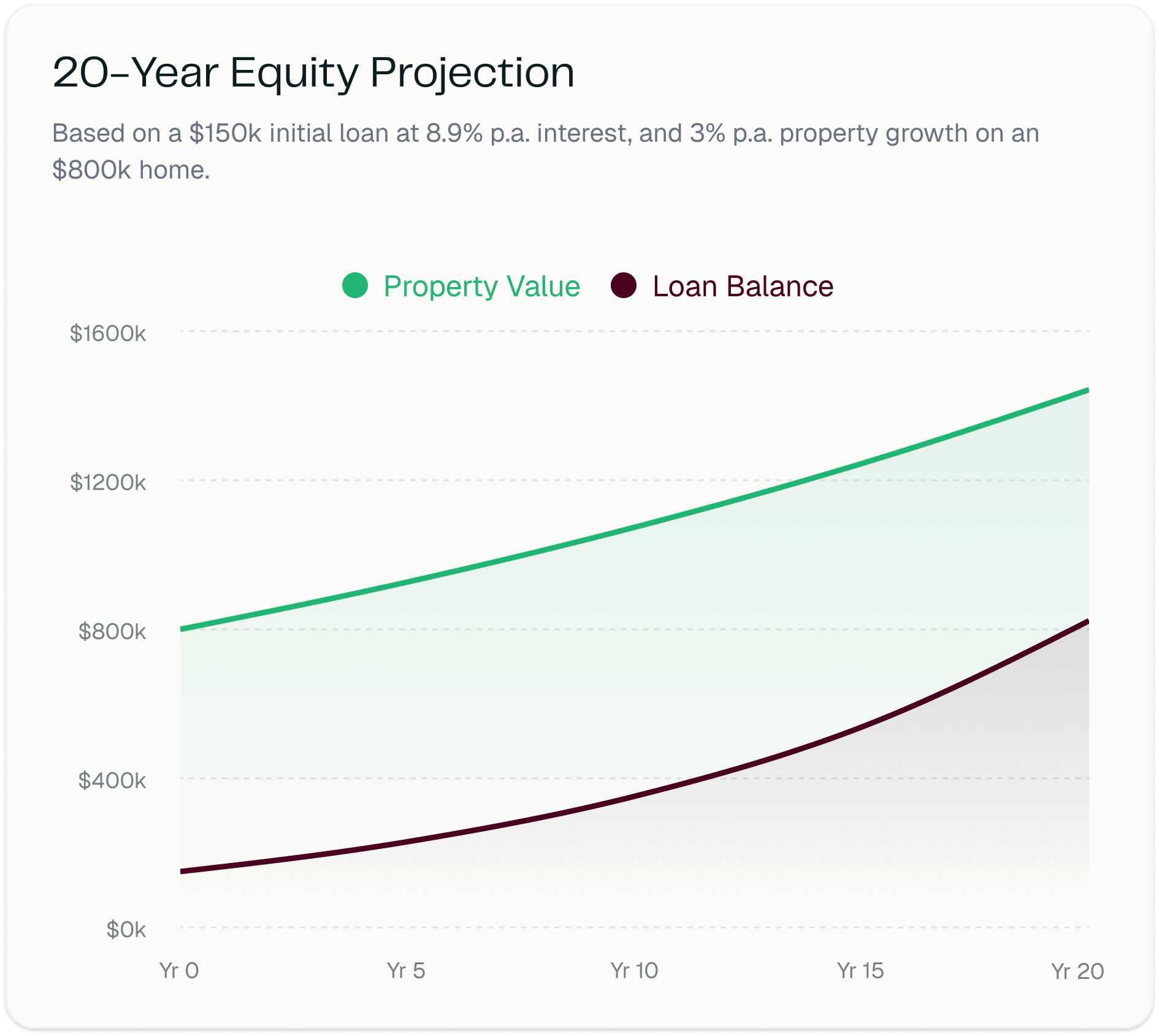
Because you are not making regular repayments, the interest on a reverse mortgage compounds. This means interest is calculated on the initial loan amount plus the interest that has already been added.
Over a 10, 15, or 20-year period, the loan balance will grow significantly. However, historical data shows that property values generally grow alongside it. For many borrowers, the remaining equity at the end of the loan is still substantial, allowing them to afford aged care or leave an inheritance.
One of the biggest concerns for retirees is leaving nothing for their children. If you want to guarantee an inheritance, you can use an Equity Protection Option. This allows you to ring-fence a percentage of your property's future sale value, for example 20%, that the lender cannot touch, regardless of how large the loan balance grows.
Your family home is exempt from the Age Pension assets test. Borrowing against it does not generally affect your pension entitlements, provided you spend the funds on lifestyle expenses, home improvements, or clearing debt.
However, if you take a lump sum and leave it sitting in a standard bank account, or use it to purchase a new income-producing asset, it will be subject to Centrelink's asset and income tests. We strongly recommend speaking to a financial planner or Services Australia regarding your specific situation.
If you need to move into residential aged care, you typically have up to 12 months to sell the property and repay the loan. You can also transition a standard reverse mortgage into an aged care funding product without needing to sell immediately, providing valuable breathing room for your family during an emotional time.
Book a complimentary, no-obligation consultation with our senior lending specialists.