Alt doc loans, still widely called low doc loans, let self-employed borrowers prove their income with Business Activity Statements, bank statements and an accountant's declaration instead of two years of tax returns. The cost is usually a higher interest rate, a lower maximum LVR (loan-to-value ratio, the size of your loan against the value of the property) and fewer lenders willing to look at your file.
Sole traders, contractors, company directors and trust beneficiaries rarely have income that fits PAYG verification. That is why low doc home loans exist, and why a self-employed home loan often takes a different path to approval.
This guide covers which documents lenders accept, how alt doc pricing is set and what you give up for less paperwork.
New to self-employed lending? Start with our guide to self-employed home loans.
What is an alt doc loan?
An alt doc loan is a home loan for self-employed borrowers who verify income with alternative evidence, such as Business Activity Statements, bank statements and an accountant's declaration, rather than two years of tax returns and Notices of Assessment. Lenders still verify that evidence independently.
The label describes how your income is checked, not how closely. Stryve Finance, a mortgage broker based in Concord in Sydney's inner west, arranges these loans across a panel of more than 50 lenders.
Is a low doc loan the same as an alt doc loan?
Lenders and brokers use the two terms interchangeably, but the documentation behind them is different, and the history explains why.
“Low doc” historically meant self-certified income. You signed a declaration stating what you earned, and the lender largely took your word for it. No BAS, no bank statements, no accountant.
That model ended with the National Consumer Credit Protection Act 2009 (NCCP). It introduced responsible lending obligations, enforced by ASIC, which require lenders to take reasonable steps to verify a borrower's financial situation before offering credit. ASIC sets out how that works in Regulatory Guide 209.
Self-certification does not meet that bar, so the market moved to “alt doc”, where the evidence is still independently verified, just not through a tax return.
There is no genuine no-doc home loan product available in Australia today. Anyone suggesting otherwise is either using old language or selling something you should walk away from.
Some lenders still market the product as “low doc” out of habit, so the name on the brochure tells you very little. An alt doc application is not always ATO-free either. Some lenders will still ask for a Notice of Assessment or a partial tax return as a cross-check, even when the core income evidence is a BAS set.
Low doc home loan requirements
There is no single national checklist. Low doc home loan requirements vary by lender, and the document set you can supply often determines which lenders are even worth approaching. For a plain explainer of each document and what it proves, see our guide to what a low doc home loan is. The focus below is narrower: which combinations lenders accept, and how that shapes your shortlist.
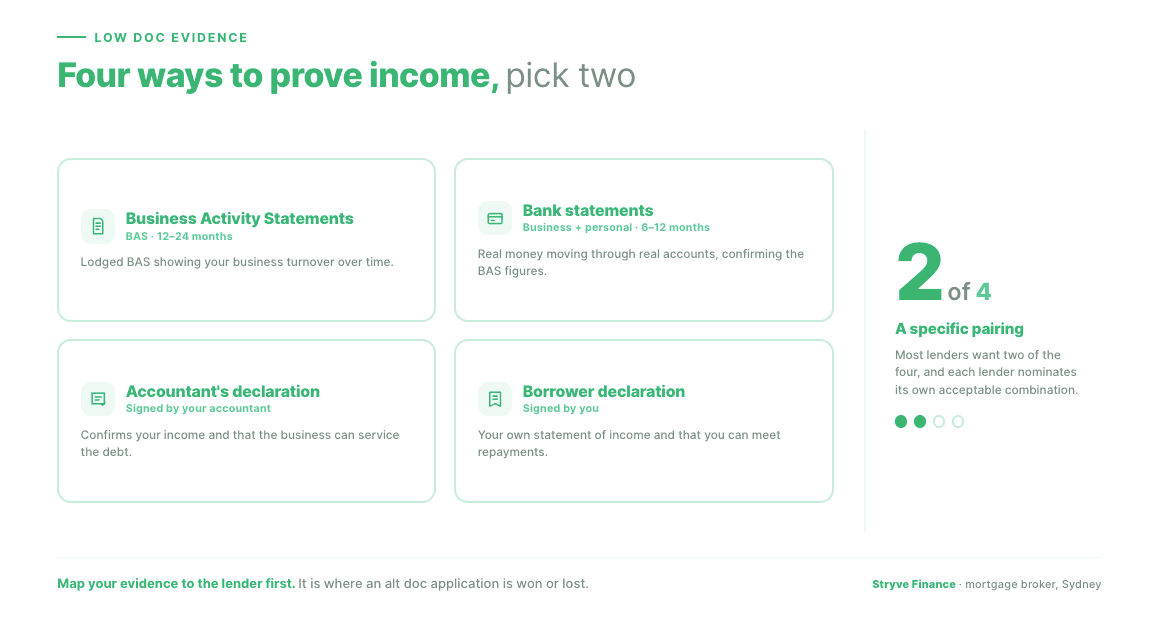
Lenders work from four types of evidence:
- Business Activity Statements (BAS): commonly 12 to 24 months of lodged BAS showing business turnover.
- Business and personal bank statements: commonly 6 to 12 months, confirming the BAS figures are real money moving through real accounts.
- Accountant's letter or declaration: confirming your income and that the business can service the proposed debt.
- Signed borrower income declaration: your own statement of income and confirmation you can meet repayments.
Most lenders do not want all four. They want a specific combination, usually two of the four, and each lender sets its own acceptable pairings.
Your ABN and GST registration also generally need to have been active for a minimum period, commonly cited in the one to two year range, though this varies by lender.
Which two you can supply is only half of it. Your business structure also changes what counts as evidence.
How entity type changes the low doc loan documents
- Sole trader: usually leans hardest on the accountant's declaration plus personal and business bank statements.
- Company: may need entity-level evidence such as company financials, company BAS and confirmation of your shareholding.
- Trust: often requires trust financials and distribution evidence showing income actually flows to you as beneficiary.
- Contractor: may be assessed on contracts and invoices alongside BAS, particularly where a single payer dominates.
Treat these as starting points. Each lender sets its own list for each structure.
Expect supporting items too: identification, statements for existing loans and credit cards, and evidence of rental or other income you want counted. For a fuller run-through, see our guide to the documents required for a self-employed home loan.
The practical move is to work out which lenders accept the evidence you already have, rather than chasing documents your accountant cannot produce. With access to 50+ lenders, that mapping exercise is usually where an alt doc application is won or lost.
How low doc home loan rates are set
Low doc home loan rates typically sit above the full doc equivalent. The lender is pricing for less certainty about your income, which is a genuine difference in risk rather than a penalty for being self-employed.
Four things move the number on an alt doc home loan:
- Your LVR band: A lower LVR generally means better pricing, and the steps between bands can be sharp.
- Whether LMI applies: Lenders Mortgage Insurance (LMI) protects the lender, not you, and it is often triggered at a lower LVR on alt doc than full doc.
- Credit history and conduct: A clean repayment history on existing debts carries real weight when income evidence is lighter.
- The strength and consistency of your evidence: Two years of BAS that reconcile cleanly to bank statements price differently to twelve months that do not.
The premium is not fixed. It narrows as your LVR drops and your evidence strengthens.
Purpose matters too. Alt doc pricing and the maximum LVR a lender will allow often differ between an owner-occupied home and an investment property, so the same borrower can see two different offers depending on what they are buying.
Check the comparison rate as well as the headline rate. Alt doc products sometimes carry application fees, risk fees or ongoing fees that a sharp advertised rate hides. For current rate ranges, LVR tiers and which lenders are active, see our low doc home loans page.
A rate quoted without your LVR, your evidence set and your credit conduct in front of it is a guess, not a quote. We will also show you what commission the lender pays, so you can see the full picture before you commit.
Full doc, alt doc and low doc loans compared
Every figure varies by lender and none of it is a quote.
| Full doc | Alt doc | Low doc (legacy label) | |
|---|---|---|---|
| Income evidence required | Two years of tax returns and Notices of Assessment | Combinations of BAS, bank statements, accountant declaration and borrower declaration | Historically self-certified income only; no longer offered in that form |
| Typical maximum LVR | Highest of the three | Typically lower than full doc, varies by lender | Varies by lender where the label is still used |
| Rate positioning | Baseline | Typically above full doc | Typically above full doc |
| LMI implications | Applies above a set LVR threshold | Often applies at a lower threshold, and some lenders restrict it entirely | Varies by lender |
| Who it suits | PAYG borrowers and established self-employed with current financials | Self-employed borrowers without two years of finalised returns | Effectively superseded by alt doc post-NCCP |
What you give up for less paperwork
Alt doc solves a real problem, but it costs you in four ways.
- You pay more over the life of the loan: Over a long loan term even a modest rate gap adds up, so it is worth calculating. As an illustration only, not a quote, on a $600,000 loan over 30 years a rate half a percentage point higher costs roughly $195 more a month, about $2,300 a year, or nearly $11,700 over five years before you refinance. The gap is a round assumed figure rather than any lender's real rate, and your numbers will move with your own balance, term and pricing.
- You need a bigger deposit: A lower maximum LVR means more cash up front. If LMI is available at your LVR, that premium is another cost on top, and it is often charged at a lower threshold than full doc.
- Fewer lenders compete for you: A smaller panel means less pricing leverage now, and less again at refinance time.
- Your file gets read harder: Alt doc does not mean lighter assessment. It means the assessor has less income evidence, so everything else gets more attention. Overdrawn transaction accounts, missed repayments, dishonours and unmanaged ATO debt all carry more weight than they would on a full doc file.
For a borrower whose business is trading well but whose second tax return is eighteen months away, the alternative to alt doc is not a cheaper loan. It is no loan, and a wait while the property market moves.
You are paying for speed and flexibility, not for a looser assessment.
Who alt doc loans suit and who should think twice
If you already have two years of finalised tax returns and Notices of Assessment that reflect your current income, apply full doc. It is almost always cheaper. If you do not have them, cannot wait for them and can show current income through BAS, bank statements and an accountant's declaration, alt doc is the route. Where both are open, full doc usually wins on price and alt doc on speed, and the deciding factor is whether your latest return reflects what you earn now.
Alt doc tends to work well for:
- Recently self-employed borrowers who do not yet have two years of returns
- Borrowers whose most recent return understates current income, often because of legitimate deductions or a strong recent trading period
- Anyone who has restructured recently, for example moving from sole trader to company
- Borrowers with a solid deposit who simply cannot get finalised financials back from their accountant before a purchase deadline
Think twice if:
- You could qualify full doc with three months of better preparation
- Your second return is close to being lodged, which may make waiting cheaper than switching later
- You are stretching to the very top of your borrowing capacity, where a rate premium bites hardest
Self-employed people are a large and growing borrower group. The ABS counted about 1.1 million independent contractors in August 2025, roughly 7.6 per cent of everyone employed, and self-employment overall sits near 16 per cent of the workforce. Most of them cannot verify income the PAYG way, which is why alt doc exists. That does not make it the automatic answer for every self-employed applicant.
Treat it as a timing question first and an eligibility question second. A good broker checks full doc viability before recommending anything else.
Why alt doc applications get declined
Four failure modes account for most declines.
- BAS figures that do not reconcile with bank statement turnover: This is the big one. If your lodged BAS says one thing and twelve months of deposits say another, the lender cannot verify your income, and under NCCP responsible lending obligations that is a verification failure, not a paperwork nuisance. Fix: reconcile the two yourself before you apply, and have a written explanation ready for any legitimate gap such as a large one-off refund or an inter-account transfer.In practice: we recently had a contractor whose deposits ran well above his lodged BAS turnover. The assessor flagged it, and the gap turned out to be a lump sum he had moved from a personal savings account into the business account to cover a slow month. One line in a covering note, plus the two matching statements, cleared it. Left unexplained, the same figures would have read as unverifiable income and likely been declined. Details changed for privacy.
- An accountant who will not sign the declaration: Usually because the figures are unverified, the relationship is only a few months old, or they have not prepared your financials. Fix: talk to your accountant early, well before you find a property, and ask directly whether they will sign a lender declaration and on what basis.
- Applying before the registration clock has run: ABN and GST registration minimums vary by lender, and applying a month short is an avoidable decline. Fix: check your registration dates on the Australian Business Register before lodging.
- Unmanaged ATO debt sitting on the file: This kills more self-employed applications than most borrowers expect. Small business collectable tax debt reached $35.9 billion in 2024-25, about two-thirds of the ATO's $54.2 billion total, per the June 2026 Australian National Audit Office report, and the ATO is recovering harder than it did through the pandemic. A visible tax debt tells a lender your business may not be meeting its obligations, and since 1 July 2025 the general interest charge on that debt is no longer tax deductible, so it costs more to carry. Fix: get onto a formal ATO payment plan and keep it current, or clear the debt, well before you apply. A debt under an active, up-to-date arrangement reads very differently to one left to accrue interest.
Each decline can leave a mark on your credit file and shrink an already small lender pool, so it pays to have your file checked before you lodge anything.
Refinancing from alt doc to a full doc loan
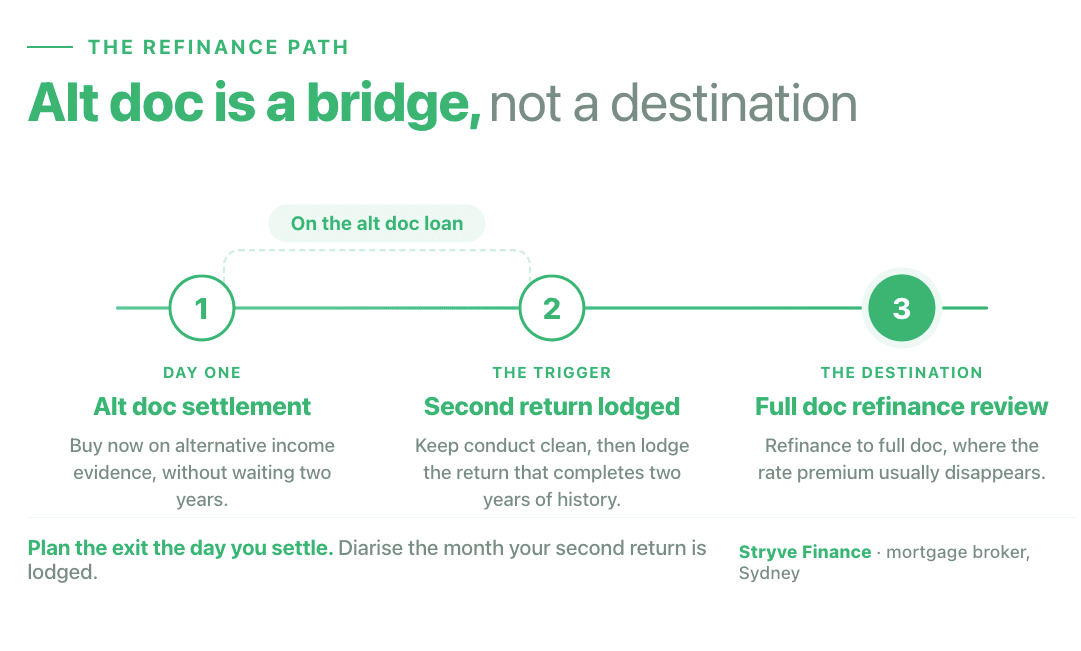
For most borrowers alt doc is a stepping stone. Once you have two years of tax returns and matching Notices of Assessment, a full doc refinance becomes possible, and that is normally where the rate premium disappears. Some lenders will consider a single year of returns.
It usually takes three steps to get from alt doc settlement to a full doc refinance.
The equity, LVR and document side of that switch is covered in our guide to the low doc refinance home loan. In the meantime, these habits keep your file refinance-ready for the day your second return is lodged:
- Keep repayment conduct spotless, including credit cards and business facilities
- Keep business and personal accounts clearly separated and out of overdraft
- Lodge BAS and tax returns on time, every time
- Deal with any ATO payment plan rather than letting it sit
Then set a diary note for the month your second return is lodged. That is the moment to review. Before you switch, weigh break costs on any fixed portion, exit and application fees, and whether LMI would need to be paid again. A refinance only makes sense once the total cost of moving is less than the savings. With access to more than 50 lenders, Stryve Finance can run that comparison across the panel and, when the time comes, handle the refinance from your alt doc loan back to full doc.
Frequently Asked Questions
What is the difference between a low doc and an alt doc home loan?
Alt doc means your income is verified using alternative evidence such as BAS, bank statements or an accountant's declaration. Low doc is the older label for self-certified income, which responsible lending obligations effectively ended. Most Australian lenders now use the two terms for the same alternative verification product.
Are alt doc home loan rates always higher than full doc?
Usually, yes. Alt doc pricing typically sits above the full doc equivalent because the lender is pricing for reduced income verification certainty. The size of the gap is not fixed. It narrows as your loan-to-value ratio drops and your alternative income evidence gets stronger and more consistent.
How long do you need to be self-employed to get a low doc home loan?
Most lenders want your ABN and GST registration held for a minimum period before they will consider an alt doc application, and that period varies by lender. Some also look at how long you have traded in the same industry. Check the registration clock before you lodge anything.
What documents do you need for a low doc loan?
Lenders generally accept a combination of Business Activity Statements, business or personal bank statements, an accountant's letter or declaration, and a signed borrower income declaration. Most want two of the four. Some still request ATO documents such as Notices of Assessment, plus identification and existing loan statements.
Can you get a low doc loan with one year of BAS?
Sometimes, yes. A handful of lenders will consider 12 months of BAS where the rest of the file is strong, though most prefer a full two years, and a shorter history usually means a lower maximum LVR or a slightly higher rate. Pairing that single year of BAS with matching bank statements and an accountant's declaration makes a big difference. Because policy on this varies widely between lenders, it is worth checking which ones accept a shorter BAS history before you apply.
Before you apply
Requirements vary by lender, so the evidence you can produce decides your shortlist. Rates sit above full doc for reasons you can influence, mainly LVR and evidence quality. The trade-off is real, but for a borrower who would otherwise wait two years it often stacks up. If you want that mapping done for you, Stryve Finance works with self-employed borrowers across Sydney and nationally to match your evidence to the right lender.
Not sure which documents your lender will accept? See how our low doc home loans process works for self-employed borrowers.
This information is general in nature and does not take your objectives, financial situation or needs into account. Consider whether it is appropriate for you and seek professional advice before acting on it. Stryve Pty Ltd ABN 70 630 099 080 are Credit Representatives of Finsure Finance and Insurance Pty Ltd. Lending services are authorised by Finsure Finance and Insurance Pty Ltd (ACN 068 153 926) Australian Credit Licence 384704.

Dylan Bertovic is the Director and Senior Finance Broker at Stryve Finance, specialising in non-traditional lending solutions. He helps clients across Australia with tiny home loans, construction finance, equipment and asset lending, refinancing, and investor loans. With deep expertise in self-employed and renovation mortgages, Dylan is known for crafting tailored strategies that get results.