
A low doc refinance home loan gives self-employed borrowers a practical way to refinance when mainstream lenders say no. It is one of the most useful tools available to anyone who runs a business, earns genuine income, and still gets knocked back because their tax returns do not tell the full story. This guide from Stryve Finance explains how a refinance home loan for self-employed borrowers works, what documents lenders accept, how much equity is needed, and how to build the strongest possible application.
Why self-employed borrowers hit a wall when they try to refinance
Picture this. A self-employed borrower runs a profitable business, pays their mortgage on time every month, and decides to refinance for a better rate. The lender pulls their tax returns, sees a low taxable income thanks to perfectly legitimate deductions, and knocks them back.
It is one of the most frustrating experiences in the property market. The very tax minimisation strategies that are smart for business are the exact thing that trips up serviceability assessments with mainstream lenders.
Under National Consumer Credit Protection (NCCP) Act obligations, lenders must conduct a responsible lending assessment. They measure declared income against expenses. When tax returns show low taxable income, the self-employed borrower fails serviceability, even if cash flow is strong and every repayment has been made on time.
There is another timing problem. The ATO requires annual tax return lodgement, but self-employed borrowers often have returns that lag 12 to 18 months behind current income. So the lender is assessing yesterday's numbers against today's loan.
This is not a reflection of financial health. It is a structural mismatch between how self-employed income works and how traditional lenders assess it. And it is far more common than most borrowers realise. Self-employed people make up around one in six Australian workers, and at 30 June 2026 there were more than 2.8 million actively trading businesses in the country, close to two thirds of which are sole operators with no employees. For a large slice of the workforce, the standard income test simply does not fit.
What is a low doc refinance home loan and how does it differ from a standard refinance
A low doc refinance home loan is a specialist pathway that allows self-employed homeowners to refinance an existing mortgage using alternative income verification instead of full tax returns and payslips.
It is not a no-verification shortcut.
The basics of refinancing a home loan apply here, but the income verification step is where self-employed borrowers face a different process. Under ASIC's responsible lending guidance, lenders must still take reasonable steps to verify income, even for low doc applications. Borrowers sign an income declaration, and lenders verify it against available evidence such as Business Activity Statements (BAS) or accountant letters.
What changes at refinance compared to the original purchase is worth understanding. The lender reassesses income from scratch. The property is revalued at current market prices. And the borrower's business circumstances may have shifted, for better or worse, since the original loan was written.
Low doc loans are explained in more detail on Stryve Finance's low doc home loans page, but the key point for refinancing is this. The product exists specifically for self-employed borrowers whose income is real but does not fit neatly into a standard lender's verification box.
Why self-employed borrowers refinance through a low doc loan
Self-employed borrowers refinance through low doc loans for the same strategic reasons anyone refinances. They want a lower interest rate. They want to release equity for business investment or personal use. They want to consolidate debt into a single, more manageable repayment. Or they want to switch from a higher-rate low doc purchase loan into a better product after building equity and a stronger track record.
These are empowering, strategic moves. Not last-resort options.
ASIC MoneySmart notes that low doc loans may carry higher interest rates than standard loans. In practice that premium usually sits at around 0.5 to 1.5 percentage points above a comparable standard variable rate. With average owner-occupier variable rates near 5.9 per cent in mid 2026 and the RBA cash rate held at 4.35 per cent, a self-employed borrower who originally took a low doc purchase loan at a premium rate may now have enough equity and business history to refinance into a more competitive low doc product. The rate differential matters. If the new rate is lower than the current rate, even with the low doc premium, the refinance delivers real savings.
Consider a self-employed electrician with a three-year ABN history and consistent quarterly BAS lodgements showing strong revenue. Their existing lender refuses to refinance because their tax returns show low taxable income after vehicle, tool, and subcontractor deductions. A specialist lender assesses their declared gross income supported by BAS statements and an accountant's letter, approves the refinance, and the borrower moves to a rate that saves them hundreds per month. That scenario plays out regularly. Refinancing sits near record highs across the market, with owner-occupiers switching a record 42.9 billion dollars of home loans to a new lender in the March quarter of 2026 alone.
What documents do lenders accept for a low doc refinance
This is where preparation makes or breaks the application. Low doc lenders accept alternative income verification documents as proxies for payslips and tax returns. Most applications are built around four documents.
- Business Activity Statements (BAS)
- An accountant's letter
- Business bank statements
- A signed income declaration
Here is what each one does and what lenders look for.
BAS: Lodged with the ATO quarterly or monthly, BAS must typically cover the most recent 12-month period. Lenders use them to assess revenue trends and consistency. They are one of the strongest alternative documents because they are lodged with a government body and are difficult to fabricate.
Accountant's letter: A letter from a registered accountant confirming the borrower's income. Lenders want to see a specific income figure, not a vague statement. The accountant should be registered with a recognised professional body.
Business bank statements: Typically 6 to 12 months of statements showing consistent revenue deposits. Lenders look for regular income patterns, not just a single large deposit. They also check for signs of financial stress like dishonours or overdrawn accounts.
Signed income declaration: The borrower declares their gross income. Under NCCP Act obligations, the lender then verifies this declaration against the alternative documents listed above.
Before starting an application, it helps to have all of this in one place. The checklist below sets out the four documents in the order most lenders review them, from the BAS that anchors the assessment through to the signed income declaration that ties everything together. Self-employed borrowers can save or print it and tick each item off as it is gathered, so nothing is missing when the application is submitted.
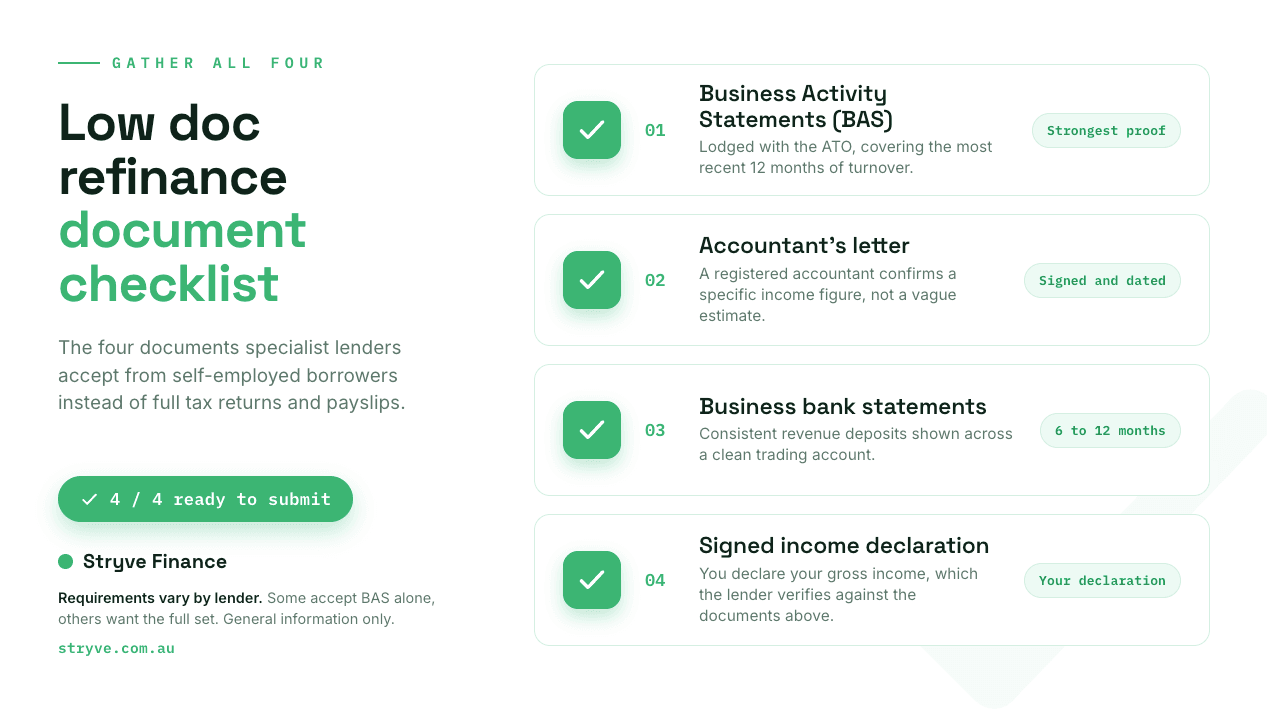
Having all four ready does more than speed things up. A complete, consistent document set gives the lender a clear picture of the business, cuts down on back-and-forth requests, and strengthens the case for approval at a competitive rate. For a self-employed borrower, it is often the difference between an application that stalls and one that moves.
Requirements vary by lender. Some accept BAS alone. Others require BAS plus an accountant's letter. Self-employed borrowers must generally have held an ABN for a minimum of 12 to 24 months, depending on the lender, to be eligible.
This is exactly why the lender match matters. A specialist mortgage broker experienced in self-employed refinancing can match the right documents to the right lender for the borrower's situation.
See what self-employed refinance options are available.
A quick conversation with a Stryve Finance mortgage broker can clarify which documents are needed and which lenders are the best fit.
LVR and equity requirements for low doc refinancing
LVR (loan-to-value ratio) is the percentage of the property's value that the loan covers. Low doc refinance loans in Australia typically require a maximum LVR of 80%. That means the self-employed borrower must hold at least 20% equity in the property.
In dollar terms, for a property valued at $800,000, the maximum loan amount at 80% LVR would be $640,000. If the existing loan balance is $660,000, the borrower does not yet have enough equity to qualify without other adjustments.
To make that tangible, here is how the maximum loan changes across a few property values at 80 per cent and 85 per cent LVR.
| Property value | Maximum loan at 80% LVR | Maximum loan at 85% LVR |
|---|---|---|
| $700,000 | $560,000 | $595,000 |
| $800,000 | $640,000 | $680,000 |
| $1,000,000 | $800,000 | $850,000 |
Figures are illustrative and based on the lender's accepted valuation, which may differ from the purchase price or the owner's estimate.
Some specialist lenders may go to 85% LVR with LMI (Lenders Mortgage Insurance), which is a one-off premium that protects the lender if the borrower defaults. LMI adds cost, so it needs to be weighed against the savings the refinance delivers.
For self-employed homeowners who are close to the 80% threshold, options include paying down the existing loan further before applying, or waiting for property value growth to shift the ratio. A current property valuation is the starting point for understanding where the numbers sit, and Stryve Finance's guide on how to calculate your LVR for refinancing walks through the maths.
How to strengthen a low doc refinance application
Preparation is everything. These concrete steps improve the chances of approval and can influence the rate offered.
- Keep BAS lodgements current: Lenders want the most recent 12 months. Late or missing BAS lodgements are a red flag. If lodgements have lapsed, get them up to date before applying.
- Maintain clean business bank statements: Consistent revenue deposits over 6 to 12 months tell a strong story. Avoid mixing personal and business transactions. No dishonours, no unexplained large withdrawals.
- Reduce personal debt before applying: Credit cards, personal loans, and buy-now-pay-later balances all reduce borrowing capacity. Paying these down before the application improves serviceability.
- Get the accountant's letter prepared early: Do not wait until the lender asks. Have the accountant prepare a letter confirming income before the application is submitted.
- Confirm ABN history: Most lenders require 12 to 24 months of active ABN history. If the borrower recently changed business structure, for example from sole trader to company, some lenders may treat this as a new ABN. Check with a broker first.
Variable income is common for self-employed borrowers. Lenders expect some fluctuation. What they do not want to see is a sharp unexplained decline. If income dipped due to a specific event like a slow season, the accountant's letter can provide context.
Under Australian credit law, a mortgage broker has a best interests duty to recommend a loan that is in the borrower's best interests, not merely suitable. That duty has applied since January 2021 and means the broker should be actively helping structure the strongest possible application.
Why a specialist broker matters for a self-employed refinance
Going direct to a lender as a self-employed borrower is risky. If that lender's policy does not accommodate the borrower's income structure, the application gets declined. Each declined application can affect future applications.
A specialist broker like Stryve Finance who focuses on self-employed applicants knows which lenders are flexible on low doc income, which documentation combinations each lender prefers, and how to structure the application for the best outcome. Access to 50+ lenders means the broker can match the self-employed borrower to a lender whose policy fits their specific situation. Non-bank and specialist lenders, which sit outside some of the caps that apply to the major banks, are often the practical route for self-employed borrowers.
Lender commission transparency matters too. The borrower should know exactly how the broker is paid, with no hidden fees. Under Australian credit law, the broker's best interests duty ensures the recommended loan is genuinely in the borrower's best interests.
This is not a generalist service. Self-employed refinancing requires specific lender knowledge that most mainstream brokers simply do not have.
Frequently Asked Questions about Low Doc Refinance Home Loans
Will I pay a higher interest rate on a low doc refinance?
Usually, yes. ASIC MoneySmart notes that low doc loans may carry higher rates due to perceived higher risk. In practice the premium tends to sit at around 0.5 to 1.5 percentage points above a comparable standard variable rate. Even so, the refinance may still deliver meaningful savings compared with the self-employed borrower's current rate.
What is the difference between a low doc and a full doc refinance?
The difference comes down to how income is verified and the trade-offs that follow. A full doc refinance uses two years of lodged tax returns and financial statements, usually unlocks the lowest advertised rates, and can go to a higher LVR, up to 90 to 95 per cent in the right scenario. A low doc refinance uses alternative documents like BAS, business bank statements, and an accountant's letter, generally carries a rate premium of around 0.5 to 1.5 percentage points, and is usually capped at 80 per cent LVR, or 85 per cent with LMI. Approval timeframes are broadly similar once documents are ready. Many self-employed borrowers start on a low doc loan and refinance to a full doc product later, once two years of clean financials are lodged and the rate premium can be removed.
Can I refinance if my tax returns show low income?
Yes. That is exactly what low doc refinancing is designed for. Lenders assess declared income supported by alternative documents like BAS statements, accountant letters, and business bank statements rather than relying solely on tax returns.
How long does a low doc refinance take?
The timeline is similar to a standard refinance, typically 4 to 6 weeks from application to settlement. However, preparation of alternative documents can add time if not done in advance. Having BAS, bank statements, and an accountant's letter ready before applying keeps things on track.
Do I need a minimum ABN period?
Most lenders require 12 to 24 months of active ABN history. The exact requirement varies by lender, which is another reason working with a specialist broker who knows each lender's policy saves time and avoids unnecessary knockbacks.
Can I access equity through a low doc refinance?
Yes, subject to the 80% LVR threshold and individual lender policy. If the property has grown in value or the loan has been paid down, the self-employed borrower may be able to release equity for business investment, renovations, or other purposes.
Get a personalised assessment of refinance options.
A Stryve Finance broker can review the numbers and identify which lenders and products fit the borrower's situation.
General advice disclaimer
This article provides general information only and does not take into account your objectives, financial situation, or needs. It does not constitute financial, credit, tax, or legal advice. Interest rates, lender policies, and government requirements change and were current at the time of writing in August 2026. Speak to a qualified mortgage broker at Stryve Finance about your individual circumstances before making any decisions.

Dylan Bertovic is the Director and Senior Finance Broker at Stryve Finance, specialising in non-traditional lending solutions. He helps clients across Australia with tiny home loans, construction finance, equipment and asset lending, refinancing, and investor loans. With deep expertise in self-employed and renovation mortgages, Dylan is known for crafting tailored strategies that get results