
Understanding how long it takes to refinance a home loan starts with knowing what the process involves and where the time actually goes. Refinancing in Australia is at record levels: Australian Bureau of Statistics figures show 167,797 home loans were refinanced in the March 2026 quarter alone, up 11.5% on a year earlier, and more than 640,000 mortgages were refinanced across 2025. This guide walks through the full timeline, stage by stage, with honest timeframes attached.
For guidance on whether now is the right time to refinance, that decision is covered separately in should I refinance my home loan in 2026.
Refinancing a home loan comes down to a handful of practical goals. A lower interest rate. Reduced monthly repayments. Access to equity built up in the property. Consolidating other debts into one loan. Or switching to a loan with better features like an offset account or redraw facility.
The financial case is real. Moneysmart notes there can be an interest rate difference of more than 2% between variable home loan rates on the market. That gap is significant. The average owner-occupier variable rate on new loans sat at around 5.93% at the end of March 2026, while the sharpest rates available to refinancers were closer to 5.69%. On average, moving off an existing rate onto a market-leading one can save several hundred dollars a month. With access to 40+ lenders, Stryve Finance can help borrowers see where those refinance rates sit across the market.
But this article is not about the why. It is about the how and the how long. For a full breakdown of the reasons to consider refinancing, that guide covers the lot. Here, the focus is on the process itself, stage by stage.
How long does it take to refinance a home loan in Australia
Most refinances in Australia take 4 to 8 weeks from the first document gathered to final settlement. Straightforward applications managed through a broker can settle in as little as 3 weeks. The timeline depends on how fast the lender processes the application, how long the valuation takes, and how quickly the borrower supplies documents.
That 4- to 8-week window is not a guess. It reflects the cumulative time across six distinct stages, from the first document gathered to the day the new loan settles. The timeline below maps each stage against a typical eight-week schedule and shows where the process can be compressed: Stages 1 and 2 run at the same time rather than one after the other.
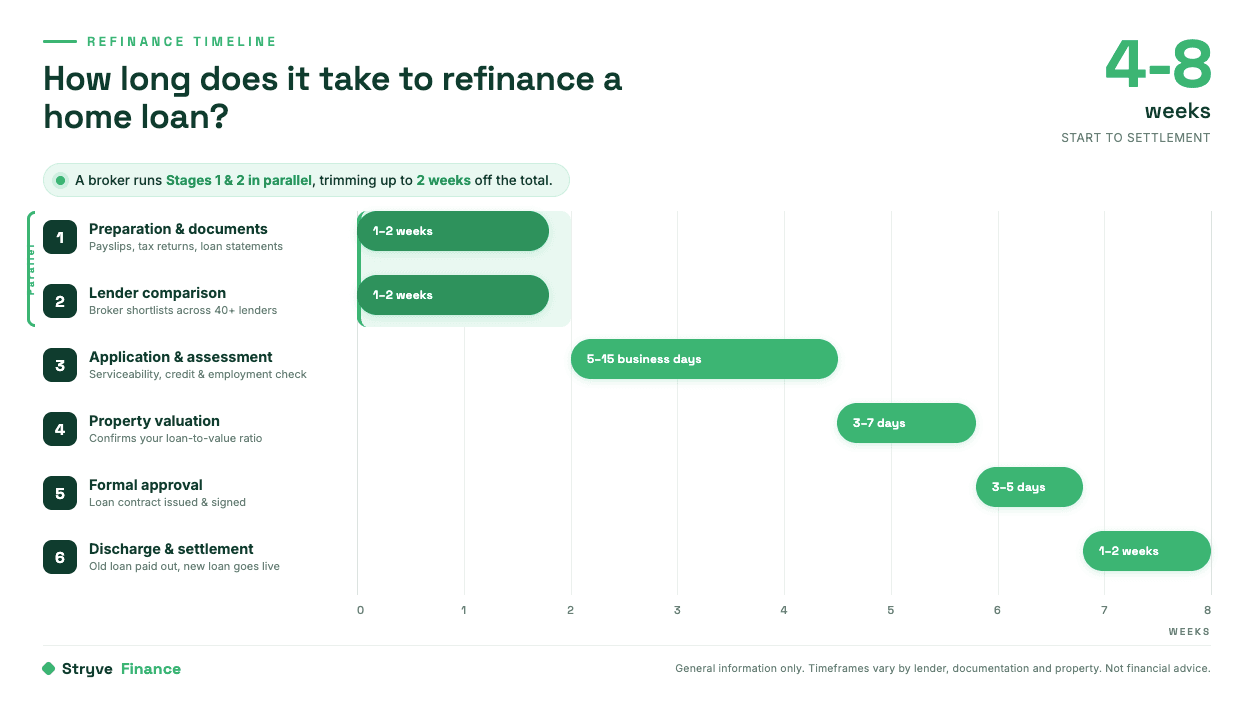
With the full picture in view, the value of that overlap becomes clear. While a borrower is still pulling documents together, a broker can already be comparing lenders in the background, which is often the difference between a four-week settlement and an eight-week one. Here is what happens at each stage, and how long to allow for it.
The refinance process step by step (with realistic timeframes)
Stage 1: Preparation and document gathering (1 to 2 weeks)
Before anything is submitted, the paperwork needs to be in order. That means recent payslips, tax returns, bank statements (typically the last three months), and details of the current loan, including the outstanding balance and account number.
Self-employed borrowers should expect to provide additional documentation. Two years of tax returns, business activity statements, and potentially an accountant's letter. Stryve Finance has specialist experience with self-employed applicants and can advise upfront on exactly what is needed.
This stage feels tedious. It is. But getting it right here prevents delays at every stage that follows.
Stage 2: Lender comparison and broker shortlisting (1 to 2 weeks, can overlap with Stage 1)
This is where a broker earns their keep. Rather than approaching lenders one by one, a broker compares options across multiple lenders simultaneously. With access to 40+ lenders, the shortlist is based on the borrower's actual situation, not just headline rates.
One critical point from Moneysmart: always check the comparison rate, not just the advertised rate. The comparison rate factors in fees and charges, giving a more accurate picture of the true cost.
Borrowers often feel overwhelmed by choice at this point. A broker narrows the field to two or three genuine contenders.
Stage 3: Application submission and lender assessment (5 to 15 business days)
Once a lender is chosen, the formal application goes in. The lender reviews income, expenses, existing debts, credit history, and employment stability. This is a full serviceability assessment, meaning the lender stress-tests whether the borrower can meet repayments if rates rise.
If serviceability is a concern, improving borrowing power before applying can make a real difference. Small changes like closing unused credit cards or reducing discretionary spending can shift the numbers.
The wait here can feel long. It is normal. Lender assessment queues vary, and there is little the borrower can do but sit tight.
Stage 4: Property valuation (3 to 7 business days)
The new lender orders a valuation of the property to confirm its current market value. This determines the loan-to-value ratio (LVR), which is the loan amount expressed as a percentage of the property's value.
If the valuation comes in lower than expected, the LVR rises. An LVR above 80% may trigger Lenders Mortgage Insurance (LMI), an additional cost that protects the lender, not the borrower. If this happens, options include reducing the loan amount, providing additional security, or reconsidering the timing. Working out the LVR ahead of time avoids surprises here.
A low valuation is not the end. It just means recalculating the approach.
Stage 5: Formal approval and loan documentation (3 to 5 business days)
The lender issues conditional approval first, then unconditional approval once all conditions are met. The lender draws up the loan contract and sends it to the borrower for review and signing.
Read every page. Check the interest rate, the comparison rate, the loan term, and any ongoing fees. This is the last point where you can make changes without cost.
Stage 6: Discharge of old loan and settlement (1 to 2 weeks)
The old lender processes a discharge of the existing mortgage. The new lender then settles, pays out the old loan, and registers the new mortgage against the property title. Moneysmart advises factoring in discharge and other switching costs before committing. The full cost breakdown is in the next section.
For a closer look at what switching to a new lender involves, that guide walks through the detail.
This is the stage borrowers have least control over. The two lenders coordinate behind the scenes, and the borrower waits.
Timeline summary
| Stage | What happens | Typical duration |
|---|---|---|
| 1. Preparation | Gather payslips, tax returns, bank statements, current loan details | 1 to 2 weeks |
| 2. Lender comparison | Broker shortlists lenders, compares rates and features | 1 to 2 weeks (overlaps with Stage 1) |
| 3. Application and assessment | Lender reviews serviceability, credit, employment | 5 to 15 business days |
| 4. Property valuation | Lender orders valuation, LVR calculated | 3 to 7 business days |
| 5. Formal approval | Loan contract issued, borrower reviews and signs | 3 to 5 business days |
| 6. Discharge and settlement | Old loan discharged, new loan settles | 1 to 2 weeks |
| Total: 4 to 8 weeks end to end |
Costs to watch before refinancing
Refinancing is not free. Current market figures put the total upfront cost for a standard owner-occupier at roughly $400 to $1,500, before break costs or LMI. Factor these costs in before committing.
| Cost type | Typical range | Who charges it |
|---|---|---|
| Discharge fee | $150 to $800 (commonly around $350) | Current lender, to release the mortgage |
| Application or establishment fee | $0 to $600+ (some lenders up to $1,000) | New lender, to set up the loan |
| Valuation fee | $0 to $600, often waived | New lender |
| Government registration fees | Around $365 in NSW from 1 July 2026 (two dealings at $182.73 each) | State land registry |
| Lenders Mortgage Insurance (LMI) | Varies; applies only if LVR exceeds 80% | New lender's insurer, cost passed to the borrower |
| Break costs | Can run into thousands | Current lender, only on fixed-rate loans exited early |
Moneysmart advises checking whether switching will save money after accounting for all fees, not just the rate difference. Break costs in particular can be substantial on a fixed-rate loan. Stryve Finance operates with full lender commission transparency, so borrowers can see exactly how the broker is paid.
Run the numbers through the refinance calculator to see whether the savings outweigh the costs in a specific situation.
How soon can you refinance a home loan
There is no legal minimum waiting period. A borrower can technically refinance the day after settlement. But practically, most lenders prefer to see at least 6 to 12 months of loan history, sometimes called “seasoning,” before approving a refinance application.
Fixed-rate loans add another layer. Refinancing before the fixed term ends triggers break costs, which compensate the lender for lost interest revenue. These can be significant, sometimes running into thousands of dollars depending on the remaining term and rate differential.
LVR is also a factor. If the property has not had time to appreciate, or the borrower has not paid down enough principal, the LVR may be higher than expected. As noted in the costs section above, an LVR over 80% can mean paying LMI on the new loan even if it was not required on the original.
Refinancing early is not off the table. But the costs need to clearly outweigh the savings. For help deciding whether refinancing makes sense right now, that guide covers the decision in detail.
How often can you refinance a home loan
There is no legal limit on how many times a borrower can refinance. But practical constraints make frequent refinancing counterproductive.
- Fees add up: Repeated discharge fees, application fees, and valuation fees erode the savings that justified refinancing in the first place.
- Credit score impact: Each application typically causes a small, temporary dip of around 5 to 10 points that recovers within a few months, but multiple enquiries in a short period can do more lasting damage and make future applications harder.
- Serviceability reassessment: Each new lender conducts a full serviceability assessment. Changes in income, expenses, or lending criteria can produce a different outcome each time.
A sensible rule of thumb: review the loan annually, but only refinance when the savings clearly outweigh the costs. The Reserve Bank of Australia (RBA) Monetary Policy Board meets eight times a year to set the cash rate, which flows through to home loan interest rates. Rate movements can create genuine refinancing opportunities, but not every rate change warrants action.
How a broker can speed up the refinance timeline
A broker compresses the refinance timeline in three practical ways.
- Parallel processing: While the borrower gathers documents (Stage 1), the broker is already running lender comparisons (Stage 2). These stages overlap instead of running sequentially.
- Simultaneous submissions: Rather than applying to one lender, waiting, then trying another, a broker can submit to the best-fit lender with confidence, having already compared options across 50+ lenders.
- Active follow-up: Brokers chase valuations, follow up on assessments, and flag issues before they become delays. The borrower does not need to sit on hold with a lender's call centre.
Stryve Finance operates with full lender commission transparency and no hidden fees, so recommendations are always aligned with the borrower's outcome.
See how the refinance process works with a broker for the full rundown.
Next steps once the process makes sense
The refinance process takes 4 to 8 weeks with the right preparation. Each stage is manageable when borrowers know what to expect and what to have ready.
Ready to compare offers? Compare refinance home loans across Australian lenders to see what is available.
To check whether the numbers work, the refinance calculator shows potential savings against the costs involved.
When it is time to move forward, refinance with Stryve Finance to get started with a broker who walks you through every stage.
Frequently asked questions about refinancing a home loan
Why refinance a home loan?
Borrowers refinance to secure a lower interest rate, access better loan features like offset accounts, or tap into built-up equity. The goal is to reduce loan costs or restructure the loan to better fit current circumstances. For a deeper look, see the reasons to consider refinancing guide.
What are the benefits of refinancing a home loan?
The main benefits include potential interest savings, lower repayments, the ability to consolidate higher-interest debts, and greater flexibility in loan features. Moneysmart notes variable rate differences can exceed 2% across the market, so the savings potential is real.
When can you refinance a home loan?
Technically, any time. Practically, most lenders prefer at least 6 to 12 months of loan history before approving a refinance. Fixed-rate borrowers should factor in break costs before making a move.
How often can you refinance a home loan?
There is no legal limit. However, repeated fees, credit enquiries, and serviceability assessments make frequent refinancing impractical. Review annually and act only when savings clearly outweigh costs.
How soon can you refinance a home loan?
Most lenders prefer 6 to 12 months of seasoning on the existing loan. Refinancing earlier is possible but may involve break costs on fixed-rate loans, and a higher LVR that could trigger LMI.
What is the advantage of refinancing a home loan?
The advantage depends on the borrower's situation. For some, it is a lower rate. For others, it is accessing equity for a renovation or investment. The key is ensuring the savings or benefits outweigh the costs of switching, including discharge fees, application fees, and any LMI.
This article provides general information only and does not take into account your objectives, financial situation or needs. Before acting on it, consider whether the information is appropriate for your circumstances and seek professional advice. Lending criteria, fees and interest rates vary between lenders and are subject to change.

Dylan Bertovic is the Director and Senior Finance Broker at Stryve Finance, specialising in non-traditional lending solutions. He helps clients across Australia with tiny home loans, construction finance, equipment and asset lending, refinancing, and investor loans. With deep expertise in self-employed and renovation mortgages, Dylan is known for crafting tailored strategies that get results