
Most borrowers remember the LVR (loan-to-value ratio) they had when they first bought their property. Very few have recalculated it since. That is a missed opportunity, because the way to calculate LVR for refinancing is not the same as when you bought, and your current LVR is likely very different from the one you started with. Stryve Finance, a Sydney-based mortgage broker, helps borrowers understand their current LVR position before they approach a single lender. LVR is simply the percentage of your property's value that is still covered by your loan. If you owe $600,000 on a property worth $800,000, your LVR is 75%.
The LVR formula
LVR = (current loan balance ÷ current property value) × 100
Example: $600,000 loan balance ÷ $800,000 property value × 100 = 75% LVR
Here's what matters for anyone thinking about refinancing: the property value used is the current market value, not the original purchase price. This is a requirement under the NCCP Act (National Consumer Credit Protection Act), which governs responsible lending assessments at refinance.
So if your property has grown in value and you've been chipping away at your loan balance, your LVR today could be significantly lower than when you bought. A lower LVR can unlock sharper rates, remove the need for LMI (Lenders Mortgage Insurance), and open up product features you didn't qualify for originally. It's worth knowing where you stand before you do anything else.
How to Calculate Your LVR for Refinancing
If you want to calculate your LVR for refinancing, you need two numbers: your current loan balance and your current property value. Here's how to find both and apply the formula.
Step 1: Find your current loan balance
Log into your online banking or check your latest loan statement. You're looking for the outstanding principal, not the original loan amount. This figure drops with every repayment you make.
Step 2: Estimate your current property value
This is where it gets interesting. You can start with recent comparable sales in your area, or use online property estimate tools for a ballpark figure. But keep in mind that lenders will not accept your own estimate. Under the NCCP responsible lending requirements, lenders must verify the current property value themselves.
They'll order one of three valuation types depending on the lender, your LVR, and the loan size:
- Desktop valuation: a valuer assesses the property using data and comparable sales without visiting
- Automated valuation model (AVM): an algorithm estimates value based on property data and market trends
- Full physical valuation: a qualified valuer inspects the property in person
Your own estimate is a useful starting point, but the lender's valuation is the one that counts.
Step 3: Apply the formula
Take your loan balance, divide it by your estimated property value, and multiply by 100.
Step 4: Map your result to the LVR thresholds below.
This tells you which rate tier and product options you're likely looking at. Even a rough calculation gives you a much clearer picture before you start talking to lenders.
How Refinance LVR Differs from Purchase LVR
When you bought your property, the lender calculated your LVR using the purchase price or the bank valuation, whichever was lower. That's the standard approach for purchase loans.
At refinance, the calculation works differently. The denominator in the LVR formula is based entirely on the current market value of your property, determined by a lender-ordered valuation. The original purchase price is irrelevant.
This distinction matters most if you're considering a cash-out refinance. When you borrow additional funds above your current loan balance, the numerator in the formula becomes your existing balance plus the cash-out amount. That can push your LVR significantly higher than a straight refinance.
Lenders treat LVR thresholds strictly. Being even 0.5% above 80% can trigger LMI or a rate loading. So understanding exactly how your refinance LVR is calculated, and what happens if you add a cash-out component, is critical before you apply.
The Four LVR Thresholds Every Refinancer Should Know
Not all LVRs are created equal. The LVR requirements for refinancing fall into four meaningful tiers that determine what rates, products, and conditions you will be offered. Knowing which tier you fall into is one of the most useful things you can do before refinancing.
| LVR range | Rate impact | LMI status | Product access |
|---|---|---|---|
| Below 60% | Sharpest rates; distinct pricing tier at some major lenders | No LMI required | Full product access including offset; fixed and variable |
| 60–80% | Competitive standard rates across most lenders | No LMI required | Full features: offset, redraw, fixed and variable options |
| 80–90% | Rate loading typical; higher than standard pricing | LMI required (waivers for some professions) | Some features restricted; fixed rate availability varies by lender |
| Above 90% | Significantly higher rates; very few lenders | LMI almost certain; no transfer from previous loan | Very limited; refinancing above 95% extremely restricted |
The gauge below shows where each tier sits and what it means for your rate, your LMI exposure, and your product options.
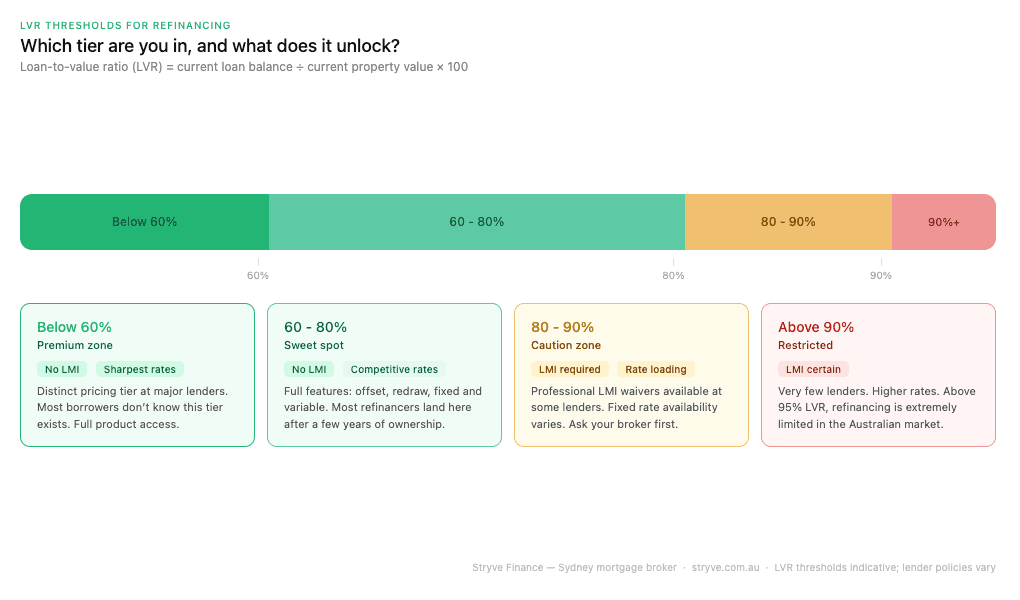
Here is what each tier means in practice, starting with the one most borrowers do not know about.
Below 60% LVR: the sharpest rates. This is the tier most borrowers don't know about. Several major lenders, including CommBank, price distinctly at this level. If your LVR sits below 60%, you're in the lowest-risk category and can access the most competitive rates on the market. This tier is a genuine differentiator that's rarely discussed.
60-80% LVR: competitive standard rates, no LMI. This is the sweet spot for most refinancers. You'll have access to competitive rates across a wide range of lenders, full product features like offset accounts, and no requirement for LMI. The 80% LVR threshold is the standard Australian industry benchmark below which lenders consider you low-risk.
80-90% LVR: higher rates, LMI likely. Above 80%, most lenders require LMI or a guarantor. Rates are typically higher, and some product features may be restricted. Some lenders offer LMI waivers for certain professionals (medical, legal, accounting) at LVRs up to 90%. This is lender policy, not legislation, and varies by institution. Worth asking about if it applies to you. Note also that some lenders restrict fixed rate availability above 80% LVR, so if you want to lock in a fixed rate, a Stryve Finance broker can identify which lenders still offer it at your LVR.
Above 90% LVR: very limited options. A small number of lenders will refinance above 90%, but your choices narrow significantly. Rates are higher, LMI is almost certain, and loan features are restricted. Above 95% LVR, refinancing is extremely limited in the Australian market.
When LMI Applies on a Refinance
LMI protects the lender, not you. As ASIC's MoneySmart explains, it can cost thousands of dollars and is generally required when your LVR exceeds 80%. This applies at refinance just as it does at purchase.
Here's the misconception that catches people out: LMI paid on your original loan does not transfer to a new lender. If you refinance above 80% LVR with a different lender, you may need to pay LMI again from scratch. That's a significant switching cost that can erode the savings you're chasing.
The cash-out trap is another one to watch. Even if your base refinance LVR sits comfortably below 80%, adding a cash-out component could push you above the threshold and trigger LMI. Run the numbers on the total new loan amount, not just your existing balance.
If you're in a qualifying profession, ask your broker about professional LMI waivers. These are lender-specific policies that can save you thousands, but they're not available everywhere and they're not legislated.
Before committing to any refinance, ASIC MoneySmart advises calculating the total cost of switching, including LMI, exit fees, and establishment fees. For a full breakdown of refinance costs including LMI, it's worth understanding every line item. You can also calculate whether refinancing still saves you money after LMI to make sure the switch stacks up.
Example: How Sydney Property Growth Could Have Lowered Your LVR
Let's make this concrete. Say you purchased a Sydney property in 2021 for $900,000 with an $810,000 loan. That's a 90% LVR. You paid LMI, accepted a higher rate, and had limited product options.
Fast forward to today. Here's what's changed:
| At purchase (2021) | Now (estimated) | |
|---|---|---|
| Property value | $900,000 | $1,050,000 |
| Loan balance | $810,000 | $770,000 |
| LVR | 90% | 73.3% |
The visual below makes that shift concrete, same loan, same borrower, very different position.
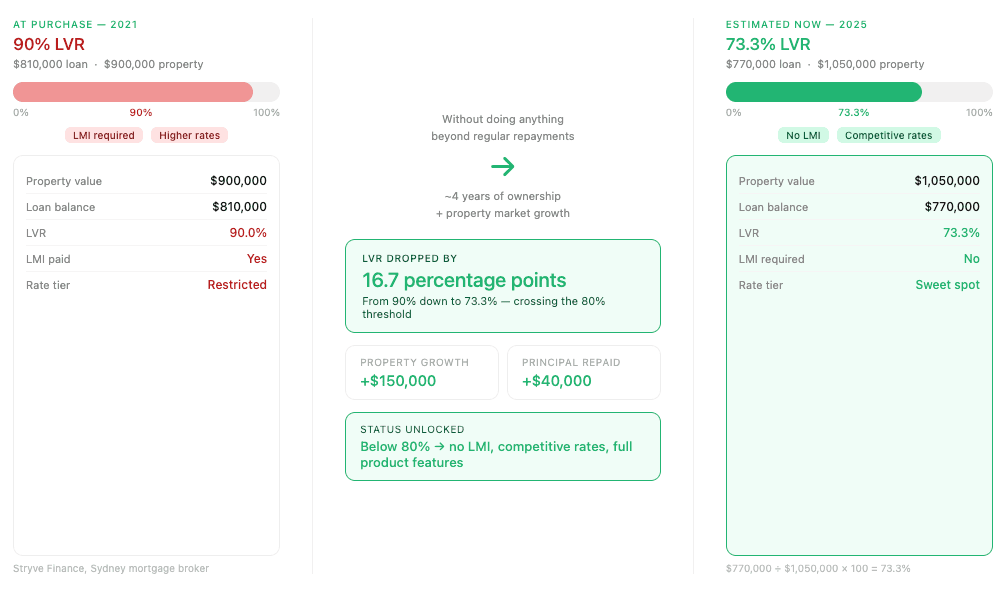
That 16.7 percentage point drop is the entire difference between paying LMI and accessing full product features, and it happened without any active decision from the borrower.
The maths: $770,000 ÷ $1,050,000 × 100 = 73.3% LVR.
Without doing anything beyond making regular repayments, this borrower has moved from the 90% tier (LMI required, limited options, higher rates) to below 80% (no LMI, competitive rates, full product access). CoreLogic data shows Australian capital city dwelling values rose approximately 8.7% in the year to March 2025, meaning the tailwind for existing owners has been substantial.
This dynamic isn't unique to Sydney. It applies across Australian capital cities where property values have risen. If you've held your property for a few years, there's a good chance your effective LVR is lower than you think.
A lower LVR also means you've built equity. If you need funds for renovations, investment, or other goals, you could access that equity through a cash-out refinance while still staying below the 80% threshold.
Get a personalised refinance quote based on your current LVR. Talk to a Stryve Finance broker in Sydney to see where you sit across 50+ lenders.
Check Yours Before You Talk to a Lender
Use this as a quick sanity check before you start any refinance conversation. This LVR refinance calculator worksheet helps you estimate your position without waiting for a lender valuation.
- Find your current loan balance. Check your latest loan statement or online banking. Write down the outstanding principal amount.
- Estimate your current property value. Look at recent comparable sales in your suburb or use an online property estimate tool. Be realistic, not optimistic.
- Apply the formula. Divide your loan balance by your estimated property value. Multiply by 100. That's your estimated LVR.
- Map your result to the thresholds. Below 60%: sharpest rates. 60-80%: competitive rates, no LMI. 80-90%: LMI likely. Above 90%: limited options.
Remember, this is an estimate. Under the NCCP, lenders must conduct their own property valuation, and the result may differ from yours. But this gives you a solid starting point so you're not walking in blind.
Ready to get a more accurate picture? Plug your numbers into the refinance calculator to see how your LVR maps to real rate options.
How a Broker Confirms Your Actual LVR Before You Apply
Your own estimate is useful. A broker-confirmed LVR is better. A Stryve Finance broker in Sydney can request a desktop or full valuation through their lender panel to confirm your current LVR before any formal application is lodged. That means no surprises and no wasted credit enquiries.
Here's where access to 50+ lenders makes a real difference. Different lenders use different valuation methods and may value the same property differently. That can shift your LVR above or below a critical threshold. A broker who can compare across the panel finds the valuation and rate combination that works best for your situation.
Stryve Finance also discloses what each lender pays in commission, so the recommendation is based on your outcome, not theirs.
See what rates your current LVR qualifies for. Talk to a Stryve Finance broker to map your numbers to the best available options across the panel.
Frequently Asked Questions
How do I calculate my LVR for refinancing?
Divide your current loan balance by the current market value of your property, then multiply by 100. The key difference from purchase is that the property value used is today's market value, not what you originally paid. Your lender will order their own valuation to confirm this figure.
What LVR do I need to refinance in Australia?
Most lenders require an LVR below 80% for standard terms without LMI. Some lenders will refinance at LVRs up to 90% or even 95% with LMI, but options narrow significantly, and rates are higher. Above 95% LVR, refinancing is extremely limited.
Do I have to pay LMI when refinancing?
Only if your LVR exceeds 80% with the new lender. LMI from your original loan does not transfer. If you switch lenders and your LVR is above 80%, you may need to pay LMI again. Some lenders offer waivers for qualifying professionals at LVRs up to 90%.
What is a good LVR for refinancing in Australia?
Below 80% is the benchmark that avoids LMI and unlocks competitive rates. Below 60% is where many lenders offer their sharpest pricing. The lower your LVR, the more options and better terms you will have access to.
Is LVR calculated differently for refinancing vs buying?
Yes. At purchase, lenders use the lower of the purchase price or the bank valuation. At refinance, the denominator is based entirely on the current market value determined by a lender-ordered valuation, not the original purchase price. This means borrowers who bought several years ago often have a much lower LVR for refinancing purposes than they realise, particularly if property values in their area have risen since purchase.
General advice warning
This article provides general information only and does not constitute financial or credit advice. LVR thresholds, LMI requirements, and lender policies are indicative and subject to change. Consider your own circumstances and seek advice from a qualified mortgage broker before making any financial decisions.

Dylan Bertovic is the Director and Senior Finance Broker at Stryve Finance, specialising in non-traditional lending solutions. He helps clients across Australia with tiny home loans, construction finance, equipment and asset lending, refinancing, and investor loans. With deep expertise in self-employed and renovation mortgages, Dylan is known for crafting tailored strategies that get results