
If you have been staring at fee schedules and lender fine print, feeling like you need a translator, you are not alone. Refinancing jargon can make a straightforward decision feel impossibly complicated. This guide strips it back to plain English, so you know exactly what you are paying before you sign anything.
Refinancing simply means replacing your current home loan with a new one, either with the same lender or a different one. If you are new to the concept, the full explanation of how refinancing a home loan works covers the process end to end.
According to Moneysmart (ASIC), interest rates can differ by more than 2% between variable home loan rates on the market. That gap makes it worth checking periodically. Australians are acting on it: a record 640,137 home loans were refinanced across the country in 2025, up 20% on the year before, and owner-occupiers switched a record $42.9 billion to new lenders in the March quarter of 2026 alone (Australian Bureau of Statistics Lending Indicators). But a lower rate only matters if the cost of refinancing a home loan does not eat up your savings.
This post covers costs only. No product recommendations, no lender comparisons. Just the numbers you need to make an informed decision independently.
The cost of refinancing a home loan at a glance
The cost of refinancing a home loan in Australia typically ranges from $700 to $2,500 for a standard variable-rate loan. That figure covers the discharge fee from your current lender, a new application or establishment fee, a property valuation, legal and settlement costs, and government registration charges. If you are on a fixed rate, break costs can push the total much higher.
Here is what the total cost to refinance a home loan typically looks like for a $600,000 owner-occupier variable-rate loan switching to a new lender.
| Fee category | Indicative range |
|---|---|
| Discharge fee (current lender) | $150 - $500 |
| Application/establishment fee (new lender) | $0 - $600 |
| Valuation fee | $200 - $600 |
| Legal/settlement fee | $150 - $400 |
| Government registration charges | $250 - $550 |
| Total estimated cost (typical) | $700 - $2,500 |
A few things to note about this table. The ranges reflect a standard variable-rate loan, and the individual maximums rarely all apply at once. Many lenders waive certain fees for refinancers, which is why some line items start at zero. The government charges vary by state, covered in more detail below.
If you are on a fixed rate, the picture changes significantly. Break costs can add thousands, or even tens of thousands, of dollars on top of the figures above. They deserve their own section, which follows next.
Before committing, Moneysmart recommends four checks: ask your current lender for a better deal first, confirm whether Lenders Mortgage Insurance (LMI) will apply, compare the fees and charges on the new loan (discharge fee, application fee, any switching fee, break costs, and stamp duty), and check the length of the new loan so you do not accidentally stretch your term. The table above maps directly to the fees part of that framework.
Discharge and exit fees
A mortgage discharge fee is the administrative cost your current lender charges to close out the loan and release the property title. Think of it as the paperwork fee for letting you go. The typical range sits between $150 and $500, though some lenders have dropped this fee entirely. It is worth calling your current lender to confirm the exact amount before you start the process.
Worth knowing: genuine exit fees, sometimes called early termination or deferred establishment fees, were banned on all new home loans taken out from 1 July 2011. If your loan started after that date, your lender cannot charge a penalty simply for leaving. What remains is the discharge fee above, plus government charges, plus fixed-rate break costs where they apply. If your loan predates July 2011, check your contract, as older exit fees may still apply.
For a full breakdown of what is involved, read about mortgage discharge fees in detail.
Fixed-rate break costs: the fee that catches people off guard
Break costs are the compensation a lender charges when you exit a fixed-rate loan before the fixed term ends. They apply only to fixed-rate loans broken during the fixed period, not to variable-rate loans. They exist because the lender locked in funding at a specific rate on your behalf, and leaving early creates a shortfall.
Here is why they can be so high. Lenders calculate break costs based on the difference between your locked-in rate and the current wholesale rate, multiplied by the remaining term and your loan balance. If wholesale rates have dropped since you fixed, that gap widens and the cost climbs.
Break costs can run into thousands or even tens of thousands of dollars depending on how much rates have moved and how long you have left on your fixed term. This makes them potentially the single largest cost of refinancing a home loan, and the one most likely to catch borrowers off guard.
Moneysmart flags break costs as a key item to check before switching if you are on a fixed rate. For the full explanation and calculation walkthrough, see how home loan break costs are calculated.
Application and Settlement fees from the new lender
Your new lender may charge an application or establishment fee to set up the loan. This typically ranges from $0 to $600. Many lenders waive it entirely for refinancers as an incentive to switch, so it is always worth asking.
On top of that, expect legal and settlement fees of $150 to $400. These cover the conveyancing or settlement process required to transfer the mortgage from one lender to another.
Both fees are standard when moving to a new lender and worth factoring into your total costs alongside any rate savings. The process of switching home loans to a new lender involves several steps beyond just the fees, so it helps to understand the full picture before committing.
A note on “no-cost” refinancing. Some lenders advertise fee-free or no-cost refinancing by waiving the application, valuation, and settlement fees. These offers are real and can genuinely lower your upfront costs, but check what is actually being waived. A waived fee is a true saving, while a fee that is rolled into the loan is simply deferred, and you pay interest on it over the life of the loan. Also confirm whether a slightly higher interest rate or an ongoing package fee offsets the upfront saving. Stryve Finance always reads the fine print on these offers so borrowers can see the real cost, not just the headline.
Valuation fees
The new lender will typically require a property valuation to confirm your property's current market value. This determines your LVR (loan-to-value ratio), which is the percentage of the property's value that you are borrowing.
Valuation fees generally range from $200 to $600. Some lenders cover this cost as part of their refinance offer, so check before assuming you will pay out of pocket.
One important flag. If your property value has dropped since you purchased it, your LVR may now exceed 80%. In that case, you could be required to pay LMI (Lenders Mortgage Insurance), which protects the lender if you default. LMI can add thousands to your costs and may change the entire equation on whether refinancing makes financial sense.
Government charges (and why they vary by state)
Refinancing involves two government lodgements: discharging the old mortgage and registering the new one with your state's land titles office. Both attract a fee, and those fees were last increased on 1 July 2026 for the 2026 to 2027 financial year.
Refinancing involves two government lodgements: discharging the old mortgage and registering the new one with your state's land titles office. Both attract a fee, and those fees were last increased on 1 July 2026 for the 2026 to 2027 financial year. Here's how the total compares across the three most populous states.
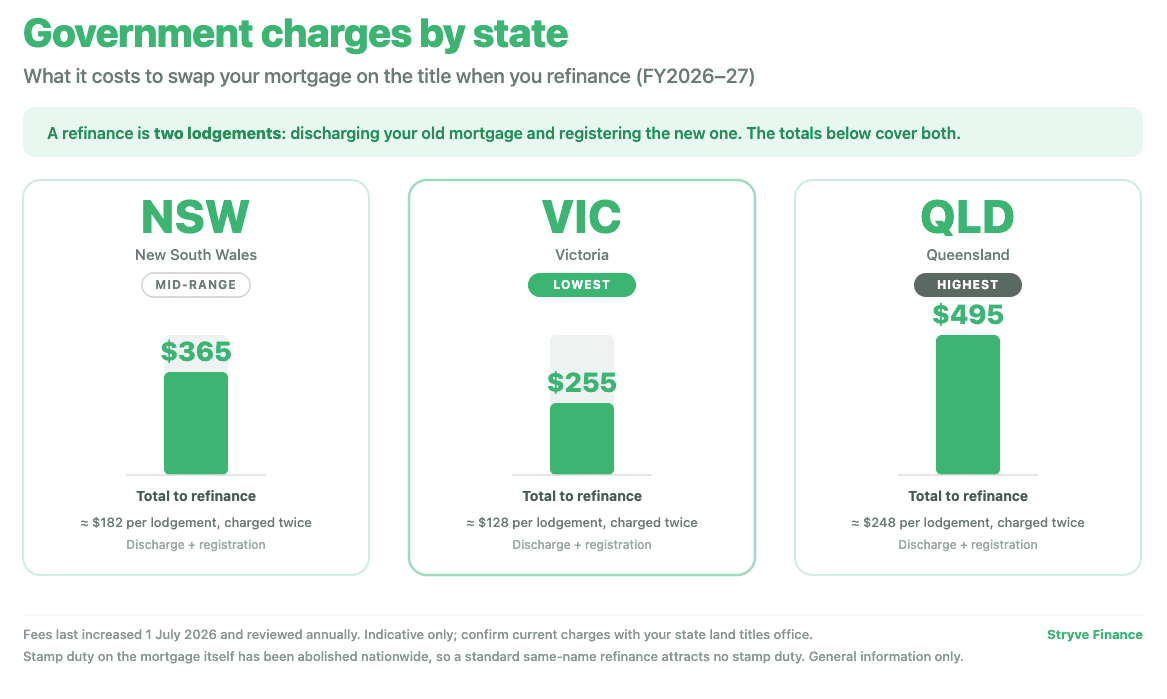
Wherever you're refinancing, budget for both lodgements rather than just one, since it's easy to underestimate this line item by half if you only price in a single fee. As these figures are reviewed annually, it's worth checking your specific state's land titles office for current charges before settlement. Stamp duty is often mentioned in this context, but stamp duty on the mortgage itself has been abolished in every Australian state and territory, so a standard refinance in the same borrower's name generally attracts none.
Stamp duty is often mentioned in this context, but stamp duty on the mortgage itself (mortgage duty) has been abolished in every Australian state and territory. A standard refinance in the same borrower's name generally attracts no stamp duty. Transfer duty may only apply if the names on the title change, for example if you add or remove a co-borrower during the refinance.
The 2026 cashback reality check
If you are banking on a lender cashback offer to cover your switching costs, it is worth a reality check.
Cashback offers have thinned out considerably. Most major banks have stepped back, with ANZ withdrawing its refinance cashback in October 2025, and the deals that remain come mostly from smaller and non-major lenders. These typically sit in the $1,000 to $4,000 range and carry strict eligibility rules and clawback conditions, meaning you may have to repay the cashback if you refinance again within 12 to 24 months. For context, the Reserve Bank of Australia (RBA) increased the cash rate three times in the first half of 2026, in February, March, and May, lifting it to 4.35% where it has since held. Higher repayments have pushed more borrowers to shop around, but a shrinking pool of cashback deals means you should not assume one will be waiting when you switch.
Do the arithmetic before relying on a cashback. Subtract the cashback amount from your total switching costs. Then check whether the remaining out-of-pocket cost is still justified by the rate savings you will gain.
Before factoring in any cashback, check the current home loan cashback offers Stryve Finance tracks to see what's available right now.
How to work out if refinancing is worth the cost
Once you tally the total costs to refinance, the break-even calculation is straightforward.
Using the $600,000 loan scenario from the cost table above: if your total costs come to $1,500 and you save $200 per month on repayments, your break-even point is 7.5 months. After that, every month of savings is money in your pocket. Here's what that looks like plotted month by month.
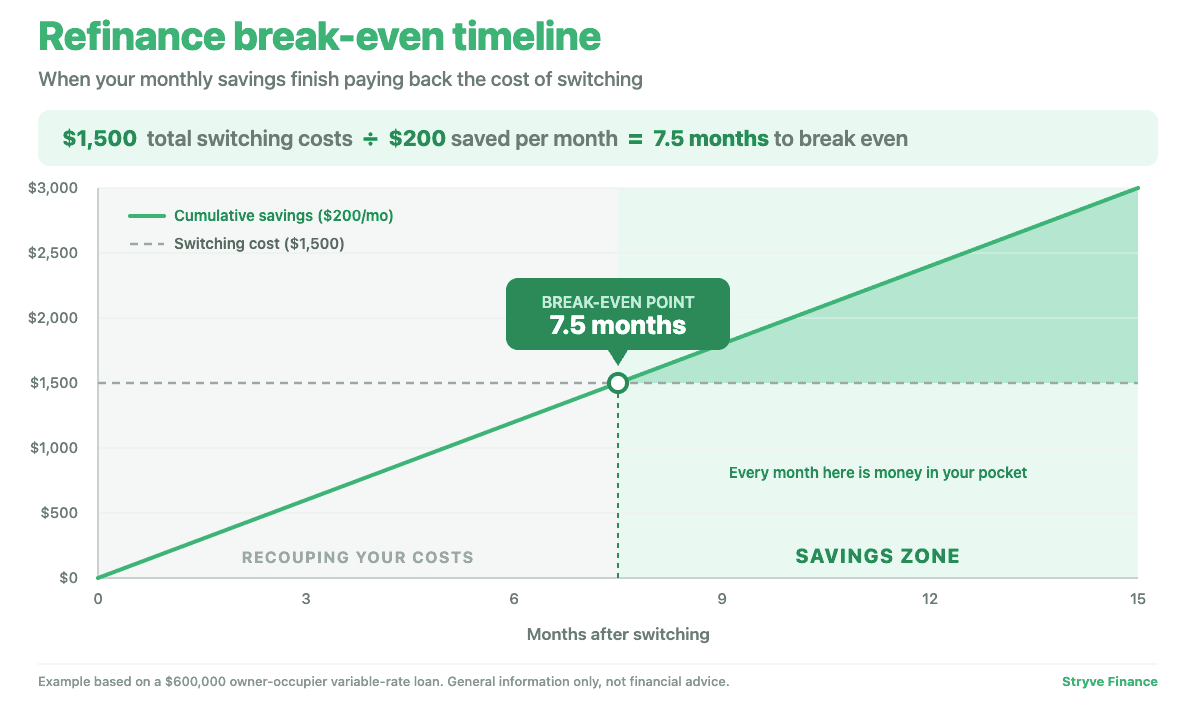
Once you cross that 7.5-month mark, the chart's savings zone tells the story on its own, everything to the right of the line is pure saving. The steeper your monthly saving relative to your switching costs, the sooner that zone starts. If the break-even period stretches beyond 12 to 18 months, the case for refinancing weakens, especially if you might move or refinance again in that timeframe.
Moneysmart frames the core decision as a simple sum:
Total switching costs / monthly repayment saving = months to break even
Using the $600,000 loan scenario from the cost table above: if your total costs come to $1,500 and you save $200 per month on repayments, your break-even point is 7.5 months. After that, every month of savings is money in your pocket.
If the break-even period stretches beyond 12 to 18 months, the case for refinancing weakens, especially if you might move or refinance again in that timeframe.
Rate savings are not the only factor worth weighing. Better loan features, a functional offset account, or greater repayment flexibility can add value that doesn't show up in a simple rate comparison. For the broader decision framework, read about deciding whether to refinance in 2026.
An independent brokerage like Stryve Finance, with access to a broad panel of lenders, can help run these numbers across multiple options with full lender commission transparency and no hidden fees. If the numbers stack up, you can compare refinance home loan options to find a rate that holds up after costs.
Estimate the savings before committing
Every dollar figure in this guide exists for one reason: to help you know whether the upfront costs are worth the long-term savings on your specific loan.
The fastest way to find out is to plug your own numbers into a refinance savings calculator. Enter your current loan balance, rate, and the rate you are considering. The calculator does the rest.
Understanding the costs of refinancing a home loan upfront means no surprises at settlement. For the full step-by-step process, from application through to settlement, the complete guide to refinancing a home loan covers everything in one place. Stryve Finance can walk you through each cost as it applies to your loan.
Frequently asked questions about home loan refinance costs
How much does it cost to refinance a home loan?
For a standard variable-rate home loan, total costs typically range from $700 to $2,500. This includes discharge fees, application fees, valuation, settlement, and government charges. Fixed-rate borrowers may pay significantly more due to break costs, which are calculated based on rate movements and the remaining loan term.
What are the costs to refinance a home loan in Australia?
The main fee categories are: discharge fee from your current lender ($150 - $500), application or establishment fee from the new lender ($0 - $600), property valuation fee ($200 - $600), legal and settlement fees ($150 - $400), and government registration charges ($250 - $550 depending on your state).
Can cashback offers cover home loan refinance costs?
They can, but cashback offers have thinned out, with most major banks stepping back and the remaining deals concentrated among smaller lenders. Do not assume a cashback will fully offset your switching costs. Subtract the cashback from your total fees and check whether the remaining cost is justified by your monthly repayment savings, and confirm the clawback period before you commit.
How long does it take to recoup the costs of refinancing a home loan?
Use the break-even formula: total switching costs divided by your monthly repayment saving. For example, $1,500 in costs with a $200 monthly saving gives a break-even point of 7.5 months. Anything under 12 months generally signals a strong case for switching.
Is it worth refinancing to save 0.5%?
Often, yes, as long as the savings outweigh your switching costs within a reasonable timeframe. On a $600,000 loan with about 25 years remaining, a 0.5% rate cut lowers repayments by roughly $180 a month. If switching costs you around $1,300, you would break even in about seven months, and every month after that is a saving. The smaller your loan balance or the higher your switching costs, the less a 0.5% gap moves the needle, so always run your own numbers first.
General advice disclaimer: This article provides general information only and does not take into account your personal objectives, financial situation, or needs. It is not financial or credit advice. Consider seeking advice from a licensed professional before making a decision about refinancing.

Dylan Bertovic is the Director and Senior Finance Broker at Stryve Finance, specialising in non-traditional lending solutions. He helps clients across Australia with tiny home loans, construction finance, equipment and asset lending, refinancing, and investor loans. With deep expertise in self-employed and renovation mortgages, Dylan is known for crafting tailored strategies that get results