
Property values softened across much of Australia in the second half of 2026. National home values fell 0.7 per cent in July 2026, the sharpest monthly drop since December 2022, according to Cotality's Home Value Index (formerly CoreLogic). As that gap widens, the number a lender puts on a home is increasingly diverging from what owners expect. That gap has real financial consequences for anyone refinancing right now. It can shift the interest rate on offer, trigger thousands of dollars in insurance costs, or stall a refinance altogether.
Most people asking “whats my home worth” start with free online tools. CommBank Property Insights, Domain, and CoreLogic all offer quick estimates. Others ask a local agent. These are useful starting points if you want to estimate your property's market value, and a separate post covers that topic in detail.
But for a refinance, none of those numbers is the one that matters. The lender orders its own valuation. That figure alone sets the Loan-to-Value Ratio (LVR), the rate tier, and whether Lenders Mortgage Insurance (LMI) applies. Under the National Consumer Credit Protection Act 2009, responsible lending obligations require lenders to make reasonable inquiries about the borrower's financial situation and verify that information, which in practice includes confirming the value of the security property. A formal valuation is part of that assessment for most refinance applications.
Not sure what your property might be worth on the open market? Start with a general market estimate.
Lender-branded tools like CommBank Property Insights or a CBA valuation estimate use Automated Valuation Models (AVMs). These are indicative only and legally distinct from the lender's formal valuation. The commbank property value you see on screen is not the number the bank will use to approve your refinance.
Three valuations, three different numbers: only one matters for your refinance
There are three types of property valuation a refinancer will encounter. Each produces a different number, and understanding why they diverge is the first step to avoiding a nasty surprise.
1. Automated valuation model (AVM)
This is the algorithm-driven estimate from property portals or bank tools. It pulls comparable sales data, applies statistical modelling, and spits out a figure. No one visits the property. The confidence interval can be wide, especially for unusual properties or thin markets. A free home valuation from Domain or a valuation of home calculator falls into this category.
2. Agent appraisal
A local agent's opinion of market value. Agents use their knowledge of the area and recent sales to calculate home appraisal figures. These tend to run optimistic. The agent is often trying to win a listing, so the number leans toward what a seller wants to hear rather than what a lender needs to know.
3. Lender's formal valuation
This is ordered by the lender, not the borrower. It is conducted by a licensed valuer from the lender's approved panel. The valuer assesses the property “as-is,” using recent comparable sales, property condition, and location factors. The mandate is conservative. The lender needs to know what the property would sell for quickly in a worst-case scenario.
Line up all three figures against the same property and the pattern holds almost every time. An algorithm-driven estimate lands somewhere in the middle. An agent's appraisal, shaped by the pressure to win a listing, tends to run highest. And the lender's own valuation, the one that actually determines the loan, comes in lowest.
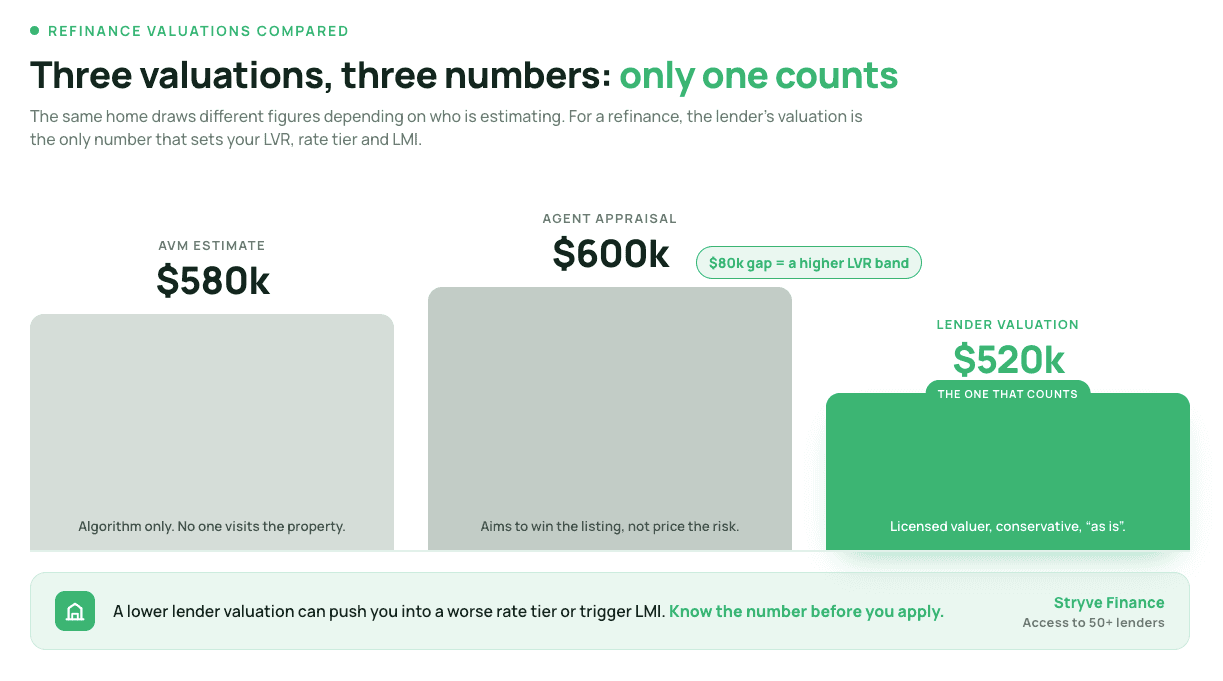
The lender's formal valuation is typically the lowest of the three, as shown above. It excludes emotional or aspirational value. It is not trying to impress anyone. That $80,000 gap between an agent's number and the lender's number is not a rounding error either. It is often enough to shift a refinance into a higher LVR band, changing the rate on offer before LMI even enters the conversation.
The lender's formal valuation is typically the lowest of the three. It excludes emotional or aspirational value. It is not trying to impress anyone.
According to ASIC MoneySmart, the lender commissions the valuation, and the borrower typically pays the fee. Borrowers have no automatic right to receive a copy of the report, though many lenders will provide it on request.
For a refinance, the lender's valuation is the only number that determines LVR, rate pricing, and LMI. A home value appraisal from an agent or an AVM estimate carries no weight in the loan approval.
How the lender valuation process works for a refinance
Here is what happens, step by step.
- The borrower applies to refinance with a new lender (or their existing one).
- The lender orders a valuation. Depending on the loan amount, estimated LVR, and internal policy, this may be a desktop or AVM assessment, a kerbside (drive-by) valuation where a valuer inspects only the exterior, or a full physical inspection by a panel valuer. As a rough guide in 2026, desktop and AVM assessments are typically used at lower LVRs and cost from nothing up to around $200, kerbside valuations sit in the middle at roughly $200 to $350, and full inspections apply at higher LVRs and generally run $300 to $600, though the borrower does not always pay for a refinance.
- The valuer inspects the property (if physical). They assess comparable sales, building condition, land size, zoning, and location factors such as flood risk or proximity to infrastructure.
- The valuer submits the report to the lender. The borrower does not instruct the valuer or negotiate the outcome.
- The lender uses the assessed value to calculate LVR and determine loan conditions, including rate pricing and whether LMI is required.
Who pays? The borrower typically covers the valuation fee, though some lenders waive it for refinance applications.
How long does it take? A desktop or AVM valuation can come back in hours. A full physical inspection may take 5 to 10 business days, depending on the valuer's availability and property location.
How your valuation sets your LVR band (and why that matters more than you think)
What is LVR?
LVR stands for Loan-to-Value Ratio. It measures how much of the property's value is covered by the loan.
LVR = loan amount ÷ property value × 100
If you want to work out your LVR in detail, that guide walks through the full calculation. The property value in that formula is the lender's assessed value, not an online estimate. And the LVR band the borrower lands in determines the rate and whether LMI applies.
Here is how that plays out across the full range of outcomes, from the safest tier a lender offers through to the point where most will not refinance at all.
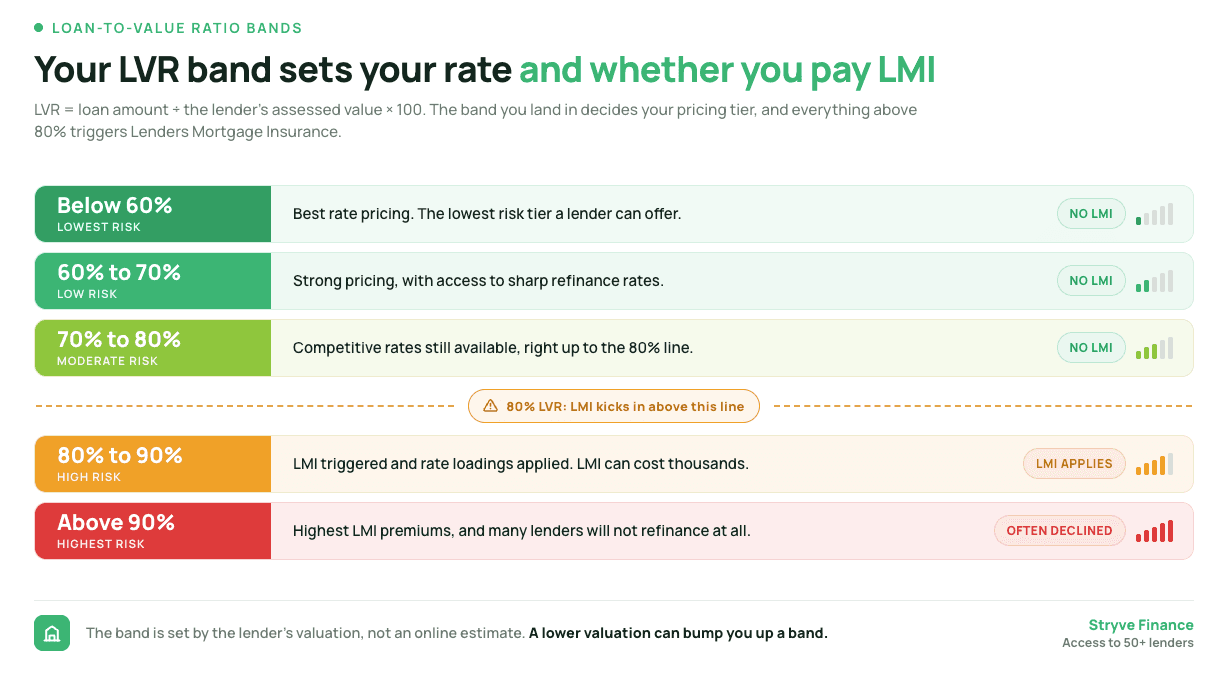
The line to watch is the one at 80%. Cross it, even by a fraction of a percent, and LMI moves from optional to compulsory, often adding thousands of dollars to the cost of the loan. The following example shows exactly how a valuation shortfall can push a borrower across that line without them realising it until the offer comes back.
A concrete example. A borrower has a $400,000 loan and expects a $600,000 valuation. That puts them at 67% LVR, comfortably in a strong pricing tier. But the lender's valuer assesses the property at $520,000. Now the LVR is 77%. The borrower is still under 80%, but they have landed in a worse rate tier. If they needed to borrow even slightly more, they would cross the 80% threshold and trigger LMI.
LMI protects the lender, not the borrower. It can cost thousands of dollars and is often capitalised into the loan, increasing the total amount owed.
Want to see how a different valuation changes your refinance position? Run the numbers on your refinance.
Why valuations are coming in lower in 2026
After strong growth earlier in the cycle, property values across much of Australia turned lower through the second half of 2026. Cotality's Home Value Index recorded a 0.7 per cent national fall in July 2026, and more than three-quarters of capital city suburbs saw values decline over the preceding three months. Valuers rely on recent comparable sales, so as prices ease, the comps pull assessed values down with them.
This creates a specific risk for refinancers. Many bought or last valued their property at peak prices. The equity they assumed they had may not be there when the lender's valuer assesses the property today.
The consequences are concrete. A lower-than-expected valuation can push a refinancer into a higher LVR band, trigger LMI they did not budget for, or result in a worse rate than the one they were trying to escape. According to ASIC MoneySmart, LMI is generally required when the LVR exceeds 80% of the lender's assessed property value, not the purchase price or market estimate. A borrower who believes they have sufficient equity can still be caught out.
In the worst case, the borrower becomes a mortgage prisoner: someone who cannot refinance because their equity position no longer supports a new loan at a competitive rate. Finder's 2026 Home Loan Report estimated that as many as 36 per cent of borrowers were in this position, whether through insufficient equity or serviceability that no longer meets lender criteria. They remain stuck on their current loan, often at a higher rate, with no clear path out.
What to do if your refinance valuation comes in low
A low valuation is not the end of the road. There are practical steps to take.
- Ask for the valuation report: ASIC guidance encourages borrowers to request the report so they can understand the basis of the assessed value. Review the comparable sales used. If the comps are outdated or not genuinely comparable, that is grounds for a challenge.
- Provide comparable sales evidence: If the valuer missed a strong recent sale nearby, a broker can submit additional comps to the lender to support a review.
- Request a formal valuation review or second valuation: Some lenders allow this, especially when new evidence is provided. The process varies by lender.
- Present the property well before a physical inspection: Declutter, complete minor repairs, ensure the valuer can access all areas including the garage, granny flat, or renovated spaces. First impressions matter even for a licensed valuer.
- Adjust the loan amount: Borrowing less can bring the LVR back into a better band. This may mean keeping a smaller portion of debt with the existing lender.
- Try a different lender: Different lenders use different panel valuers and AVMs, so the assessed value can vary. A broker with access to 40 or more lenders, like Stryve Finance, can identify which lender is likely to produce a more favourable result.
- Wait: If the market is expected to stabilise, waiting three to six months and reapplying may yield a better valuation as new comparable sales settle at higher levels.
A strong valuation alone will not get a refinance approved if serviceability falls short. Valuation sets LVR, but income and expenses set borrowing power. If serviceability is a concern, it is worth looking at ways to boost your borrowing power before refinancing.
Talk to a refinance broker before you apply
Understanding the lender valuation process, the LVR consequences, and the options if it comes in low puts a refinancer in a much stronger position.
A refinance broker can run an indicative valuation check before a formal application, identify lenders whose AVMs are likely to assess the property favourably, and navigate the process if the number comes in low. Stryve Finance provides full lender commission transparency and charges no hidden fees, with access to over 50 lenders.
Talk to a Stryve Finance to understand how the valuation may affect your rate and LMI position. Or run the numbers on your refinance to see how different valuations change the outcome.
Frequently Asked Questions
What is my home worth for a refinance?
The answer depends on the lender's formal valuation, not an online estimate or agent appraisal. The lender commissions a valuation from a licensed valuer or uses an AVM, and that assessed value determines the LVR, rate pricing, and whether LMI applies.
Is a CommBank property value estimate the same as a bank valuation?
No. CommBank Property Insights and similar tools use automated valuation models to produce an indicative estimate. The formal valuation for a refinance is a separate, lender-instructed process conducted by a licensed valuer or a lender-approved AVM. The two are legally distinct.
Can I get a free home valuation before refinancing?
Free online tools give a general market estimate, but the lender's valuation, which the borrower usually pays for, is the one that counts. A broker can sometimes run an indicative AVM check before a formal application to flag potential issues early.
Can I dispute a bank valuation?
Borrowers can request the valuation report, review the comparable sales used, and provide additional evidence to support a review. A broker can also submit the application to a different lender whose panel valuer or AVM may assess the property differently.
What happens if my valuation is lower than expected?
A lower valuation raises the LVR. This can push the borrower into a higher pricing tier, trigger LMI above 80% LVR, or make the refinance unviable at the desired loan amount. The “what to do if your refinance valuation comes in low” section above outlines seven practical steps.
How long does a lender valuation take?
Desktop or AVM valuations can return in hours. A full physical inspection by a panel valuer typically takes 5 to 10 business days, depending on location and valuer availability.

Dylan Bertovic is the Director and Senior Finance Broker at Stryve Finance, specialising in non-traditional lending solutions. He helps clients across Australia with tiny home loans, construction finance, equipment and asset lending, refinancing, and investor loans. With deep expertise in self-employed and renovation mortgages, Dylan is known for crafting tailored strategies that get results