Most self-employed borrowers walk in assuming two years of tax returns, and that assumption stops plenty of good applications before they start. But it's not the whole story. Lenders assess a one-year file every day, weighing ABN history, prior PAYG experience, deposit strength and account conduct alongside the return itself.
This guide explains what moves a one-year application forward, illustrated with a first-year sole trader's numbers from ABN registration through to approval.
Can you get a home loan with one year of tax returns?
Yes. Some lenders will consider a 1-year tax return home loan, provided you've held your ABN for a minimum period, your income aligns with prior PAYG work in the same field, and the rest of your application stacks up. One lodged return does not automatically rule you out.
Policies vary between lenders, and nothing here commits you to any particular one. One credit team may rule out a scenario that another assesses on its merits. That matching problem is a large part of why brokers arranged around 81% of all new home loans in the March 2026 quarter (MFAA). As a Sydney mortgage broker working across 50+ lenders, Stryve Finance treats finding that difference as the whole job.
Below we cover what lenders are really testing for, the five things that make a one-year file work, a full worked example with numbers, your options if one return is not enough, and where these applications come unstuck.
If you want the broader picture first, start with our guidance for borrowers seeking a self-employed home loan.
The two-year rule is lender policy, not law
Self-employment is mainstream in Australia. Around two-thirds of businesses have no employees at all (ABS Counts of Australian Business), so lenders routinely assess a one-return, sole-trader file-it's not an oddity.
No legislation in Australia requires two years of tax returns to buy a home. It is a credit policy setting, written by each lender, and settings differ.
That matters because a decline from one bank tells you very little about the next. Each lender decides its own position on minimum trading history, acceptable income evidence and which industries it is comfortable with. Same borrower, same file, different answer.
What does not change is the obligation to verify. Credit providers operate under the National Consumer Credit Protection Act and ASIC's responsible lending guidance, so no lender can simply take your word on income. Even a low doc home loan requires evidence through BAS, business bank statements or an accountant declaration.
The question is never whether evidence is needed. It is which evidence a particular lender will accept.
What lenders are actually looking for in two years of returns
The paperwork is a proxy. What a credit assessor wants to know is whether your income is stable and repeatable, or whether you happened to have one good year.
Two returns let them compare year on year. Most will then take the lower figure, or an average, depending on the trend. One return removes that comparison entirely, so the lender needs other evidence to close the confidence gap.
Here is the part that surprises most new sole traders.
What income do lenders use?
Lenders generally assess your taxable income as declared to the ATO and confirmed on your Notice of Assessment, not your gross turnover.
You can invoice $250,000 and present a taxable income of $70,000. The lender assesses the $70,000.
Some lenders will add certain items back to that figure. Depreciation is the common one, along with genuine one-off expenses that will not recur. Add-backs must follow standard accounting treatment rather than wishful thinking, and lenders treat them differently.
What makes a one-year application work
Five things move the needle on a thin-file application. None of them is a guarantee, and each is weighted differently depending on whose policy you are working to.
- Length of ABN and GST registration history: Lenders use your ABN registration date and GST registration status to confirm how long you have genuinely been trading. Minimum periods vary by lender.
- Prior PAYG employment in the same industry: This is the quiet hero. It converts one year of trading into a much longer record of earning in the same trade or profession. A sparkie with eight years on the tools and one year on their own ABN is not a beginner.
- A strong deposit and a lower LVR: LVR (loan-to-value ratio) is the loan amount as a percentage of the property value. A lower LVR means the lender carries less risk, and it usually reduces or removes LMI (Lenders Mortgage Insurance). On a $500,000 loan at 90% LVR, LMI commonly runs to roughly $8,000 to $12,000, and it falls away entirely once you reach a 20% deposit (figures indicative; premiums vary by lender and insurer).
- Clean credit and clean account conduct: No dishonours, no missed repayments, no informal overdrafts. On a thin file, conduct carries more weight than usual.
- Corroborated income from BAS and bank statements: BAS lodgements, PAYG instalments and business bank statements sit alongside the return, all telling the same story.
Strength in one area can offset thinness in another. Nothing offsets an income figure you can't verify.
The practical step is matching your scenario to a policy that fits it. If your ABN is newer than that, Stryve Finance can walk you through the self-employed less than 2 years home loan options on our service page.
A worked example: Jess, a first-year sole trader
Reviewed by a licensed Stryve Finance credit adviser. The tax points below are general. Confirm depreciation add-backs and deduction treatment with your accountant or registered tax agent before acting.
Jess is an electrician. She spent nine years as a PAYG employee for a commercial contractor, then finished up in March and registered her ABN in April to go out on her own.
All figures below are illustrative only. They are not a quote, an approval, or an indication of borrowing capacity.
Jess's path from registering her ABN to an approved file ran across two years, and the order of events matters more than the wait itself. Here is the whole sequence before we walk through it.
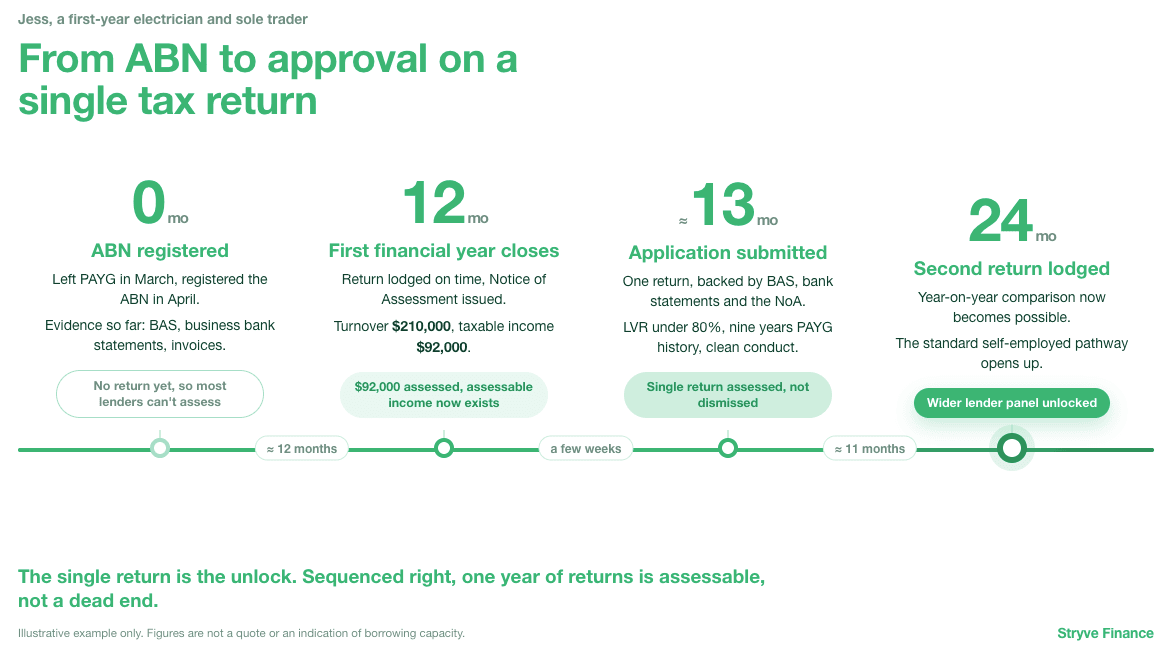
Each marker is worth unpacking, because the timing of one against the next is where a one-year file is won or lost.
The April to June stub period gave her three months of trading and very little else. Her first meaningful financial year ran from 1 July to 30 June the following year.
Months 0 to 6. Jess has BAS lodgements, business bank statements and invoices. No tax return exists yet, because the financial year has not closed. Most lenders cannot assess her at this point, regardless of how well she is trading.
Her turnover crossed the ATO's $75,000 GST registration threshold early, so she registered for GST. That registration later became useful evidence of genuine trading.
Month 12, financial year closes. Jess turned over $210,000. Materials, subcontractors, vehicle running costs, tools, insurance and accounting came to $118,000. Her taxable income was $92,000. Depreciation on the ute and her equipment accounted for $8,000 of those expenses.
She lodged on time and received her Notice of Assessment a few weeks later.
Because Jess is a sole trader, there is no separate business return. Business income flows straight through to her individual return, so one document does the work of two. Different structures behave differently, and it is worth understanding how lenders read each type of business income.
The lender assessed the $92,000, not the $210,000. Some lenders would consider adding back the $8,000 depreciation, lifting the assessable figure. Treatment varies.
Here is that gap at a glance. What Jess invoices and what a lender assesses are two very different numbers, and the difference is simply her deductible expenses.
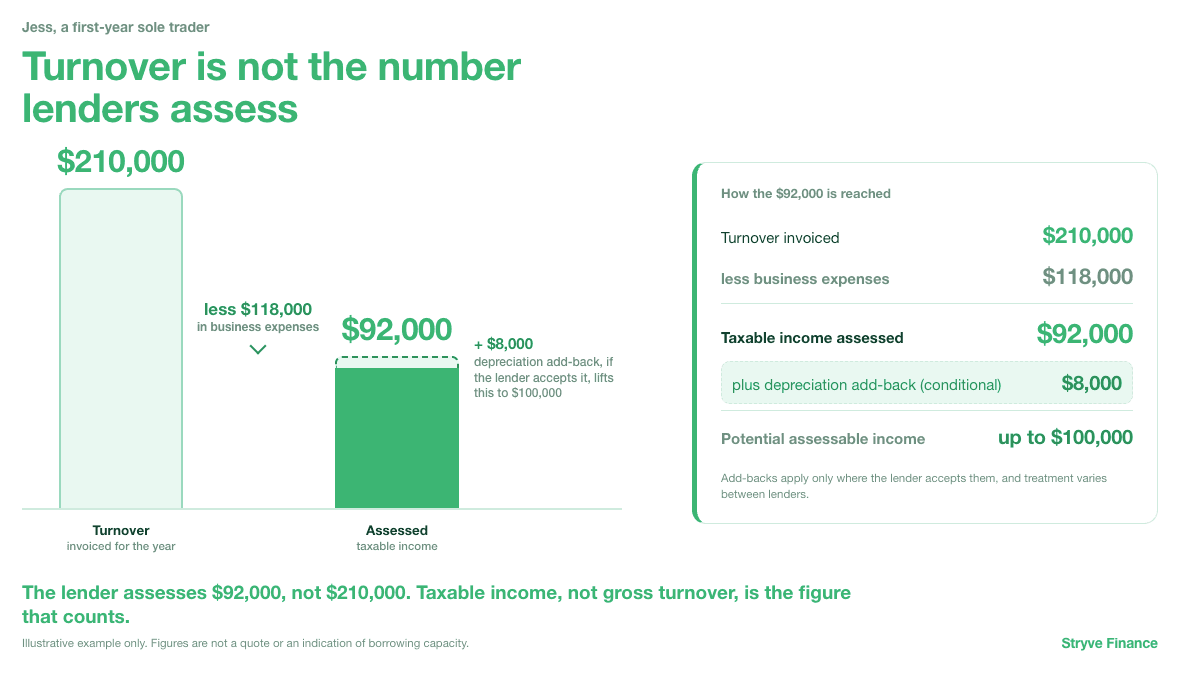
So the working figure is $92,000, or up to $100,000 if the depreciation add-back is accepted. With the assessable income settled, the deposit is the next piece of the picture.
Jess had $130,000 saved. On a $620,000 purchase, borrowing $490,000, that put her LVR just under 80 per cent. Combined with nine years of PAYG work as an electrician and clean conduct across every account, her single return was assessed rather than dismissed.
Month 24. A second return lands, the year-on-year comparison becomes possible, and the standard self-employed pathway opens up across a much wider set of lenders.
What would Jess have done differently? Registered the ABN the week she finished her PAYG role rather than leaving a gap, and spoken to her accountant before June about the trade-off between deductions and assessable income.
One year of returns does not have to mean waiting. Have a chat with the Stryve Finance team, who work with self-employed applicants every day, and find out which lenders would actually look at your file.
Your options when one year of returns is not enough
Sometimes the file just is not there yet. You have four honest paths, set out below.
| Option | What it solves | What you give up | Best suited to |
|---|---|---|---|
| Wait for the second return | Removes the thin-file problem entirely, opening the widest lender choice and the sharpest pricing | A few months of waiting | Borrowers close to lodging their second return with no urgency to buy |
| Alt doc or low doc | Verifies income without two full returns, using BAS, business bank statements or an accountant declaration | Usually some pricing, and a lower maximum LVR | Traders with strong BAS and banking records but only one return so far |
| Guarantor | Solves the deposit and LVR shortfall outright | Puts a family member's property on the line | Buyers with a willing parent and a modest deposit |
| Partner on PAYG income | Adds stable salaried income to strengthen the serviceability picture | Ties the loan to a co-borrower | Couples where one partner has steady employment |
The last two options move risk onto someone else, so they deserve a proper conversation rather than a quick yes.
Stryve Finance quotes lender commissions openly and charges no hidden fees, so you can see the cost of each path before you choose one.
Where one-year applications come unstuck
Four failure points come up again and again.
- The return is lodged late: If Jess had lodged in March instead of soon after 30 June, she would have spent eight months unable to apply. The return and the Notice of Assessment both need to exist before the file goes in.
- Aggressive year-one deductions: Every dollar of deduction reduces taxable income, and taxable income is the figure most lenders use to assess you. Push Jess's $92,000 down to $58,000 and her borrowing capacity falls with it. The tax you save in year one can cost you borrowing capacity for the next two.
- A gap between PAYG and the ABN: Jess finished in March and registered in April. A six-month gap would have broken the continuity story that made her prior experience count.
- Applying to the wrong lender: Some policies rule out a one-year file before anyone reads it. A declined application still leaves a credit enquiry on your file, so you need to choose a lender before submission, not after. Several enquiries in quick succession compound the problem: on a thin file with limited history, a cluster of recent applications reads as credit-hungry and can pull your score down at the exact moment lenders are scrutinising it hardest.
Your six to twelve month preparation checklist
Not applying yet? Good. This is the window where you have the most control.
- Lodge your first return on time. No return, no Notice of Assessment, no application.
- Separate business and personal banking completely. Mixed accounts make income impossible to read and slow every assessment down.
- Keep BAS lodgements current. BAS and PAYG instalments are the supplementary evidence lenders lean on when only one return exists.
- Protect your account conduct. No dishonours, no missed repayments, no late card payments.
- Talk to your accountant early. Frame it as a timing decision, not a tax avoidance one. There is a real tension between minimising this year's tax and maximising assessable income, and it is easier to manage in April than in August.
Documents to have ready
Getting these together early keeps the assessment moving once you do apply:
- Your most recent individual tax return
- The matching ATO Notice of Assessment
- Your last four BAS lodgements
- Six months of business bank statements
- Evidence of ABN and GST registration
- Prior PAYG payslips or an employment letter covering your time in the same field
Also get your deposit position clear. Knowing your likely LVR before you speak to anyone helps you choose realistic lenders.
Run your situation past Stryve Finance early, so you know what to fix in the next six months, at no cost and with no hidden fees. Start with our self employed under 2 years home loan options.
Frequently Asked Questions
Is one year of tax returns enough for a home loan?
For some lenders, yes. A one-year file can be assessed if the return is supported by BAS, business bank statements, and a Notice of Assessment, and if trading history and deposit are strong. Policy settings differ between lenders, so the answer depends on which one you approach.
How long do I need to have held my ABN?
Minimum ABN periods vary by lender, and there is no single industry standard. Lenders check your ABN registration date and GST status to confirm genuine trading history. Some policies assess a home loan with a one-year ABN, while others exclude it.
Does prior PAYG experience in the same field help?
Considerably. Prior PAYG work in the same trade or profession extends your earning track record beyond your trading history, which is often what makes a newly self-employed mortgage work. Lenders read it as continuity of income rather than a standing start.
Can I get a home loan with an ABN under 2 years?
Yes, under some policies. Lenders generally assess an ABN under 2 years home loan or sole trader home loan based on ABN length, verified income, deposit size, and credit conduct. No single factor decides it, and each lender weighs them differently.
Is a one-year full doc application better than a low doc loan?
It depends on your records. A full doc application on one return can reach sharper pricing and higher LVRs when that return is strong. A low doc home loan trades some of that for flexibility when your paperwork is thinner. Stryve Finance compares both before you apply.
Does one year of tax returns affect your interest rate?
It can, though there is no fixed rule. Pricing depends on the lender, the product, your LVR and how your income is verified. A thin-file or low-doc application may carry a loading, while a strong full-doc file at a low LVR can price close to standard rates.
Important information
This information is general in nature. It does not take into account your objectives, financial situation or needs, and you should consider whether it is appropriate for you before acting on it.
All figures in the worked example are illustrative only. They are not a quote, an offer of credit, or an indication of borrowing capacity. Lender policies, pricing and eligibility criteria change without notice.
Stryve Finance (Stryve Pty Ltd, ABN 70 630 099 080) is a Credit Representative of Finsure Finance and Insurance Pty Ltd (ACN 068 153 926), Australian Credit Licence 384704.

Dylan Bertovic is the Director and Senior Finance Broker at Stryve Finance, specialising in non-traditional lending solutions. He helps clients across Australia with tiny home loans, construction finance, equipment and asset lending, refinancing, and investor loans. With deep expertise in self-employed and renovation mortgages, Dylan is known for crafting tailored strategies that get results