If you're self-employed and looking to buy a home in Australia, you're probably already aware: the mortgage process can feel like an uphill battle. Unlike PAYG employees, self-employed individuals must meet stricter documentation standards, particularly around verifying income. In fact, around 20% of self-employed mortgage applications face delays or rejections due to missing or unclear financial records, according to industry lending data.
In this article, we'll break down exactly what tax returns and financial documents you need to get approved, why lenders ask for so much, and how Stryve Finance can help you streamline the process.
Let's clear the confusion and get you loan-ready.
Why Self-Employed Mortgage Applications Are Different
When you're self-employed, your income is seen as less predictable and often more complex. With over 2.2 million self-employed Australians (nearly 18% of the workforce), lenders apply heightened scrutiny to ensure income stability and sustainability before approving a mortgage.
Lenders assess risk based on how stable and verifiable your income is, and that means more scrutiny on your financials.
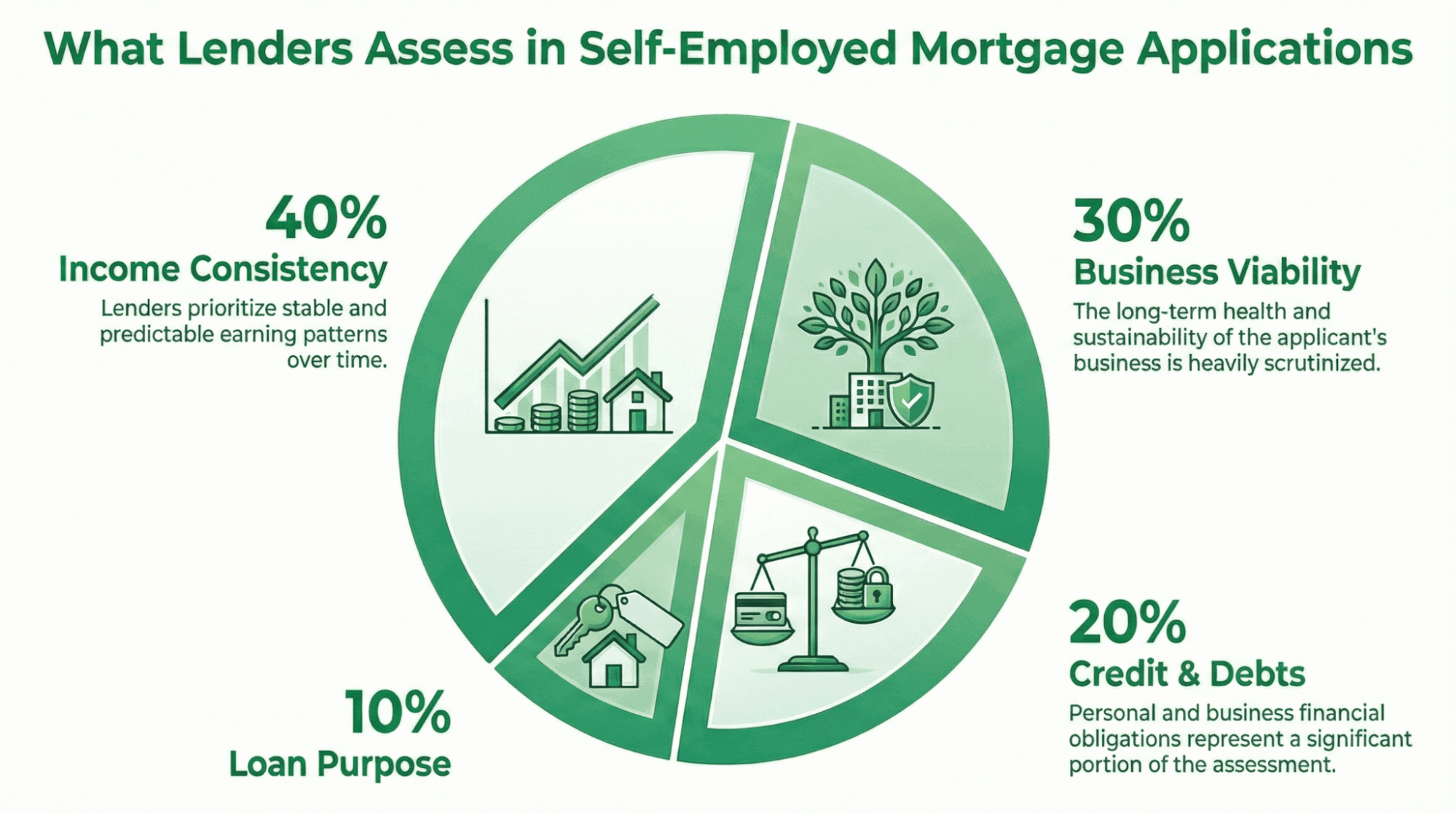
Instead of a simple payslip, lenders want to see:
- That your business is profitable
- That your income is consistent over time
- That your tax obligations are up to date
The better your documentation, the better your chances of approval, and the more competitive your interest rate.
What Makes Self-Employed Mortgage Applications Different?
When you're self-employed, applying for a home loan isn't just about your credit score or savings; it's about proving that your income is stable, ongoing, and sufficient to meet the lender's criteria. This is where self employed mortgage tax return requirements play a major role.
Unlike PAYG employees who can submit a few recent payslips, self-employed borrowers need to provide tax returns and financial records that reflect the health of their business over time. Lenders assess not just how much you earn, but how consistently you earn it, and how long your business has been operating.
Here's why mortgage applications for self-employed individuals are more complex:
- Irregular income: Business income can fluctuate month to month.
- Business expenses: Lenders evaluate net income (after expenses), not gross revenue.
- Tax minimisation strategies: While helpful at tax time, these can reduce your assessable income in the eyes of the bank.
- Different structures: Sole traders, partnerships, trusts, and company directors all require different documentation.
The result? You'll need to be more prepared. especially when it comes to lodging your tax returns, collecting your financials, and working with a broker who understands what lenders want to see.
Tax Return Requirements for Self-Employed Mortgage Applicants
When it comes to getting approved for a home loan, self-employed borrowers need to go beyond basic payslips and employment letters. Lenders want a clear, accurate picture of your income and the best way to show that is through your tax returns and supporting financial documents.
Below is a breakdown of the standard self-employed mortgage tax return requirements in Australia:
1. Personal Tax Returns (Last 2 Years)
Your personal income tax returns, typically from the past two financial years are essential. These show the income you've personally declared to the ATO and are used by lenders to assess your borrowing capacity.
Make sure:
- Returns are lodged and up to date
- The income shown is consistent over time
- You also include the Notice of Assessment from the ATO
2. Business Tax Returns (Last 2 Years)
If you operate as a sole trader, partnership, or through a company or trust, lenders will also require your full business tax returns for the same period.
These typically include:
- Profit and Loss Statements
- Balance Sheets
- Depreciation Schedules (if applicable)
These documents help lenders calculate your net profit and determine your true income after expenses. Some lenders may “add back” certain non-cash expenses (like depreciation) or one-off costs to increase your usable income.
3. Notice of Assessment (NOA) from the ATO
The Notice of Assessment confirms that the ATO has processed your tax return. It shows:
- Your taxable income
- Any tax owing or refunds
- Whether you have any outstanding tax debt (which can be a red flag)
Many lenders require the NOA to cross-check your declared income against your tax return and ensure you're in good standing with the ATO.
4. Business Activity Statements (BAS)
In cases where your most recent tax return is more than six months old, some lenders may request 12 months of BAS statements to assess your current trading position. These can give lenders a more recent view of:
- Your sales volume
- GST turnover
- Ongoing cash flow
This is particularly useful if your income has grown significantly since your last tax return was lodged.
5. Financial Statements (Prepared by an Accountant)
For borrowers running a company, trust, or more complex structure, you may also need to supply formal financial reports:
- Year-End Financial Statements
- Interim Financials (if recent tax returns are unavailable)
Lenders want to see these documents prepared and verified by a registered accountant, as they provide a professional overview of your business performance.
Having all these documents ready and accurately reflecting your business income is key to a smooth, successful mortgage application. At Stryve Finance, we help you prepare everything in a lender-friendly format to avoid delays or rejections.
Common Mistakes That Lead to Mortgage Rejection
Even successful, high-earning business owners can get knocked back for a home loan, not because they can't afford it, but because of avoidable documentation errors. Understanding and meeting the self-employed mortgage tax return requirements is only part of the picture. How your finances are structured and presented can make or break your application.
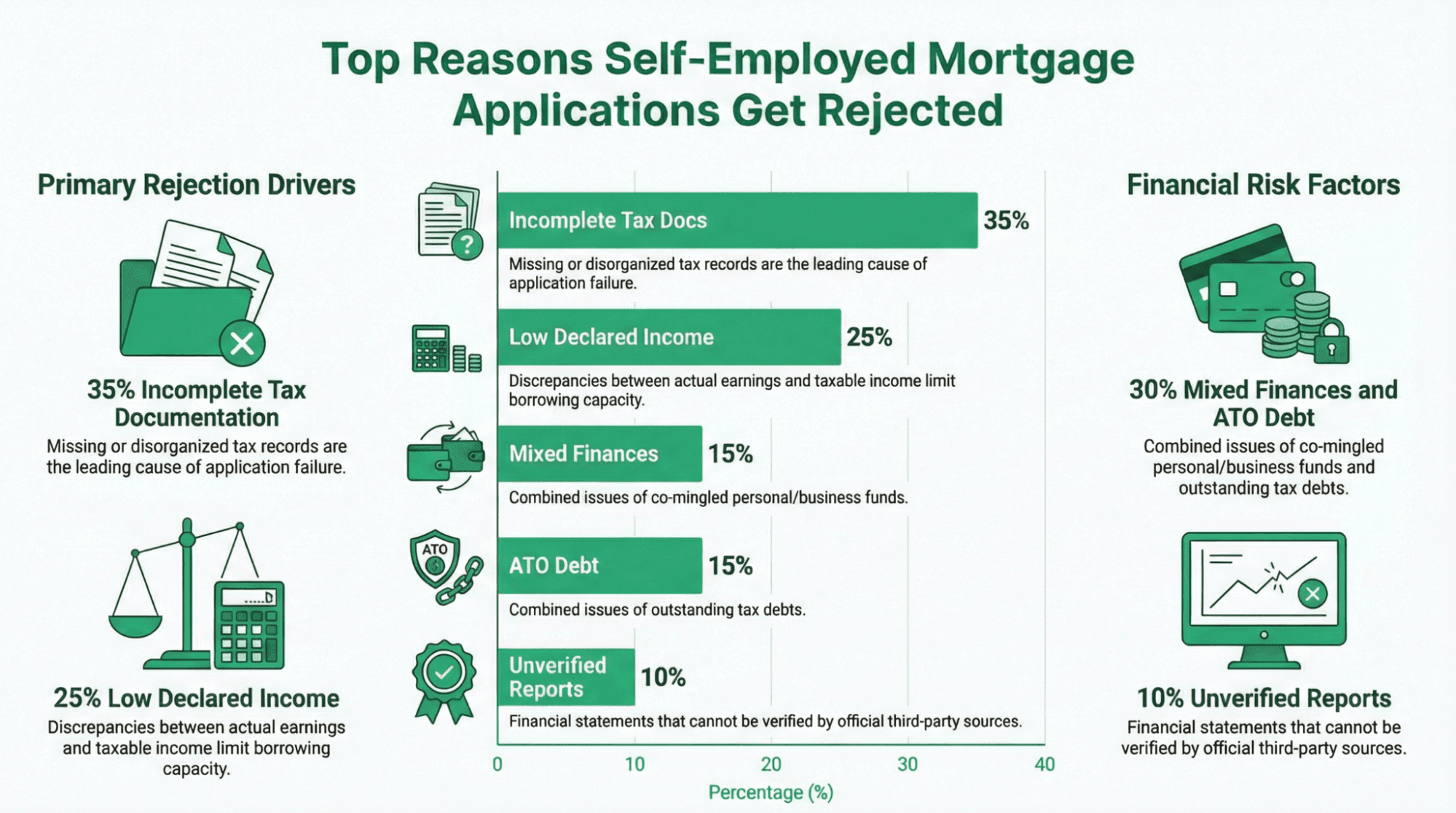
Here are the most common reasons self-employed mortgage applications are declined:
1. Incomplete or Outdated Tax Returns: Lenders usually need two years of recent, fully lodged tax returns. If you've fallen behind on lodging or only have draft copies, it could delay or derail your approval.
2. Declaring Low Income to Minimise Tax: We get it, minimising taxable income is smart business. But if your declared net profit is low, lenders will assume you can't afford the loan. You may need to strike a balance between tax efficiency and borrowing power.
3. Mixing Business and Personal Finances: Blurred lines between your personal and business accounts can make your financial picture harder to verify. Lenders want clear, separate records for income, expenses, and liabilities.
4. Outstanding ATO Debt: Unpaid tax debt (or even an ATO payment plan) can be a red flag to lenders. It suggests potential cash flow issues or financial mismanagement, even if your business is thriving.
5. Lack of Professional Financial Statements: Handwritten spreadsheets or DIY reports don't carry much weight. Lenders want accountant-prepared documents that align with your tax returns and ATO assessments.
At Stryve Finance, we help you get ahead of these issues with a full pre-application review, so your submission is clean, credible, and ready for lender scrutiny.
Frequently Asked Questions (FAQs)
Q: Can I get a mortgage with only 1 year of tax returns?
A: Yes, some lenders in Australia will accept just one year of tax returns for self-employed applicants, particularly if you've been in the same industry longer or can support your income with BAS or bank statements. However, your lender options will be more limited, and your application will need to be strong in other areas, such as your credit score and deposit size.
Q: What income do banks actually assess from my business?
A: Lenders look at your net profit after expenses, not your gross income. In some cases, they may add back certain non-cash or one-off expenses (like depreciation) to improve your assessable income. This is why understanding how your tax returns are interpreted is crucial.
Q: Can I use my accountant's letter instead of tax returns?
A: For low doc loans, yes, an accountant's declaration is often accepted as one of the alternative documents. But for traditional loans, lenders will still require full tax returns and Notices of Assessment to verify your income.
Q: What if I've only just registered my ABN?
A: Most lenders require at least 12-24 months of self-employment history under your ABN. However, some niche lenders may consider new ABNs, especially if you have prior experience in the same field or can provide strong alternative documentation, such as BAS or bank statements.
Q: Can I include income from more than one business?
A: Absolutely, but you'll need to provide separate tax returns and financials for each business. Lenders will assess the viability of each income stream individually and collectively.
Final Thoughts: Be Prepared, Not Surprised
Getting a mortgage when you're self-employed doesn't have to be painful. The key is knowing what documents you need and working with a broker who understands your situation.
While the rejection rate for self-employed mortgage applicants is higher than for PAYG borrowers, working with a broker who understands the documentation and lender expectations can drastically improve your chances of success.
At Stryve Finance, we don't just process loans, we build strategies. We're here to guide you every step of the way, from documentation to settlement.
Ready to see how much you could borrow?

Dylan Bertovic is the Director and Senior Finance Broker at Stryve Finance, specialising in non-traditional lending solutions. He helps clients across Australia with tiny home loans, construction finance, equipment and asset lending, refinancing, and investor loans. With deep expertise in self-employed and renovation mortgages, Dylan is known for crafting tailored strategies that get results