Three business owners with identical bank balances can get three different answers from the same lender. It comes down to structure. A sole trader home loan is generally assessed on net profit from your individual tax return. A company director is assessed on their director salary, plus possibly a share of retained company profit and certain add-backs. A trust beneficiary is assessed on distributions received, and sometimes on retained trust income. Each one carries a different documentation burden.
Here is the part most people miss: the structure that suits your tax position is not always the structure that suits your borrowing position. Your accountant is optimising for tax. Lenders are reading the same returns looking for stable, provable income.
This guide covers the three structures one by one, a side by side comparison table, the rules that apply to every self-employed applicant, and the mistakes that quietly sink files.
One caveat throughout. Policy varies by lender. Two applicants with identical numbers can get different answers depending on whose credit policy the file lands in front of, and access to 50+ lenders is how those differences get matched to the borrower.
New to this? Start with our guide to self-employed home loans for the full picture.
Sole traders, where net profit is the number that counts
Lenders assess a sole trader home loan on net profit after expenses, the figure at the bottom of the business schedule in your individual tax return, not on turnover. Two years of returns with matching Notices of Assessment usually set the income a lender will work from.
Turnover is not income. Lenders assess your net profit after expenses, which is the figure at the bottom of the business schedule in your individual tax return. A sole trader turning over $400,000 with $340,000 of expenses presents as a $60,000 income earner. That is the number serviceability is built on.
It is worth seeing that gap laid out. The distance between what a business turns over and what a lender can actually use is the single most misunderstood number in a self-employed application.
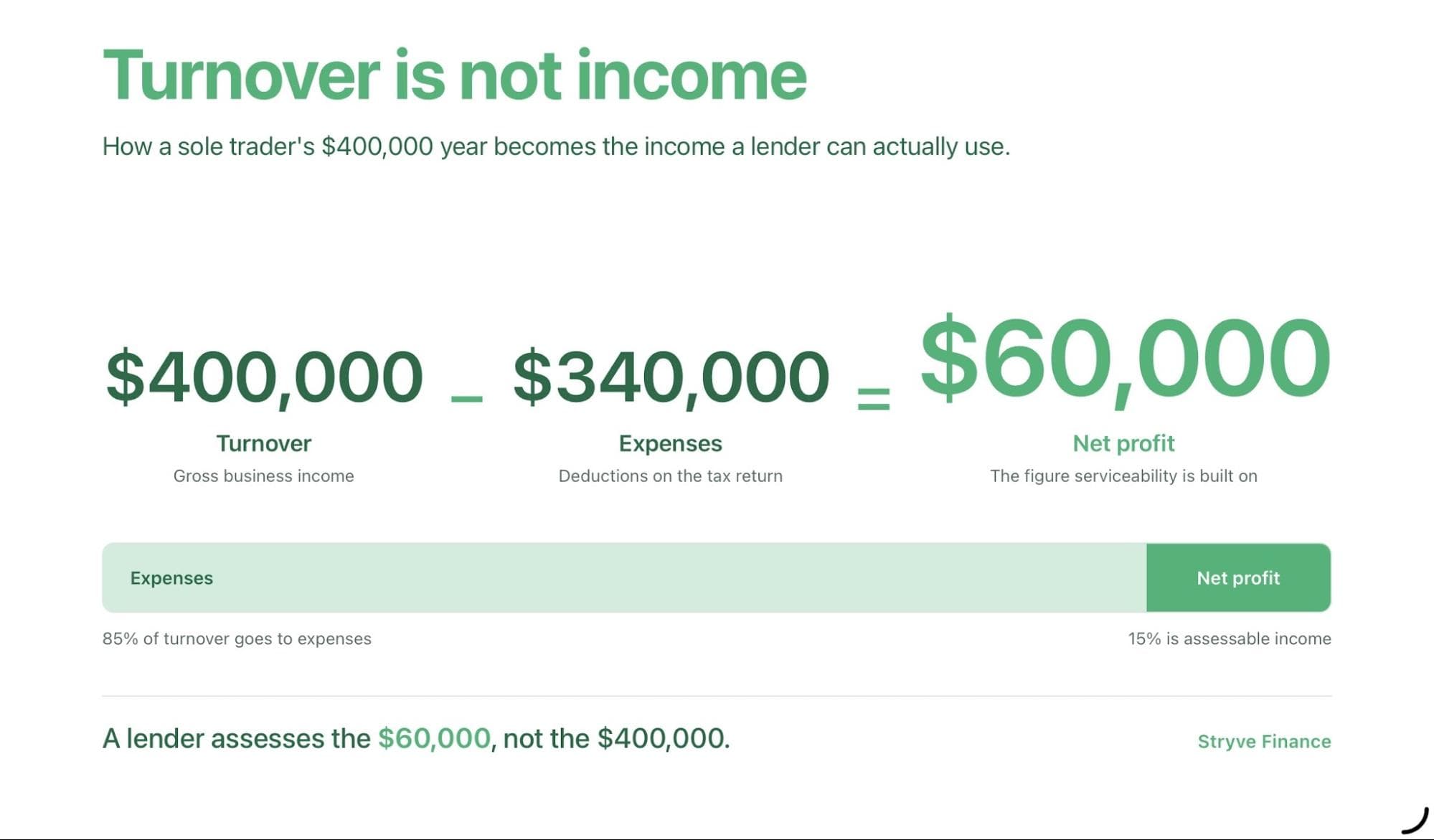
That thin final slice is what a lender works with. Borrowing capacity, serviceability and the loan a sole trader qualifies for are all built on the net profit at the bottom of the return, not the turnover at the top. It is why how that return is prepared matters as much as what the business earns
The ATO treats you and the business as the same taxpayer, so there is no separate business return to hide behind.
What you will be asked for (ordered by how long each takes to obtain):
- Two years of individual tax returns including the business schedule
- Matching ATO Notices of Assessment
- Recent BAS lodgements, often the last four quarters
- ABN registration history and GST registration history
Most major lenders look for around two years of active ABN and GST registration for full-doc assessment, though some accept a shorter history under alternative-doc policies.
Here is the trade-off nobody explains until it is too late. Aggressive deductions lower your tax bill and lower the income a lender can use. Some non-cash items, depreciation being the obvious one, may be added back depending on the lender. Others, like that vehicle you genuinely needed, simply reduce your assessable income.
What trips sole traders up:
- A large equipment write-off in the most recent financial year, gutting the profit figure a lender wants to average
- Income that dropped year on year, which often pushes the lender to use the lower of the two
- An ABN that has not been active long enough for full-doc policy
The fix is lead time. If you are eyeing the property market in eighteen months, talk to your accountant now about deduction timing. Keep your BAS and your tax returns telling the same story. A gap between them invites questions you would rather not answer mid-application.
Company directors, salary plus retained profits and add-backs
A company director home loan has two income layers, and lenders treat them very differently.
Layer one is the salary or wage the company pays you personally. That shows on your individual return and your Notice of Assessment. Easy to verify, universally accepted.
Layer two is the company's net profit. Some lenders will use a percentage of it matching your shareholding. Others will only count what has actually been paid out to you as salary or dividends. If you and your accountant have been parking profit in the company at the company tax rate, that decision is efficient for tax and awkward for borrowing.
Add-backs sit on top. Depreciation, one-off expenses and certain non-cash deductions can be added back to net profit to lift assessable income, though what is accepted differs from lender to lender. Getting a home loan through a company structure often comes down to which lender's add-back list is most generous with your particular financials.
Documents to have ready:
- Personal tax returns and Notices of Assessment, two years
- Company tax returns and full financial statements, two years
- ACN and ASIC registration history
- An explanation of the director's loan account if one exists
That last point catches people out. If you have drawn money from the company and it sits as a loan on the balance sheet, some lenders treat it as a personal liability. It reduces your borrowing capacity even though it never felt like a debt.
Minority shareholding is the other common blocker. Hold 25% of a profitable company and many lenders will only count your salary and dividends, not a slice of retained earnings. If you are planning a business owner home loan application, that conversation with your accountant about how profit is drawn should happen a full financial year ahead.
Trusts, distributions and the trust deed
A trust generally does not pay income tax in its own right. Beneficiaries are taxed on what is distributed to them. The ATO sets out that flow, and it explains why a trust home loan Australia application starts with one question: what was actually distributed to you?
Distributions that appear on your personal return with a matching Notice of Assessment are the cleanest evidence you can offer.
Retained trust income is where lenders diverge. Where the applicant clearly controls the trust as trustee or appointor, some lenders will consider undistributed profit. Others count only what was received.
One more distinction worth drawing early. The entity that borrows and the income that is assessed are separate questions. You may be able to buy in your trust or company name rather than your personal name, but the lender still assesses the underlying income exactly as set out above, and directors or beneficiaries are usually asked to provide personal guarantees for the loan.
The documentation load is heavier here:
- Trust tax returns and financial statements, two years
- Distribution statements showing who received what
- Personal tax returns and Notices of Assessment
- The trust deed itself, so the lender can identify trustee, appointor and beneficiaries
If you have a corporate trustee, add a company layer on top. That usually means another set of financials and ACN details.
What trips trust applicants up:
- Distributions split across a spouse, adult children or a bucket company, leaving the applicant with a modest personal figure
- Distributions that swing hard year to year, making averaging difficult
- A trust deed nobody can locate quickly
Ring your accountant for the deed before you start looking at properties, not after you have signed a contract. Then be ready to explain your distribution pattern in one or two sentences. Lenders are not suspicious of family trusts. They just need the numbers to make sense.
Sole trader vs company vs trust at a glance
| Structure | Income the lender assesses | Documents usually required | Most common obstacle |
|---|---|---|---|
| Sole trader | Net profit after expenses from the business schedule | Individual tax returns, Notices of Assessment, ABN and GST history, recent BAS | Deductions that legitimately reduce assessable income |
| Company | Director salary, plus possible share of net profit and add-backs | Personal and company tax returns, company financials, ACN and ASIC history | Retained profits some lenders will not use, and director's loan accounts |
| Trust | Distributions received, plus possible retained profit | Trust returns and financials, distribution statements, trust deed, personal returns | Split distributions and a deed the applicant cannot produce |
Trading history expectations sit around two years for most full-doc assessment, though alternative-doc policies exist and requirements vary by lender.
No structure is automatically better for borrowing. The numbers on the page and the lender's policy decide the outcome.
What applies no matter how your business is structured
Some mechanics are common across every self-employed home loan file.
- Trading history: Most lenders want a consistent run of self-employment, usually measured in years of active ABN registration and lodged financials. Around two years is the common benchmark for full-doc assessment, with the exact requirement varying by lender.
- The accountant's letter: It can confirm income, verify lodgement status and explain a one-off event. It cannot substitute for lodged returns on a full-doc application. Its real weight sits in alternative-doc and low doc territory.
- How do lenders assess self-employed income across two years? Commonly by averaging the two figures. Where the most recent year is significantly stronger, many lenders will still average, or use the lower figure, on the view that one strong year is not yet a trend. Where the recent year is weaker, expect the lower number to be used and expect to explain why it fell.
- Where a low doc home loan fits: If you do not have two full years of financials, some lenders accept alternative evidence: BAS lodgements, business bank statements or an accountant's declaration. These loans generally carry different pricing and tighter conditions on LVR (loan-to-value ratio), the percentage of the property value you are borrowing. A lower deposit typically also means LMI (Lenders Mortgage Insurance), a one-off premium that protects the lender, not you.
Averaging, add-backs and using the lower of two years are common practice, not universal policy. Knowing which lenders lean which way across 50+ options is most of the work.
Where self-employed applications usually come unstuck
Applying straight after a structure change. Move from sole trader to company or trust and some lenders effectively restart the clock on your trading history. The business is the same. The ABN and ACN history is not. Where the underlying business is unchanged, a minority of lenders publish a continuity rule that keeps your original start date rather than resetting it. Many others simply require two years of trading and never spell out what happens mid-restructure, which leaves the decision to the underwriter case by case. That makes it a placement question more than an eligibility one, and it is exactly where lender choice earns its keep.
Figures that do not match. If your BAS says one thing and your tax return says another, expect questions. Unexplained gaps are one of the fastest routes to a decline. Reconcile them before the file goes anywhere.
Lodging late. If your most recent financial year is not lodged, the lender works from older figures, which is a problem when your latest year is your best one. Check your position against the ATO lodgement dates and give your accountant a deadline.
Two more. Cash income you have not declared cannot be counted, no matter how real it is. And personal expenses run through the business will be treated as business expenses, reducing the profit a lender can use.
Every one of these is fixable with lead time. None of them is fatal. They are just expensive when discovered at the wrong moment.
Not sure whether your company structure is helping or hurting your borrowing power? Have a chat with Stryve Finance who reads business financials every day and works across 50+ lenders. No hidden fees, and you will know where you stand before an application is lodged.
Working out which structure story your lender will believe
If you are a sole trader, start with net profit and the timing of your deductions. If you are a director, look at how profit is drawn rather than how much profit exists. If you borrow through a trust, start with the distribution pattern and find the deed.
Your structure changes the paperwork and it changes the assessment. It does not change what your business actually earns or what you can genuinely afford.
Trading through a company or trust? See how business owner home loans are structured and what documents to gather first.
Frequently Asked Questions
Can I get a home loan as a sole trader with only one year of tax returns?
Sometimes, depending on the lender. Most require around two years of returns and ABN registration for full-doc assessment, but some accept one year under alternative-doc or fast-track policies, often with additional conditions. Your BAS history and industry experience usually matter in those assessments.
Do lenders use my company profit or just my director salary?
It varies by lender. All will use your director salary and dividends. Some will add a share of company net profit matching your shareholding, particularly where you hold a controlling interest. Others count only what has actually been paid out to you personally.
How do lenders assess self-employed income across two financial years?
Most average the two years shown on your tax returns and Notices of Assessment. Where the most recent year is lower, many lenders use that lower figure instead. Add-backs such as depreciation may lift the assessable total, though acceptance differs by lender.
What documents do lenders want for a trust home loan in Australia?
Typically the trust deed, two years of trust tax returns and financial statements, distribution statements, plus your personal tax returns and Notices of Assessment. A corporate trustee usually adds company financials and ACN details. Request the deed from your accountant early, as it is the most commonly delayed document.
Is it harder to get a home loan as a sole trader or through a company?
Neither structure is automatically harder. Lenders assess a sole trader on net profit and a director on salary plus a possible share of company profit, so the easier path depends on how your income sits on paper. A well-documented sole trader can present more simply than a director parking profit in the company.
The information in this article is general in nature and does not take into account your objectives, financial situation or needs. It does not constitute credit, tax or legal advice. Consider whether it is appropriate for your circumstances and seek advice from a qualified professional before acting on it. Lending criteria, fees and policies vary between lenders and are subject to change.

Dylan Bertovic is the Director and Senior Finance Broker at Stryve Finance, specialising in non-traditional lending solutions. He helps clients across Australia with tiny home loans, construction finance, equipment and asset lending, refinancing, and investor loans. With deep expertise in self-employed and renovation mortgages, Dylan is known for crafting tailored strategies that get results