If you have been saving for a deposit and just discovered that Lenders Mortgage Insurance (LMI) could add tens of thousands of dollars to your purchase, you are not imagining things. It is one of the most frustrating costs facing first-home buyers in Australia.
This guide, prepared by the team at Stryve Finance, breaks down exactly what LMI costs at every deposit level, then maps out when to use government schemes to avoid it and when paying LMI might actually be the smarter move.
What is LMI, and why do first-home buyers cop it?
Lenders Mortgage Insurance (LMI) is an insurance policy that protects your lender, not you, if you default on your home loan. It is triggered when your deposit is below 20% of the property's value, and the cost falls entirely on the borrower, even though the lender is the sole beneficiary.
Here is how it works. When you borrow more than 80% of a property's value, lenders consider the loan a higher risk. That ratio is called the loan-to-value ratio (LVR). According to the Australian Prudential Regulation Authority (APRA), roughly 40% of new home loans written each year have an LVR above 80%, meaning the majority of first home buyers enter the market with a deposit below 20% and therefore face LMI.
The problem for most first home buyers is clear. Saving a 20% deposit on a $750,000 property means putting aside $150,000. According to CoreLogic's 2024 Housing Affordability Report, the average time to save a 20% deposit in Sydney now exceeds 11 years, and in Melbourne it exceeds 9 years, during which prices continue to climb. It is no surprise that over 60% of first home buyers in Australia enter the market with less than a 20% deposit, according to APRA data.
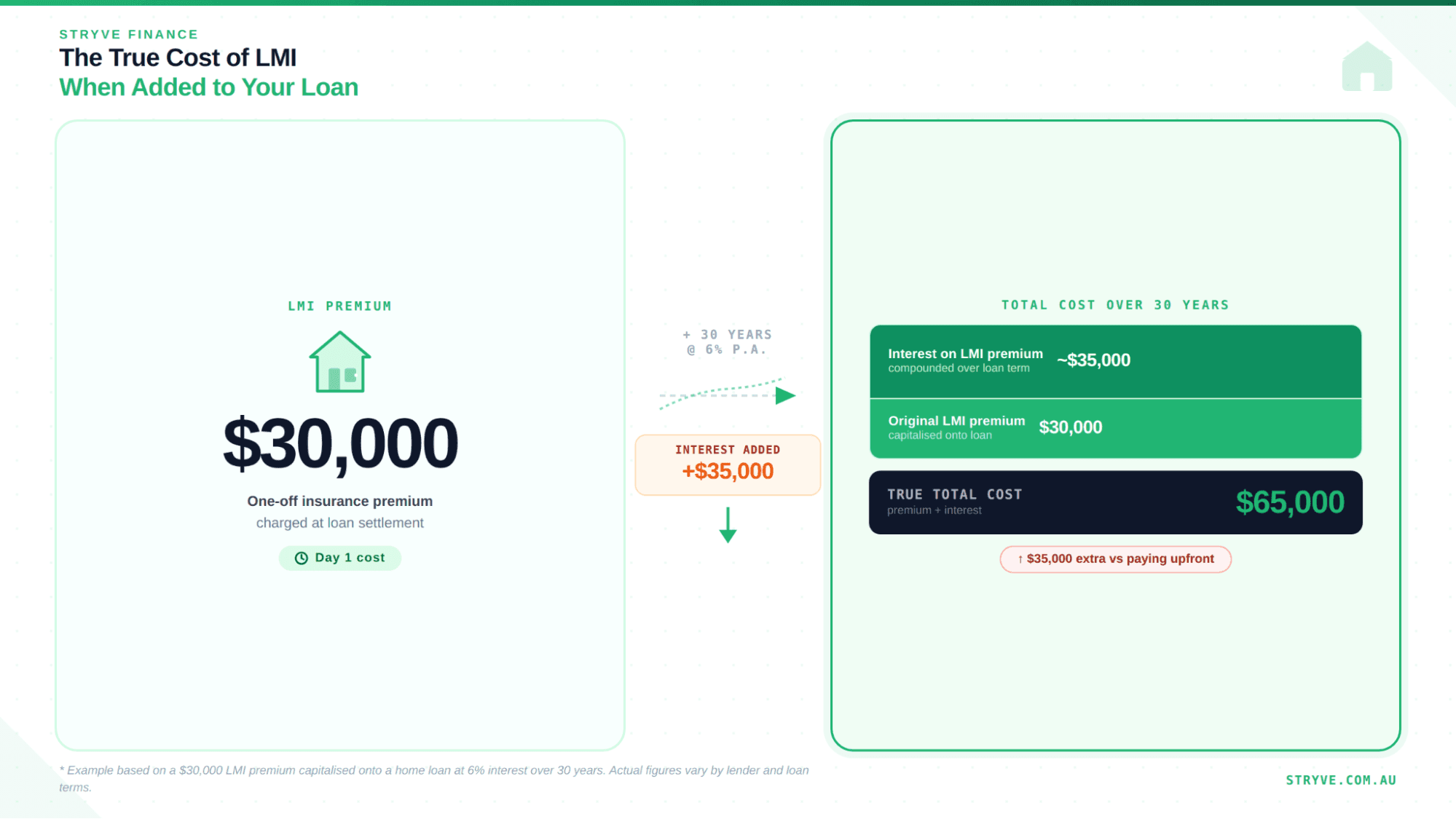
What stings most is the compounding effect. LMI is typically a one-off premium, but it is almost always capitalised onto your loan. That means you pay interest on the LMI premium itself over the full 25 to 30-year loan term. A $30,000 LMI cost does not just cost you $30,000. At a 6% interest rate over 30 years, that capitalised premium costs you approximately $65,000 in total, the original premium plus around $35,000 in compounded interest charges.
One practical note: some lenders offer a partial LMI refund if you refinance or pay off the loan within the first two to three years, so it is worth checking your lender's refund policy before committing.
How much does LMI actually cost at different deposit levels?
The single biggest factor driving your LMI cost is how much deposit you bring to the table. A larger deposit means a lower LVR, which means a dramatically lower premium.
LMI costs vary by lender, loan size and LVR tier. The figures below are indicative ranges to give you a realistic ballpark. Your actual premium may differ, but these numbers reflect what lenders' mortgage insurance costs for first-home buyers typically look like across the market.
| Deposit | LVR | $600k Property | $750k Property | $900k Property |
|---|---|---|---|---|
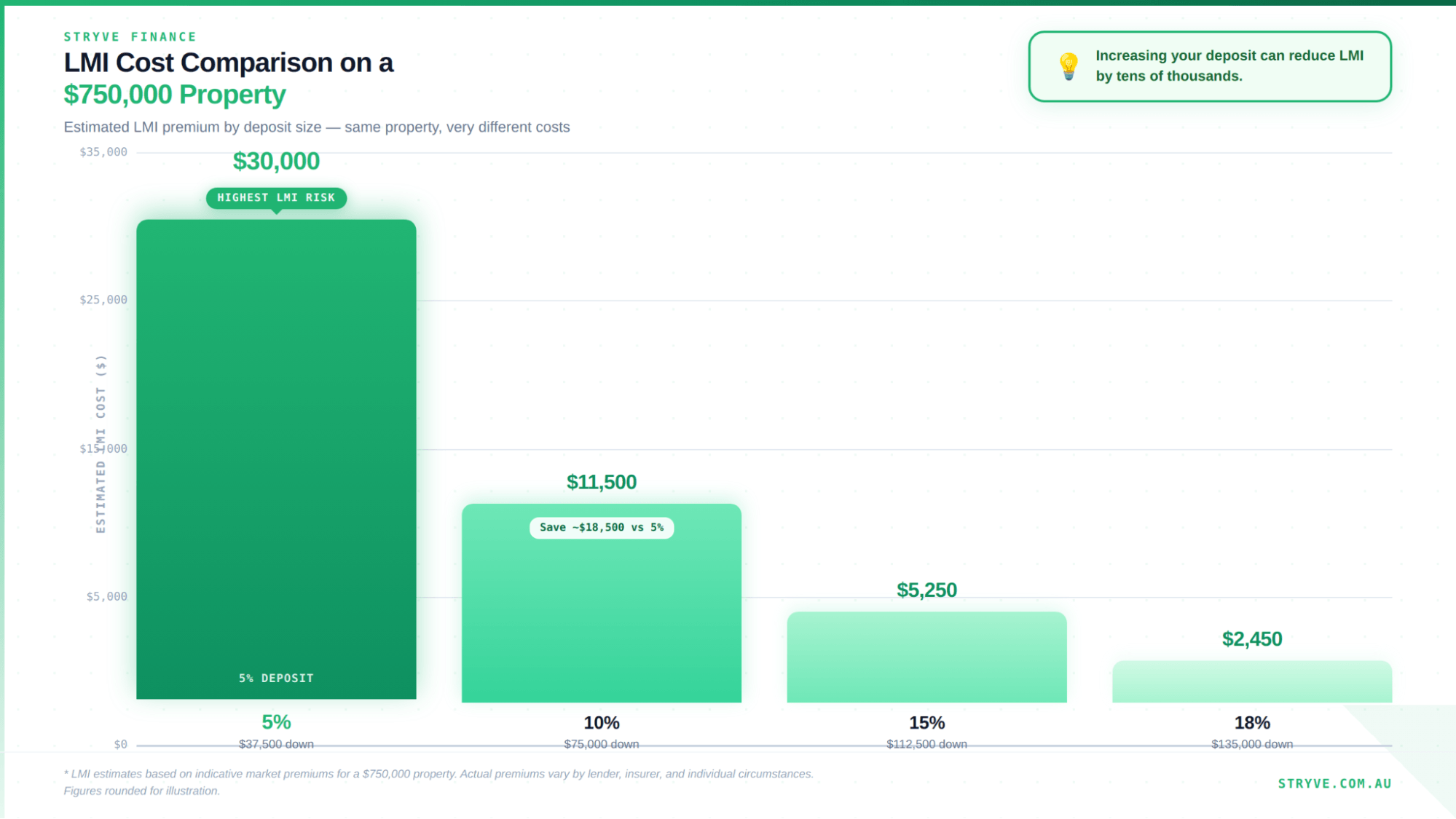
| 5% ($30k - $45k) | 95% | $20,000 - $28,000 | $25,000 - $35,000 | $30,000 - $42,000 |
| 10% ($60k - $90k) | 90% | $6,500 - $12,000 | $8,000 - $15,000 | $9,500 - $18,000 |
| 15% ($90k - $135k) | 85% | $2,800 - $5,600 | $3,500 - $7,000 | $4,200 - $8,400 |
| 18% ($108k - $162k) | 82% | $1,500 - $2,400 | $1,900 - $3,000 | $2,300 - $3,600 |
Look at the difference between a 5% and 10% deposit on a $750,000 property. You could save $17,000 to $20,000 by increasing your deposit from 5% to 10%.
Now factor in capitalisation. If you add a $30,000 LMI premium to a loan at 6% interest over 30 years, you will pay roughly $35,000 in additional interest on top of the premium itself. The true cost of that LMI is closer to $65,000.
This is exactly why it is worth taking the time to work out how much deposit you actually need before you start looking at properties. Even a small increase in your deposit can shift you into a lower LVR tier and slash your LMI by thousands. Stryve Finance recommends working through this calculation before you begin inspections, it frequently changes which properties are within reach.
The good news is that for many first home buyers, there are ways to skip LMI altogether.
LMI vs no LMI: total cost over 30 years
This is the comparison most buyers search for: is LMI worth it, or should I find a way around it? The numbers below assume a $750,000 property, a 5% deposit of $37,500, and a 6% interest rate over 30 years, a realistic scenario for many first-home buyers today.
Scenario A: Paying LMI (no scheme, 5% deposit)
Loan amount: $712,500. LMI premium at 95% LVR: approximately $30,000. Capitalised loan balance (LMI added): $742,500. Total repayments over 30 years at 6%: approximately $1,609,000. That total includes roughly $896,000 in interest, of which around $35,000 is interest on the LMI premium alone.
Scenario B: Using the First Home Guarantee (no LMI, 5% deposit)
Loan amount: $712,500. LMI premium: $0. Total repayments over 30 years at 6%: approximately $1,544,000. The difference between Scenario A and Scenario B is approximately $65,000, paid for the same property, at the same interest rate, with the same deposit. That $65,000 is entirely a product of LMI and the interest it accrues when capitalised.
The Stryve Finance team runs this comparison for every first-home buyer client before recommending a path forward. The right choice depends on your property price, location, and eligibility, but these numbers illustrate why skipping LMI through a government scheme is worth exploring first.
Work out your ideal deposit strategy before you start house hunting.
How to avoid LMI entirely using the First Home Guarantee
The First Home Guarantee offers no LMI for eligible first home buyers, making it the most direct path to purchasing without paying a premium.
It works by having the Australian Government guarantee up to 15% of your home loan. You bring a 5% deposit; the government covers the gap to 20%, and your lender treats the loan as if you had a full 20% deposit. No LMI required.
The Guarantee effectively acts as an LMI waiver for first-home buyers who meet the eligibility criteria. Stryve Finance brokers work exclusively with participating lenders approved under the scheme, so you can access this benefit without any additional complexity.
For single parents or single legal guardians, the minimum deposit drops to just 2% under the Family Home Guarantee stream.
From 1 October 2025, the scheme will undergo significant changes. There are now unlimited places with no income caps and no waitlists. Previously, the scheme was capped at 35,000 places per year, and many buyers missed out. That bottleneck is gone. Property price caps have also been increased in line with average house prices, opening the door to more properties in more locations.
Here is what that looks like in practice. Say you are buying a $750,000 property with a 5% deposit of $37,500. Without the Guarantee, your LVR would be 95%, and you would face LMI of roughly $25,000 to $35,000. With the Guarantee, you pay zero LMI. That is $25,000 to $35,000 you keep in your pocket or put toward other purchase costs.
You still pay interest on the full loan amount and need to meet the participating lender's serviceability requirements. But the LMI saving alone can be the difference between buying now and waiting another two to three years.
If you qualify, you can buy with just a 5% deposit and no LMI. See how to buy with a 5% deposit and skip LMI entirely.
The Help to Buy Scheme: Another way to skip LMI
The Help to Buy scheme takes a different approach. Instead of guaranteeing your loan, the government becomes a co-owner of your property by contributing an equity stake. That reduces the amount you need to borrow, which drops your LVR below the LMI threshold.
The equity contribution is up to 40% for new builds and up to 30% for existing homes. The scheme assists40,000 households and is open in participating states from 5 December 2025.
Because the government holds equity in your property, your loan is smaller from day one. A smaller loan means a lower LVR, which means no LMI and lower repayments.
The trade-off is straightforward. You own less of your home upfront. When you sell, or when you are in a financial position to do so, you repay the government's share at the current market value. If your property has grown in value, the government's share has grown too. If it has fallen, their share falls proportionally.
This makes Help to Buy a strong option for buyers who want lower repayments and can accept shared equity as the cost of entry. It is not for everyone, but for the right buyer, it removes both LMI and a significant chunk of monthly repayment pressure.
To see if Help to Buy works for your situation, check the eligibility criteria and participating states before you apply.
Find out if Help to Buy could work for you. Get a personalised equity assessment from Stryve Finance.
Paying LMI vs using a scheme: which path is right for you?
Neither path is universally better. The right choice depends on what you are buying, where you are buying, and how quickly you need to move.
| Factor | Pay LMI | First Home Guarantee | Help to Buy |
|---|---|---|---|
| Minimum deposit | 5% (with LMI) | 5% (2% single parents) | 2% minimum contribution |
| LMI cost | $3,000 - $42,000+ | $0 | $0 |
| Property price limits | None | Price caps vary by location | Price caps apply |
| Lender choice | Any lender | Participating lenders only | Participating lenders only |
| Equity ownership | 100% yours | 100% yours | Shared with the government |
| Speed to purchase | Immediate | Unlimited places from Oct 2025 | 40,000 places from Dec 2025 |
| Investment properties | Yes | No, owner-occupied only | No, owner-occupied only |
If you're unsure which option fits your situation, this quick decision flowchart helps you see when a government scheme can remove LMI and when paying it may still be the better path.
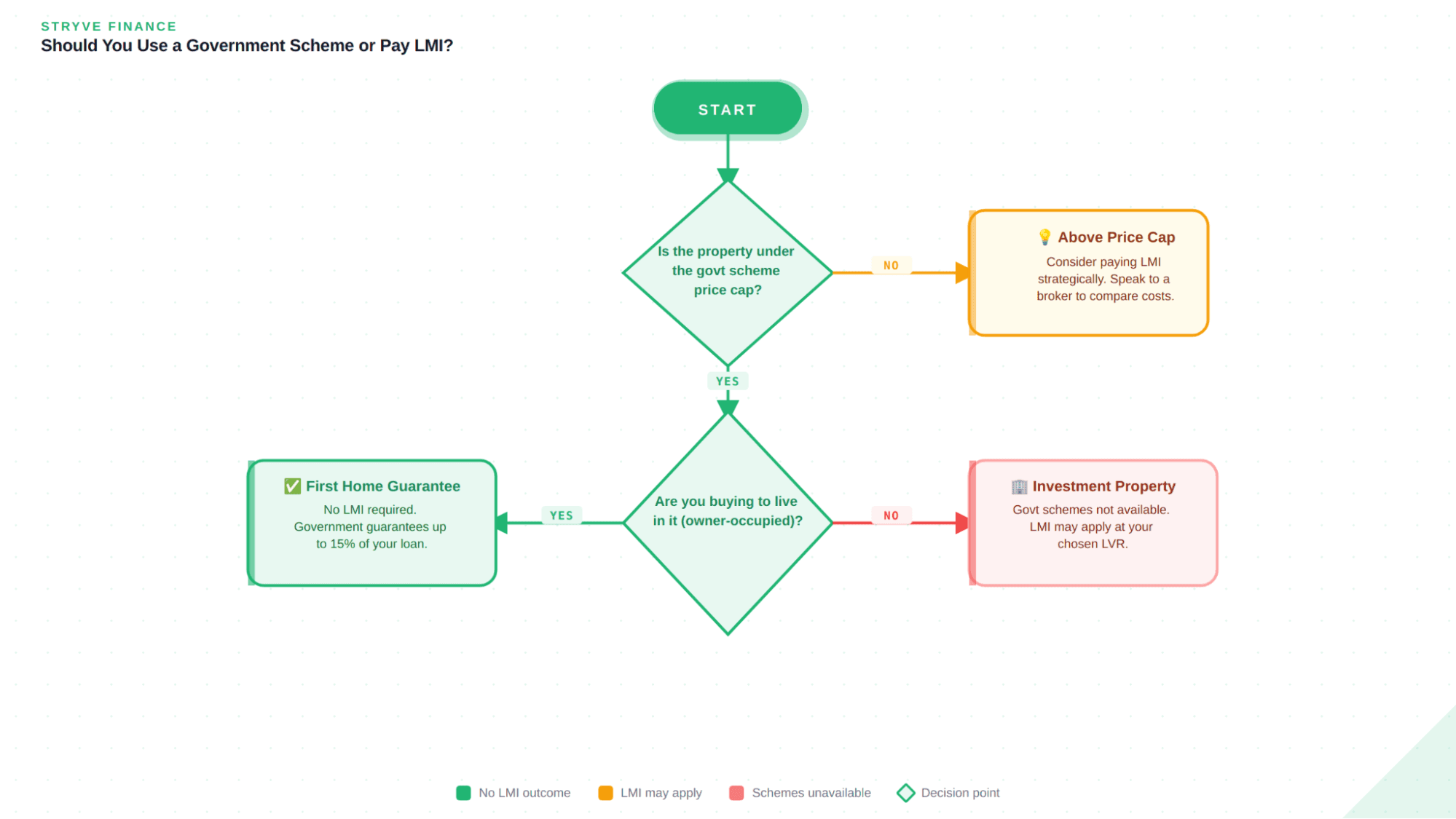
When paying LMI makes sense.
If you are buying above the property price caps in your area, the Guarantee will not cover you. In Sydney, the 2025 First Home Guarantee cap is $900,000; in Melbourne, it is $800,000. A buyer targeting a $950,000 property in Sydney has no choice but to pay LMI or save a larger deposit.
LMI also gives you access to any lender on the market, not just participating ones. With access to 50+ lenders, Stryve Finance can often find a rate competitive enough to offset part of the LMI cost. And if you are buying an investment property, government schemes simply do not apply.
Buyer A: Using the First Home Guarantee.
Sarah is buying a $700,000 apartment in Brisbane with a 5% deposit of $35,000. Under the Guarantee, she avoids roughly $28,000 in LMI. She keeps full ownership of her property, and her repayments reflect the full loan amount minus her deposit.
Buyer B: Paying LMI strategically.
James is buying a $950,000 house in a high-growth corridor of Sydney that exceeds the Guarantee's price cap. He puts down 10% ($95,000) and pays approximately $12,000 in LMI. He accepts that cost because Sydney's median house price rose approximately 7.5% in the 12 months to December 2024, according to CoreLogic data, on a $950,000 property, that is over $71,000 in value growth in a single year, which dwarfs the $12,000 LMI outlay. He also secures full lender choice, allowing his Stryve Finance broker to find the most competitive rate on the market.
Both buyers made the right call for their circumstances. The key is running the numbers for your specific situation rather than assuming one path fits all. That is exactly the analysis Stryve Finance provides, at no charge, before any client makes a decision.
Don't forget stamp duty concessions that stack with LMI savings
LMI is not the only cost you can reduce. State-based stamp duty concessions for first-home buyers can stack with LMI savings to dramatically reduce your upfront costs.
- NSW: The First Home Buyers Assistance scheme provides a full transfer duty exemption or a reduced rate, depending on your property's value threshold.
- VIC: Full stamp duty exemption for properties up to $600,000 and concessions for properties up to $750,000 under the Victorian first home buyer duty exemption.
- QLD: Full exemption for homes under $500,000 and concessions for homes under $550,000 through the Queensland first home concession.
If you qualify for both the First Home Guarantee (saving $25,000 to $35,000 in LMI) and a full stamp duty exemption, your combined upfront savings can reach $40,000 to $60,000 or more, depending on your state and purchase price. That is a significant amount of money that stays in your pocket rather than being swallowed up by fees.
On top of stamp duty concessions, eligible buyers in many states may also receive the First Home Owner Grant (FHOG) a cash payment of up to $10,000 in NSW and VIC, and up to $30,000 in QLD for new builds (as of 2024-25). The FHOG stacks with both LMI savings through the First Home Guarantee and stamp duty exemptions, meaning some buyers can enter the market with a combination of benefits that substantially reduces total upfront cost.
A Stryve Finance broker can confirm which grants and concessions apply to your specific purchase before you make an offer.
Frequently Asked Questions about LMI
Can you get an LMI refund if you refinance?
In some cases, yes. Most major LMI providers, including Helia (formerly Genworth) and QBE LMI offer a partial refund if you repay or refinance within the first two years of the loan. The refund is typically calculated on a sliding scale and applied to the portion of the policy period that was unused. Not all lenders pass this refund on to borrowers automatically, so it is worth asking your Stryve Finance broker to confirm the policy before you commit to a lender. LMI premiums are not transferable between lenders, so if you refinance to a new lender, even within the refund window, you may need to pay a new premium if your LVR is still above 80%.
Is LMI tax deductible for first home buyers?
For owner-occupied purchases, LMI is generally not tax-deductible. The property is not income-producing, so the premium is treated as a personal expense under Australian tax law. However, if you are purchasing an investment property and the LMI is capitalised onto the loan, the Australian Taxation Office (ATO) has historically allowed the premium to be deducted over a five-year period or the loan term, whichever is shorter. Tax treatment can change, and individual circumstances vary, so Stryve Finance recommends confirming your position with a registered tax agent before lodging your return.
Does LMI protect the borrower in any way?
No. LMI solely protects the lender if you default and the property is sold for less than the outstanding loan balance. It does not reduce your repayments, protect you from interest rate rises, or cover you in case of illness or job loss, those are covered by separate products such as mortgage protection insurance. Many first home buyers confuse the two. If you want cover for your own financial circumstances, speak with a Stryve Finance adviser about protection products that are designed for borrowers, not lenders.
Your LMI Action Plan: What to Do Right Now
You now have the numbers and the framework. Here is how Stryve Finance recommends turning that into a plan.
Step 1: Estimate your LMI cost.
Use the table above to get a ballpark figure based on your deposit and target purchase price. This gives you a baseline to compare against.
Step 2: Check your eligibility for the scheme.
If you are a first-home buyer purchasing an owner-occupied property within the price caps, the First Home Guarantee or Help to Buy could save you tens of thousands. You can explore your 5% deposit options to see what is available for your situation. Self-employed buyers are eligible too, not just PAYG workers.
Step 3: Talk to a Stryve Finance broker who specialises in first home buyers.
Stryve Finance has access to 50+ lenders and can map out the exact cost difference between using a scheme and paying LMI with a lender offering a sharper rate. There are no hidden fees, and lender commission transparency means you see exactly what your broker earns regardless of the path you choose.
This process does not need to be overwhelming. The information exists, the schemes are accessible, and the right advice makes the path forward clear.

Dylan Bertovic is the Director and Senior Finance Broker at Stryve Finance, specialising in non-traditional lending solutions. He helps clients across Australia with tiny home loans, construction finance, equipment and asset lending, refinancing, and investor loans. With deep expertise in self-employed and renovation mortgages, Dylan is known for crafting tailored strategies that get results