
Property has long been a cornerstone of how Australians build wealth, and a growing number are using their superannuation to invest in it. As at June 2025 there were over 650,000 self-managed super funds holding around $1.05 trillion in assets, making up roughly a quarter of Australia's entire super system, and property is a meaningful part of many of those portfolios.
But buying property with super isn't as simple as withdrawing from your super account. It's done through a self-managed super fund (SMSF) and is tightly regulated by the Australian Taxation Office (ATO). This guide explains how it works, the rules you must follow, how SMSF loans are structured, and just as importantly, the costs and risks to weigh before you commit.
This article is general information only and isn't financial, tax, or legal advice. SMSFs are complex; always get advice from a licensed financial adviser, accountant, and SMSF specialist before acting. Stryve Finance arranges SMSF lending and works alongside your professional advisers.
Can You Use Super to Buy an Investment Property?
Yes, but only through an SMSF. You can't buy property directly with a regular industry or retail super fund. An SMSF gives you control over how your retirement savings are invested, including in residential or commercial property, but it comes with strict obligations.
The key conditions:
- You must invest through a compliant SMSF: Your everyday super fund can't be used to buy property directly.
- The property must be purely for investment: It can't be your home or holiday house, and it can't be used by you, your family, or any related party.
- Everything must be at arm's length: From the purchase price to the rent, all transactions must reflect market value and can't involve related parties.
- It must satisfy the Sole Purpose Test: Every dollar in the SMSF must be working towards members' retirement benefits, not personal or short-term gain.
Done right, buying property through super can be a tax-effective, long-term strategy. Done wrong, it can trigger ATO penalties, compliance breaches, or the loss of your fund's concessional tax treatment, which is why professional advice is essential.
Setting Up an SMSF for Property Investment
To buy property with super, you first need an SMSF. Setting one up generally involves:
- Establishing and registering the fund with the ATO (trust deed, trustees, and an ABN/TFN).
- Opening a separate SMSF bank account for contributions and investment transactions, never use a personal account.
- Creating an investment strategy that documents how property fits members' retirement goals.
- Meeting annual audit and compliance obligations every year.
Most people use an accountant or SMSF specialist to set up and administer the fund. SMSFs also carry running costs: ATO data for 2023-24 put the average total operating expense at around $7,400 per fund per year. Because of this, a common rule of thumb is that an SMSF tends to become cost-effective at a balance of around $200,000 or more, below that, fixed costs can eat heavily into returns. Whether an SMSF suits you depends on your balance, goals, and circumstances, which is a conversation for your financial adviser.
You can read more about borrowing within super in our guide to SMSF borrowing strategy.
How to Use Super to Buy Investment Property, Step by Step
Once your SMSF is established and compliant, here's how a property purchase typically runs. Here's exactly how to do it:
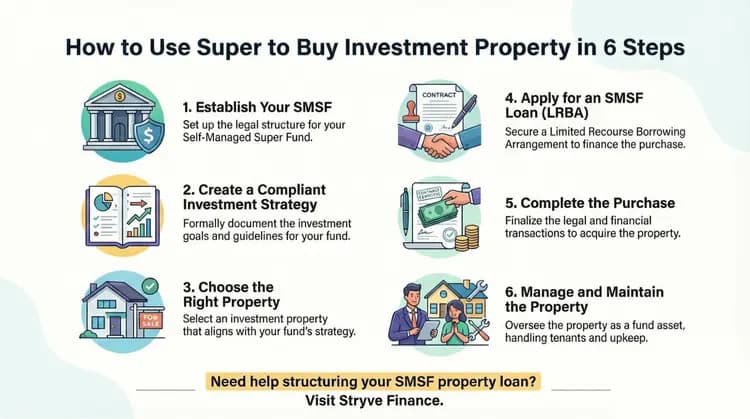
Step 1: Confirm your SMSF is set up correctly
The fund must be registered with the ATO, have a finalised trust deed and appointed trustees, and operate from its own bank account. Keep fund finances completely separate from personal finances, it's mandatory.
Step 2: Document your investment strategy
Your SMSF needs a formal investment strategy showing how a property aligns with members' retirement goals. It should address expected returns (rental yield plus capital growth), liquidity to cover repayments and expenses, diversification, and insurance for members. The ATO can ask for evidence that the property fits the strategy, so this isn't optional.
Step 3: Choose a compliant property
The property must be solely for investment, bought at arm's length (not from or rented to related parties), and consistent with your strategy. Estimating realistic rental yield and understanding the local market matter here. Across the sector, SMSFs hold roughly 5-6% of assets in residential property and around 10% in non-residential (commercial) property.
Step 4: Arrange finance (SMSF loan / LRBA)
If the fund can't buy outright, it can borrow through a Limited Recourse Borrowing Arrangement (LRBA), a loan where the lender's claim is limited to the property being purchased, protecting the fund's other assets. Typical SMSF loan features:
- LVR (loan-to-value ratio) of around 70-80%
- Security limited to the purchased property
- Repayments made from SMSF income (rent plus contributions)
- Funded by major banks and specialist SMSF lenders
This is where Stryve Finance helps: we arrange SMSF loans structured to comply with LRBA rules, working alongside your accountant and adviser.
Step 5: Complete the purchase
The legal title must be held in the SMSF's name (often via a holding/bare trust under an LRBA), not in any member's personal name. All contracts, settlement payments, and loan documents must align with SMSF and LRBA rules, your auditor will review them annually.
Step 6: Manage the investment
After settlement, the SMSF is the owner and landlord. All rental income must go into the SMSF bank account, and all expenses (maintenance, insurance, loan repayments) must be paid from it. Professional property management helps keep everything compliant and cash-flow positive.
Rules and Restrictions You Must Follow
When learning how to use super to buy investment property, it's critical to understand that every step must follow strict Australian Taxation Office (ATO) rules. These regulations exist to ensure that any property purchased through your Self-Managed Super Fund (SMSF) genuinely supports your retirement savings goal, not your personal benefit.
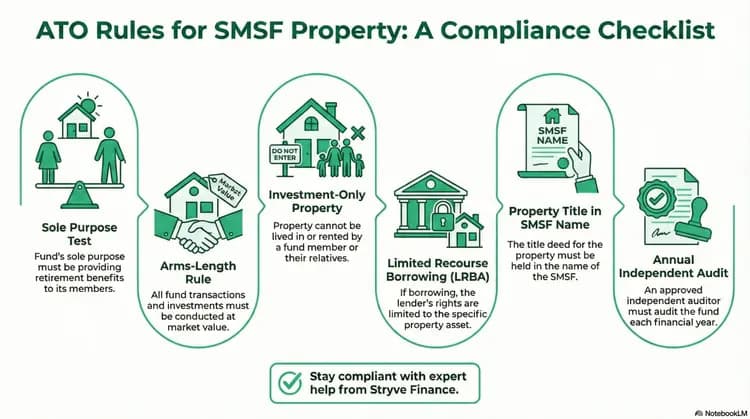
SMSF property is heavily regulated. The key rules:
- Sole Purpose Test: The investment must exist only to provide retirement benefits. You can't live in the property, let family use it, or buy it for short-term personal gain.
- Arm's length rule: The purchase price and rent must be at market value, with no related-party dealings (with a narrow exception for business real property, below).
- Investment-only use: The property must generate rental income or capital growth; it can't be a home, holiday house or your office.
- LRBA rules: Any borrowing must be structured as a Limited Recourse Borrowing Arrangement.
- Title in the fund's name: For example “The Smith Super Fund”, not “John Smith”; all documents must match.
- Annual audit: An approved SMSF auditor must review the fund every year.
The business real property exception: an SMSF can buy commercial property that your own business then leases back, but only at market rent and under strict ATO conditions. This is a common strategy for business owners.
Breaching these rules can mean significant tax penalties or disqualification of the fund, so compliance is not the place to cut corners.
SMSF Property Loans (LRBA) Explained
Most SMSFs don't have the cash to buy a property outright, so they borrow through an LRBA. The defining feature is “limited recourse”: if the loan defaults, the lender can claim only the property held under the arrangement, the rest of the fund's assets are protected.
SMSF loans differ from standard home loans: lower maximum LVRs, stricter servicing tests, higher rates, and fewer lenders in the market. They also require the right legal structure (a holding trust) to be set up before settlement. Getting the structure and lender right is exactly where specialist help pays off, see how this interacts with SMSF refinancing if you already hold SMSF property.
Is It Worth Buying Property With Super? Pros and Cons
SMSF property can be powerful, but it isn't right for everyone. Weigh both sides honestly.
Potential benefits
- Concessional tax treatment: Rental income is taxed at 15%, and capital gains on assets held over 12 months are effectively taxed at 10% (see below). In the retirement (pension) phase, income and gains may be tax-free, subject to caps.
- Leverage: An LRBA lets your fund control a larger asset than its cash alone would allow.
- Asset protection: Limited recourse protects the fund's other assets.
- Control: You choose the asset, rather than leaving it to a fund manager.
Risks and drawbacks
- Cost: Setup, audit, administration, and SMSF loan costs are higher than a standard purchase, and can outweigh the benefits for smaller balances.
- Lack of diversification: A single property can leave a fund heavily concentrated in one asset.
- Liquidity: The fund must always have enough cash for loan repayments, expenses, and member pensions; property is hard to sell in a hurry.
- Strict rules: Breaches can be costly, and you can't access the property or its value until you meet a condition of release (generally retirement).
- Beware “one-stop shops”: Be cautious of operators who bundle the property, the SMSF setup, and the loan; regulators have repeatedly warned about conflicts of interest in this space.
This is exactly why independent financial and tax advice matters before you proceed.
A Simple Worked Example
Emma and David have a combined super balance of $250,000. They set up an SMSF and buy an investment property:
- Property price: $550,000
- SMSF deposit: $250,000
- SMSF loan (LRBA): $300,000
The property earns around $28,000 in annual rent. After loan interest and expenses, the fund retains a modest net income, taxed at the concessional 15% rate. Over time, the aim is for rental income and any capital growth to build the fund's retirement balance, though property values can fall as well as rise, and returns are never guaranteed.
Illustrative only. Actual outcomes depend on the property, interest rates, expenses, and market conditions.
How the Tax Works
One of the main attractions of SMSF property is the concessional tax treatment:
- Rental income is taxed at 15% during the accumulation phase.
- Capital gains are taxed at 15%, but assets held for more than 12 months receive a one-third CGT discount, bringing the effective rate to 10%.
- In the retirement (pension) phase, rental income and capital gains may be tax-free, subject to the transfer balance cap.
These rules are general and depend on your fund's circumstances, so confirm the specifics with your accountant or adviser.
How Stryve Finance Can Help
Stryve Finance specialises in arranging SMSF property loans. We don't set up SMSFs or provide tax or financial advice, instead, we focus on the lending and coordinate with your accountant and adviser so everything lines up. We can help you:
- Structure a compliant SMSF loan under LRBA rules.
- Access specialist SMSF lenders for competitive rates and smoother approvals.
- Coordinate end to end with your professional advisers from strategy to settlement.
If you're exploring whether SMSF property finance fits your plan, book a free consultation and we'll talk through your options alongside your advisers.
Frequently Asked Questions
Can I use my super to buy an investment property?
Yes, but only through a self-managed super fund (SMSF), not a regular retail or industry fund. The SMSF must comply with ATO rules, including the Sole Purpose Test, which requires the property to be held solely for investment, not personal use.
Can I live in a property bought through my SMSF?
No. You can't live in, or let family use, a property owned by your SMSF. It must be a genuine investment property held for retirement benefit purposes.
How much super do I need to buy property through an SMSF?
There's no legal minimum, but a common rule of thumb is around $200,000 in combined super, so that setup and ongoing costs don't outweigh the benefits. Whether it's worth it depends on your circumstances, a question for your adviser.
Can my SMSF borrow to buy property?
Yes, through a Limited Recourse Borrowing Arrangement (LRBA), which limits the lender's claim to the purchased property. Repayments must come from the SMSF's bank account using rental income or contributions.
Can I buy commercial property with my SMSF?
Yes. An SMSF can buy commercial property, and your business can lease it back, provided the rent is at market value, and the arrangement meets ATO rules. It's a common strategy for business owners.
What are the tax benefits of SMSF property?
Rental income is taxed at 15%, capital gains on assets held over 12 months are effectively taxed at 10%, and income and gains may be tax-free in the retirement phase (subject to caps). Always confirm with your accountant.
What are the risks of buying property with super?
The main risks are high costs (especially for smaller balances), lack of diversification, liquidity pressure to meet repayments and pensions, strict compliance rules, and being unable to access the asset until retirement. Independent advice is essential.

Dylan Bertovic is the Director and Senior Finance Broker at Stryve Finance, specialising in non-traditional lending solutions. He helps clients across Australia with tiny home loans, construction finance, equipment and asset lending, refinancing, and investor loans. With deep expertise in self-employed and renovation mortgages, Dylan is known for crafting tailored strategies that get results