
If you are worried that taking out a reverse mortgage will reduce your Age Pension, you are asking exactly the right question. The short answer is: it depends on the product type and how you receive and use the funds.
A Home Equity Access Scheme (HEAS) fortnightly payment is treated very differently from a HEAS lump sum advance, and both are treated differently again from a private reverse mortgage. Each has its own Centrelink implications, and getting them confused can cost you.
This article focuses purely on the Centrelink and pension interaction. We will not cover whether reverse mortgage income is taxable, general reverse mortgage pros and cons, or HEAS application mechanics. Those are separate conversations. Here, we are going line by line through the income test, the assets test, and what each product does to your pension entitlements.
The Two Centrelink Tests that Matter
Centrelink uses two main tests to work out how much Age Pension you receive. If either test reduces your payment, Centrelink applies whichever test results in the lower pension amount. Understanding the reverse mortgage Centrelink impact starts with knowing how these two tests apply to different products.
The income test looks at your income from all sources. If your total assessable income exceeds certain thresholds, your pension is reduced. The more you earn, the less pension you get, until it cuts out entirely.
The assets test looks at the value of everything you own, excluding your principal home. If your total assessable assets exceed certain thresholds, your pension is reduced in the same way.
Then there is deeming. This is where Centrelink assumes your financial assets (bank accounts, managed funds, superannuation for pension-age recipients) earn a set rate of return, regardless of what they actually earn. That deemed income is then counted under the income test. So even money sitting in a zero-interest account is treated as though it is generating income.
One critical point upfront: your principal home is exempt from the assets test regardless of whether a reverse mortgage or HEAS loan is secured against it. The home itself is not the problem. What you do with the money afterwards is where things get interesting.
How HEAS Fortnightly Payments Affect Your Pension
The Home Equity Access Scheme is a voluntary, non-taxable loan administered by Services Australia. It is secured against Australian property and available to Australians of Age Pension age or older.
Here is the key fact that changes the conversation: HEAS fortnightly loan payments are not assessed under the income test and do not reduce your Age Pension entitlements.
Centrelink classifies these payments as a loan, not income. That distinction matters enormously.
This means you can receive regular HEAS fortnightly payments on top of your pension without triggering any reduction. In fact, eligible borrowers can receive up to 150% of the maximum Age Pension rate as a combined pension and loan payment, as confirmed by the Department of Social Services. That makes HEAS one of the most powerful top-up tools available to retirees on a tight budget.
HEAS eligibility extends to full and part Age Pensioners as well as self-funded retirees who own Australian property, as noted in the CEPAR/UNSW analysis.
Key takeaway: HEAS fortnightly payments are the most pension-friendly way to access your home equity. They do not reduce your Age Pension. To find out whether HEAS suits your situation, explore how the Home Equity Access Scheme works in detail.
The Catch with HEAS Lump Sum Advances
HEAS also offers advance lump sum payments, and this is where many retirees get caught out. The Centrelink treatment is completely different from fortnightly payments.
HEAS advance lump sum payments are subject to deeming provisions under the income test. That means Services Australia deems a rate of return on the lump sum amount, regardless of what the money actually earns. The deemed income is then assessed under the income test, which can reduce your pension.
Here is a practical example. Say you take a $20,000 HEAS advance and deposit it into a savings account. Even if that account earns close to nothing, Centrelink will deem income on the full $20,000 at the prevailing deeming rates. That deemed income gets added to your total assessable income, potentially pushing you over the threshold and reducing your fortnightly pension payment.
The same applies if you move the funds into a managed fund or any other financial asset. The deeming rules do not care about actual returns.
Key takeaway: if you take a HEAS lump sum advance, be aware that Centrelink will deem income on those funds. The fortnightly payment option avoids this entirely.
How Private Reverse Mortgage Lump Sums Affect Your Pension
Private reverse mortgages from commercial lenders work differently again. At the point of receipt, the lump sum proceeds are not classified as income and are not assessed under the income test. So far, so good.
But here is the trap. If you deposit those funds into a bank account or financial investment, that balance becomes an assessable asset under the assets test. Depending on your total asset position, this can reduce or even eliminate your Age Pension entitlements. The funds will also be subject to deeming, creating deemed income under the income test.
The practical strategy is straightforward: if you spend the funds promptly, they leave the assessable asset pool. Using a private reverse mortgage lump sum for home renovations, medical expenses, or paying down existing debt means the money does not sit in a bank account long enough to affect your pension.
The moment those funds are converted into something that is not a financial asset, such as improvements to your exempt principal home, they are no longer assessable.
Key takeaway: a private reverse mortgage lump sum is not income, but parking it in a bank account creates an assets test problem. Spend it on its intended purpose promptly.
Why a Line of Credit Can be Pension-Friendly
If you need flexible access to funds rather than a single lump sum, a private reverse mortgage line of credit offers a pension-smart alternative.
Unused portions of a line of credit are not assessable assets under the assets test. Only drawn funds that remain in a bank account or financial investment are counted. This means you can have a $100,000 facility approved, draw $5,000 when you need it, spend it on home maintenance, and your pension is unaffected.
The key is to draw only what you need, when you need it, and use it promptly. This minimises the time funds sit as assessable assets.
One important rule to keep in mind: if you give away reverse mortgage funds, Centrelink's gifting rules apply. Amounts above $10,000 per financial year or $30,000 over five years are assessed as a deprived asset under the assets test for five years. This applies regardless of whether the money came from a reverse mortgage or any other source.
The best product choice depends on your individual circumstances. Our HEAS vs private reverse mortgage comparison breaks down the differences in detail.
Key takeaway: a line of credit lets you control the timing and size of drawdowns, keeping your assessable assets low and your pension intact.
HEAS vs Private Reverse Mortgage
| Product type | Income test impact | Assets test impact |
|---|---|---|
| HEAS fortnightly payments | Exempt. Not assessed as income. | No impact from payments themselves. |
| HEAS lump sum advance | Subject to deeming. Deemed income is assessed. | Funds held in bank or financial assets are assessable. |
| Private reverse mortgage lump sum | Not classified as income. No impact at receipt. | Funds held in bank or financial assets are assessable. |
| Private reverse mortgage line of credit | Drawn funds subject to deeming if held as financial assets. | Undrawn balance not assessable. Drawn funds in bank are assessable. |
Key takeaway: HEAS fortnightly payments are the most pension-friendly option. Private lump sums and HEAS advances require careful management to avoid reducing your Age Pension. You can explore reverse mortgage options across 50+ lenders with full commission transparency using Stryve Finance’s comparison service.
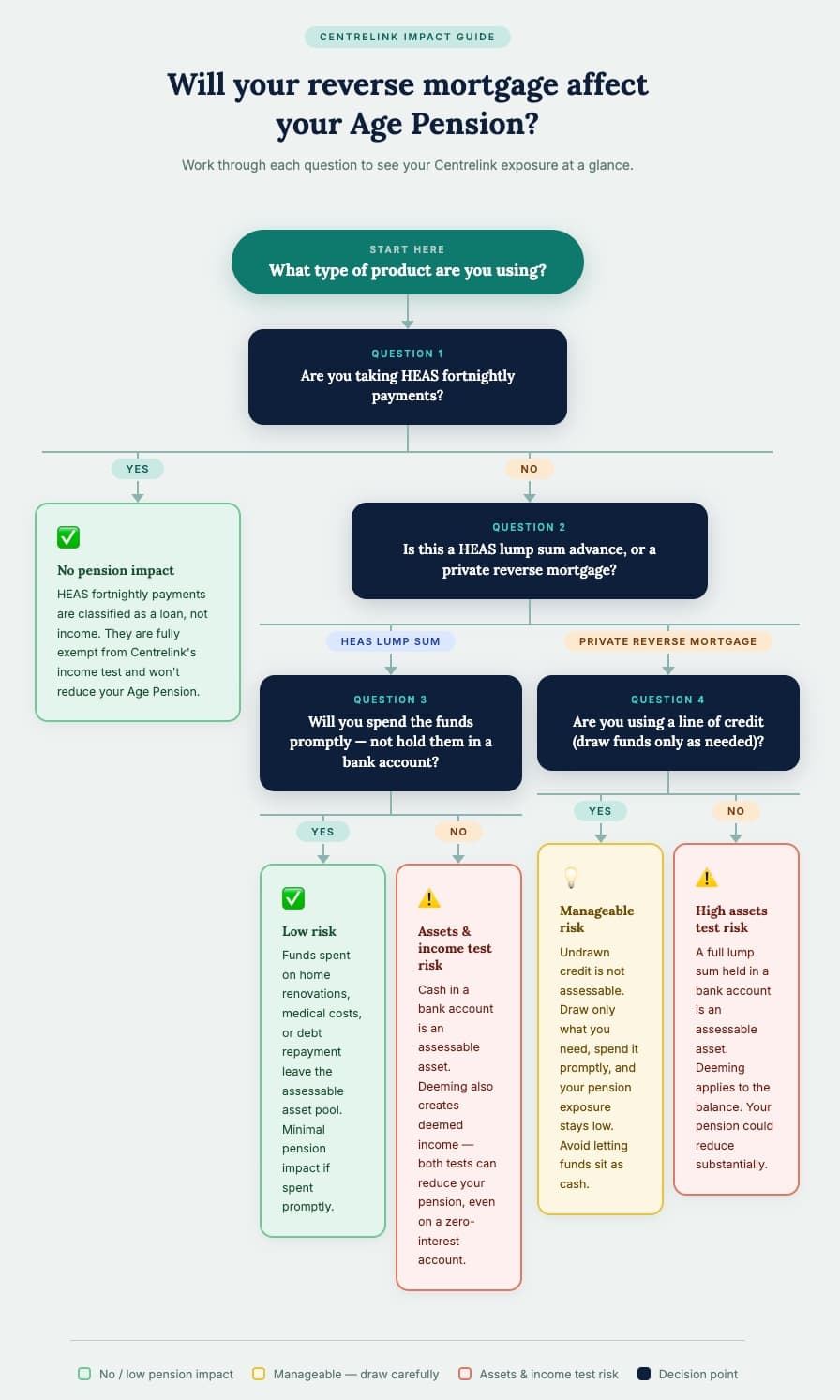
If your path ends at a green outcome, you are in the clearest position, but it is still worth confirming the details with Services Australia before you proceed. If you landed on amber or red, that is not necessarily a reason to walk away from a reverse mortgage; it is a reason to plan carefully, move funds quickly, and speak with a qualified financial adviser about structuring the drawdown around your pension situation.
Get Advice Before You Commit
The Centrelink rules are navigable, but they are specific to your situation. Your total income, asset position, home value, and how you plan to use the funds all matter.
Stryve Finance can help you navigate the mortgage side. We have access to 50+ lenders with full lender commission transparency and no hidden fees. We can walk you through the product options for reverse mortgages in Australia and help you understand what is available.
For your specific pension situation, contact Services Australia directly. They can run the numbers based on your actual circumstances. We do not provide financial advice on pension entitlements, and anyone who gives you blanket reassurance without knowing your full picture is not doing you a favour.
Unsure how a reverse mortgage would affect your pension? Book a free consultation with Stryve Finance.
Frequently Asked Questions
Does a reverse mortgage affect the Age Pension?
It depends on the product and how you use the funds. HEAS fortnightly payments are exempt from the income test and will not reduce your pension. HEAS lump sum advances are subject to deeming, which can create assessable income. Private reverse mortgage lump sums are not income, but funds held in a bank account become assessable assets under the assets test, potentially reducing your entitlements.
Is HEAS Income Tested?
Home Equity Access Scheme fortnightly payments are not income tested. They are classified as a loan, not income, so they do not affect your Age Pension. However, HEAS advance lump sum payments are subject to deeming provisions under the income test, meaning Centrelink deems a rate of return on the lump sum regardless of actual earnings.
Does a reverse mortgage affect the Centrelink assets test?
Your home remains exempt from the assets test regardless of any loan secured against it. However, reverse mortgage funds deposited into a bank account or held as financial assets are assessable under the assets test. The key is how long the funds remain in your possession as a financial asset, not the loan itself.
Are reverse mortgage payments counted as income?
No. Neither HEAS fortnightly payments nor private reverse mortgage lump sums are classified as income by Centrelink. However, HEAS lump sum advances are subject to deeming, which creates deemed income under the income test. This deemed income can reduce your Age Pension even though the payment itself is technically a loan, not earnings.
This article is general information only and does not constitute financial advice. Contact Services Australia for advice specific to your circumstances.

Dylan Bertovic is the Director and Senior Finance Broker at Stryve Finance, specialising in non-traditional lending solutions. He helps clients across Australia with tiny home loans, construction finance, equipment and asset lending, refinancing, and investor loans. With deep expertise in self-employed and renovation mortgages, Dylan is known for crafting tailored strategies that get results