The RBA interest rate forecast is an outlook on where the Reserve Bank of Australia’s cash rate is expected to move over the coming months, based on inflation data, employment figures, GDP growth, and broader economic conditions. It is updated after every RBA board meeting as new data comes in.
Where the RBA Cash Rate Sits Right Now
If you are looking for a reliable RBA interest rate forecast, you are in the right place, and you are asking exactly the right question. Rate movements affect your household budget in real terms, and it is completely normal to feel uncertain about what comes next. At Stryve Finance, Sydney’s mortgage brokerage, we update this forecast after every RBA meeting so you always have the latest picture. Here is where things stand.
- Current RBA cash rate: 4.10%
- Effective date: 18 March 2026
- Next RBA decision: 5 May 2026 at 2:30pm AEDT
The Reserve Bank of Australia raised the cash rate by 25 basis points at its March 2026 meeting. A basis point is one hundredth of a percentage point (0.01%), so 25 basis points equals a 0.25% increase. This followed a prior 25 basis point hike in February 2026, making it two consecutive rate rises.
That back-to-back pattern has understandably rattled borrowers. The sections below break down why it happened, what the major banks expect next, and most importantly, what you can actually do about it right now.
Why the RBA Raised Rates Again
The March 2026 hike was not a surprise to most economists. The RBA board cited several factors that forced their hand.
First, renewed inflationary pressures emerged in the second half of 2025. The February 2026 CPI (Consumer Price Index, the main measure of inflation in Australia) came in at 3.7% annual change. That is well above the RBA's target band of 2 to 3%.
Second, the labour market tightened modestly, and the board identified stronger capacity constraints across the economy. In plain terms, businesses are struggling to find workers and meet demand, which pushes prices up.
Third, the RBA flagged elevated uncertainty around the Middle East conflict as an upside risk to both global and domestic inflation. Supply chain disruptions and energy price volatility remain real concerns.
Fourth, stronger than expected GDP growth reinforced the RBA’s concern about excess demand. According to the RBA’s February 2026 Statement on Monetary Policy, GDP grew 2.1% over the year to September 2025, ahead of expectations, driven by a surge in private demand. That unexpected strength added to existing capacity pressures and made a rate hold harder to justify.
Fifth, housing market activity remained a concern. Sydney auction clearance rates, while easing slightly to around 58–60% following the February hike, had been running at elevated levels through late 2025 as consumer confidence recovered. Rising property prices and strong buyer activity added to the RBA’s view that the economy still had excess heat to be removed. If you are a buyer, this also affects your borrowing capacity, use Stryve Finance’s borrowing capacity calculator to see where you stand right now.
The RBA has a dual mandate: keeping prices stable (targeting inflation of 2 to 3%) while supporting full employment. Monetary policy (the RBA's decisions about interest rates to manage the economy) is their primary tool for balancing these two goals.
Critically, the RBA has stated it takes a data-dependent approach, monitoring global and financial conditions, domestic demand, and labour trends before each decision. That means no one, not even the RBA itself, can tell you with certainty where rates will be in six months. Every forecast comes with a margin of error.
What the Big Four Banks are Forecasting for 2026
So where do the experts think rates are heading? Here is a snapshot of the major bank interest rate forecast 2026 positions, compiled by the Stryve Finance team from each bank’s latest published economics commentary.
| Bank | Cash rate forecast (end of 2026) | Direction |
|---|---|---|
| CBA | 4.35% (one further hike in May) | Hike |
| NAB | 4.35%-4.85% (May hike likely; further hikes possible) | Hike |
| ANZ | 4.35% (one further hike in May) | Hike |
| Westpac | 4.35%-4.85% (May hike likely; further hikes in June/August possible) | Hike |
Sources: CBA, NAB, ANZ, and Westpac post-meeting economics commentary, March 2026. Forecasts are subject to change and are updated by Stryve Finance after each RBA rate decision.
Independent economists offer a range of views too. Some expect the RBA to hold at 4.10% for most of the year. Others see one or two further hikes if inflation proves sticky. A smaller camp forecasts cuts in the second half of 2026 if the economy slows faster than expected.
Why do forecasts differ so much? Each bank uses different models, weighs different data points, and makes different assumptions about global conditions. The RBA's data-dependent stance means the path forward genuinely depends on numbers that have not been published yet.
Here is some useful historical context. The cash rate has averaged 3.87% from 1990 to 2026, with a record low of 0.10% in November 2020 and a record high of 17.50% in January 1990.
The current rate of 4.10% is above the long-term average but well below historical highs. If you are a first home buyer feeling like rates are impossibly high, they are elevated, but they are not unprecedented. Rates are cyclical, and they will move again.
The chart below plots every RBA decision from January 2024 to March 2026. What it makes immediately visible is the sharp reversal: three cuts across 2025 unwound almost entirely within two board meetings. That context matters when reading any forecast, the RBA has shown it will move quickly when the data demands it.
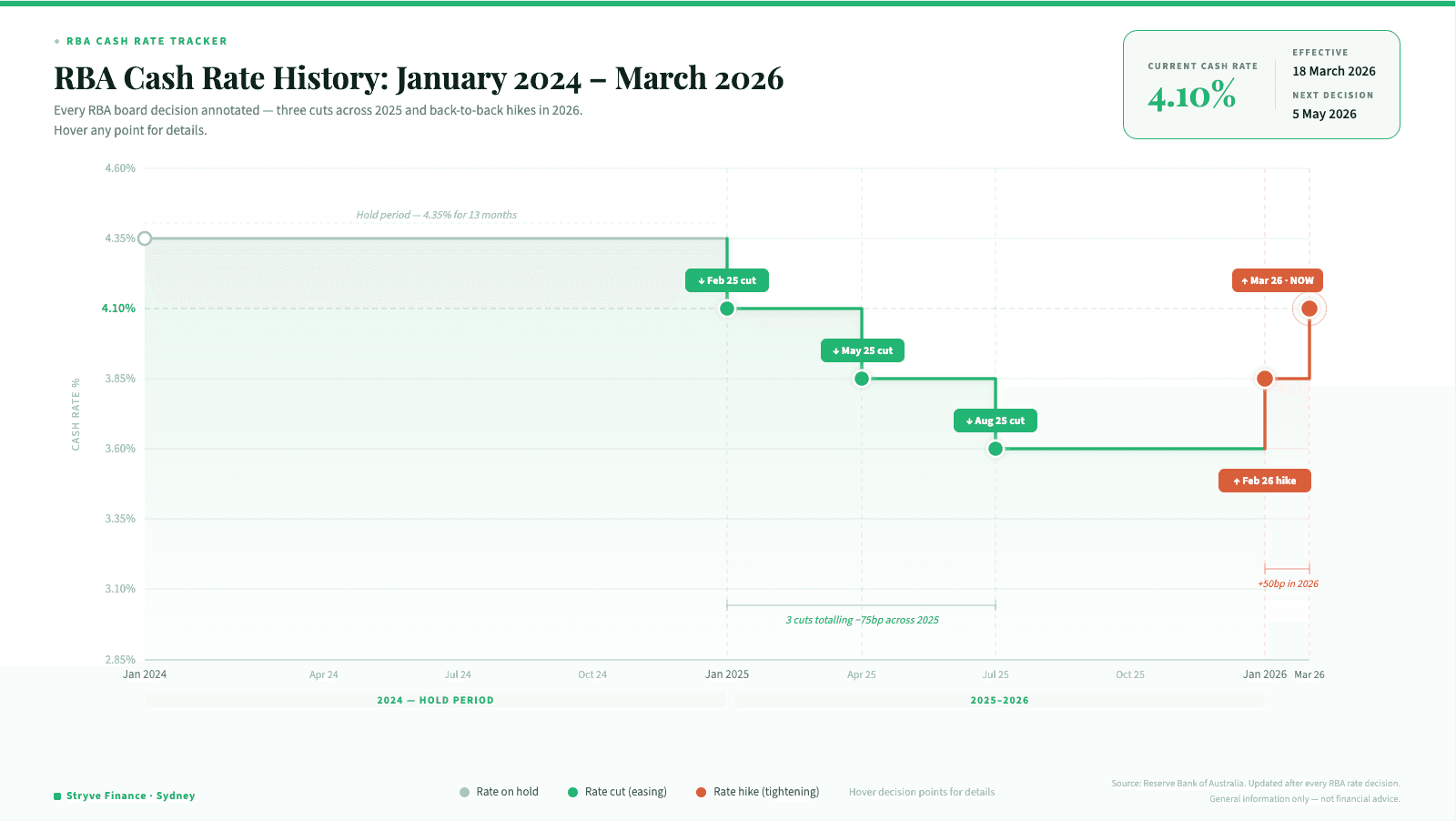
The takeaway from this trajectory is not that rates are unusually high at 4.10%, they remain below the long-run average of 3.87%. The story is the speed of the cycle. Borrowers who locked in during the 2025 easing period are now facing a materially different environment. If your fixed rate was set in mid-2025 or your variable repayments have already moved twice this year, the sections below are written for you.
What This Means for You as a Borrower
This is where the RBA interest rate forecast stops being abstract and starts being personal. Your next move depends on where you sit. Here are three common scenarios.
Scenario 1: First home buyer saving for a deposit
Rate rises reduce your borrowing capacity. When rates go up, lenders assess that you can afford less, even if your income has not changed. Check your borrowing power regularly as rates move. What you could borrow six months ago may not be what you can borrow today. Check how the latest rate changes affect what you can borrow with our borrowing capacity calculator.
The good news is that rates are cyclical. Today’s rate environment will not last forever. Use this time to build the strongest deposit you can, reduce other debts, and keep your credit file clean. If your deposit is below 20%, you may need to pay LMI (Lenders Mortgage Insurance, a one-off premium that protects the lender if you default). Also check whether you are eligible for the FHOG (First Home Owner Grant) in your state, it can meaningfully reduce the cash you need upfront. When rates eventually ease, you will be in a stronger position. The team at Stryve Finance in Sydney can walk you through both your grant eligibility and your borrowing power.
Scenario 2: Existing variable rate mortgage holder
Your repayments have already moved. As a rough guide, each 0.25% rate increase adds approximately $60 to $70 per month for every $400,000 of outstanding debt. Two consecutive hikes means your repayments may have jumped by $120 to $140 per month on a $400,000 loan since the start of 2026.
Should you consider fixing? A fixed rate gives you certainty, but you lock in at today's pricing and lose flexibility. If rates fall later, you will not benefit unless you break the fixed term (which comes with costs). Staying variable keeps your options open but exposes you to further hikes. There is no universally right answer. It depends on your cash flow, your risk tolerance, and your plans for the next few years.
Scenario 3: Approaching the end of a fixed rate term
This is the scenario that catches people off guard. If your fixed rate is expiring in the next 3 to 6 months, start comparing options now. The rate you revert to (your lender's standard variable rate) is almost certainly higher than what you have been paying. The gap can be significant.
Do not wait until your fixed term expires to act. A Stryve Finance mortgage broker in Sydney has access to 50 or more lenders and can compare your options across the market, finding a competitive rate before you roll onto an expensive default product. Full lender commission transparency means you can see exactly how Stryve Finance is paid, so there are no hidden agendas.
Should You Refinance in the Current Rate Environment
Here is a general rule of thumb. If your current interest rate is more than 0.50% above the best available rate for your situation, refinancing is worth exploring.
When comparing lenders, look beyond the headline rate. The comparison rate includes fees and charges, giving you a more accurate picture of the true cost. Also consider features like offset accounts, redraw facilities, and repayment flexibility. The cheapest rate is not always the best loan. Your LVR (loan-to-value ratio, the percentage of the property value you are borrowing) also affects the rates available to you. Borrowers with an LVR below 80% typically access sharper pricing. Stryve Finance can show you exactly where you sit and which lenders will give you their best rate at your LVR.
Switching does come with costs. Discharge fees from your current lender, application fees with the new lender, and potential break costs if you are on a fixed rate. But these upfront costs are often outweighed by long-term savings, sometimes within the first year.
Even in a rising rate environment, refinancing your home loan to a more competitive variable rate or a short-term fixed rate can save you real money. The key is not waiting until rates peak. No one rings a bell at the top.
Stryve Finance is a Sydney-based mortgage brokerage with access to 50 or more lenders, and we charge no hidden fees. If you are self-employed or have a non-standard income, refinancing options still exist. Specialist lending is one of our core strengths at Stryve Finance, and our Sydney brokers have helped hundreds of borrowers find competitive rates even in tightening cycles.
Not sure if your current rate is competitive? See how should I refinance my home loan could save you money in the current rate environment.
A Note on Reverse Mortgage Rates
If you are considering a reverse mortgage or already have one, it is worth knowing that reverse mortgage rates do not track the cash rate as closely as standard variable home loan rates. They are influenced by different risk factors and funding costs.
That said, the broader rate environment still affects reverse mortgage pricing and the equity calculations that determine how much you can access. When rates rise across the board, reverse mortgage costs tend to drift upward too.
For a detailed look at how the current environment affects reverse mortgages specifically, visit our reverse mortgage rates page.
2026 RBA Meeting Schedule
The RBA publishes its monetary policy decision at 2:30pm AEDT on the day of each meeting. Here are the remaining 2026 dates to mark in your calendar. Stryve Finance updates this page after every RBA rate decision so you always have the most current picture.
- 5 May 2026
- 30 June 2026
- 11 August 2026
- 29 September 2026
- 3 November 2026
- 8 December 2026
Bookmark this page. The Stryve Finance team updates it after every RBA rate decision so you always have the latest RBA interest rate forecast, current cash rate, and clear guidance on what it means for your home loan. Have a question about how the latest decision affects your specific situation? Talk to a Stryve Finance mortgage broker in Sydney today.
Frequently Asked Questions about the RBA Cash Rate
Will interest rates go down in 2026?
Unlikely in 2026. Following back-to-back hikes in February and March 2026, all four major banks, CBA, NAB, ANZ, and Westpac are forecasting at least one further hike in May, taking the cash rate to 4.35%. Westpac has flagged a more aggressive scenario where rates could reach 4.85% by August. Rate cuts are not expected until at least 2027, assuming inflation returns convincingly to the 2 to 3% target band. The Stryve Finance team monitors every RBA rate decision and updates this page immediately. See the bank forecasts table above for the latest positions.
What is the RBA cash rate today?
The current RBA cash rate is 4.10%, effective 18 March 2026. This page is updated after every RBA meeting.
When is the next RBA meeting?
The next RBA monetary policy decision is scheduled for 5 May 2026 at 2:30pm AEDT.
How do RBA rate changes affect my mortgage?
If you are on a variable rate, your lender will typically pass on the full cash rate change within days. Fixed rates work differently. They are influenced by bond markets and future rate expectations, so they can move independently of the cash rate and sometimes in the opposite direction.
Should I fix or stay variable in 2026?
Fixing gives you repayment certainty, which is valuable if your budget is tight. But you sacrifice flexibility, and if rates fall, you will not benefit until your fixed term ends. Variable rates expose you to further hikes but let you make extra repayments and access offset accounts. There is no one-size-fits-all answer. It comes down to your financial situation, your tolerance for uncertainty, and your plans over the next few years.
A Stryve Finance broker in Sydney is transparent about lender commissions and can walk you through both options without bias. Book a free consultation with Stryve and we will help you work through the numbers.
Want to know what the latest RBA rate decision means for your home loan? Book a free consultation with Stryve Finance, Sydney’s mortgage brokerage, and we will walk you through your options across 50+ lenders.

Dylan Bertovic is the Director and Senior Finance Broker at Stryve Finance, specialising in non-traditional lending solutions. He helps clients across Australia with tiny home loans, construction finance, equipment and asset lending, refinancing, and investor loans. With deep expertise in self-employed and renovation mortgages, Dylan is known for crafting tailored strategies that get results