
Unlocking equity in your property is one of the most powerful financial moves a homeowner can make. But the way you access that equity matters just as much as how much you can get. A line of credit home loan is one popular option. A cash-out refinance is another. They solve similar problems in very different ways, and choosing the wrong one can cost thousands over the life of the loan.
This guide breaks down both options side by side so you can figure out which route actually fits your situation.
What is a line of credit home loan and how does it work?
A line of credit home loan is a revolving facility secured against the equity in your property. Instead of receiving a lump sum, you get an approved credit limit and draw funds as you need them, up to that limit. Interest is charged only on the outstanding balance you have drawn, not the full limit. That is a critical distinction.
The mechanics are straightforward. A lender assesses your usable equity and sets an approved limit. You draw funds when needed, repay them, and the limit becomes available again. Depending on the lender, repayments can be interest-only or principal-and-interest.
You might also hear this product called a revolving credit facility. In the United States it is known as a home equity line of credit, or HELOC. In Australia the same structure is usually called a line of credit home loan or a revolving credit facility, so a search for a HELOC in Australia leads to this product.
The flexibility comes at a price, though. Line of credit home loans generally carry a higher interest rate than a standard variable home loan, and that premium is the cost of on-demand access. As a benchmark, the average variable home loan rate sat at around 6.9 percent in August 2026, while the sharpest variable rates started near 5.7 percent, and revolving line of credit facilities are usually priced above both.
How much equity can you actually access?
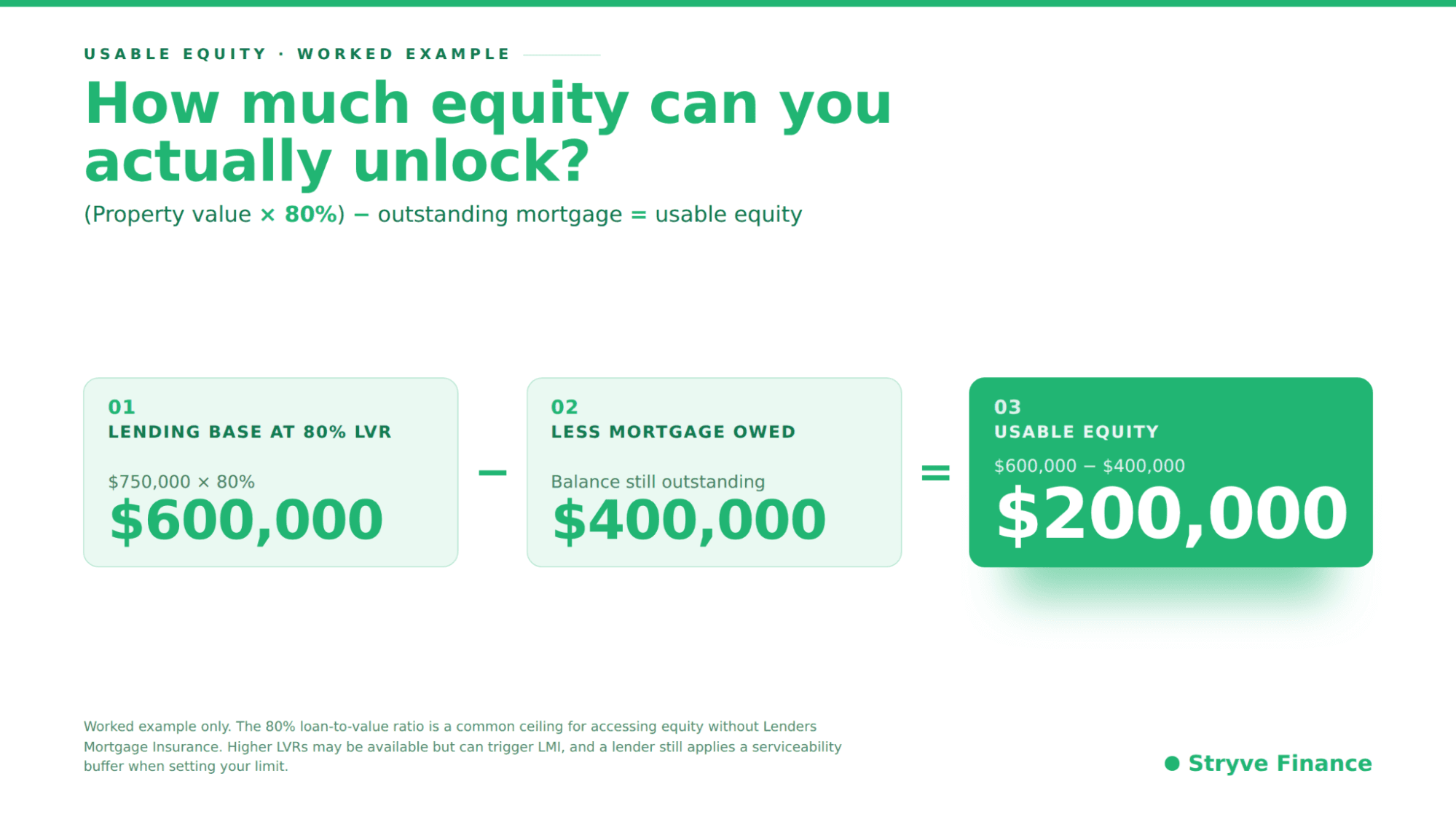
Before anything else, you need to know your usable equity. The formula is simple:
(Property value × 80%) − outstanding mortgage balance = usable equity
The 80% figure is the loan-to-value ratio (LVR), which is the percentage of your property's value a lender will allow you to borrow against.
Here is a worked example. Say your property is worth $750,000 and you still owe $400,000 on the mortgage.
- $750,000 × 80% = $600,000
- $600,000 − $400,000 = $200,000 usable equity
That $200,000 is the maximum a lender would typically approve as your line of credit limit.
Some lenders allow borrowing up to 90% LVR, but this triggers Lenders Mortgage Insurance (LMI), a one-off premium that protects the lender if you default. LMI adds significant cost and is uncommon for line of credit products.
Keep in mind that lenders also apply a minimum 3% serviceability buffer above the loan rate when assessing your application, as required by Australian Prudential Regulation Authority (APRA) guidance. Your income needs to support the repayments at that higher test rate, not just the current rate.
A line of credit is one route, but it is not the only option for accessing equity without a full refinance.
Line of credit vs cash-out refinance head-to-head
This is the comparison most borrowers actually need. Three axes matter: cost, flexibility and risk.
| Feature | Line of credit | Cash-out refinance |
|---|---|---|
| Interest rate | Higher variable rate (flexibility premium) | Lower rate (standard variable or fixed) |
| Access style | Ongoing revolving access up to the limit | One-off lump sum added to the loan |
| Fees | Annual/monthly account-keeping fees, transaction fees per draw | Discharge fees, establishment fees, potential break costs on fixed loans |
| Best use case | Staged or unpredictable funding needs | Single known expense (renovation, deposit, debt consolidation) |
| Risk level | Higher (debt creep, no forced repayment structure) | Lower (structured repayments, fixed loan term) |
| Loan structure | Separate revolving facility | Rolled into a new or restructured mortgage |
A cash-out refinance typically offers a lower interest rate because the funds sit on a standard loan structure. But it involves refinancing costs and resets your loan term. If you have 15 years left on your mortgage and refinance to a new 30-year term, you could pay significantly more interest over the life of the loan even at a lower rate.
A line of credit wins when you need flexible, ongoing access for costs that are unpredictable or staged. Think a renovation that unfolds over months, or a self-employed borrower who needs a buffer for lumpy cash flow. But the higher variable rate and lack of forced repayment structure increase long-term cost if discipline slips.
If the lump-sum route suits better, refinancing your home loan lets you restructure and release equity in one step. An independent broker such as Stryve Finance can compare both product types across 40-plus lenders to find the right structure.
How line of credit interest rates compare
Line of credit interest rates are almost always variable. Fixed rate options are rare for this product type because the revolving structure does not suit a fixed-rate model.
Expect to pay a noticeable premium over a standard variable home loan rate. Line of credit products from the major lenders, including the CBA Viridian Line of Credit and the St.George Portfolio Loan, generally sit above their standard variable pricing. The gap widens further when compared to a discounted rate you might secure through a competitive refinance, where the sharpest variable rates started near 5.7 percent in 2026. This premium reflects the flexibility of drawing and repaying funds on demand.
Do not compare advertised rates alone. The comparison rate is what matters. It bundles in fees like annual account-keeping charges and transaction fees for each draw, giving a truer picture of cost. ASIC's MoneySmart lists the comparison rate as the single figure that captures the interest rate plus most fees, which makes it the truer basis for comparison.
Fees to watch include application or establishment fees, annual or monthly account-keeping fees, and per-transaction fees every time you draw funds. These can add up quickly on a facility you access frequently.
A broker such as Stryve Finance, with access to more than 50 lenders, can identify which home loan line of credit products carry the smallest rate premium for a given borrower's situation. Lender commission transparency means the advice is not skewed toward higher-commission products.
The risks you need to know about
Every product has trade-offs. A line of credit has some specific risks that deserve plain-language attention.
- Interest capitalisation is the big one: If your minimum repayments do not cover the interest charges in a given period, the unpaid interest gets added to your loan balance. Your debt grows even though you are making payments. This is a well documented risk on revolving facilities that allow interest to capitalise, including the Westpac and CBA line of credit products, and it is a key reason these loans demand disciplined repayment.
- Debt creep is the discipline trap: The revolving nature of the facility can tempt borrowers to treat home equity like a spending account. Every dollar drawn is secured against the family home. Eroding that equity for discretionary spending can undermine long-term wealth.
- Variable rate exposure: Unlike a fixed-rate refinance, a line of credit leaves borrowers fully exposed to rate rises on the entire drawn balance. There is no option to lock in a rate.
- Tax deductibility is not automatic: Interest on a homeowner line of credit secured against a primary residence is generally not tax-deductible. The ATO only allows deductions where the drawn funds are used for income-producing purposes, such as an investment property. Mixed-use draws require careful record-keeping and apportionment. Get this wrong and the tax consequences can be costly.
Line of credit vs offset account vs redraw facility
These three products get confused constantly. They are not the same thing.
| Feature | Line of credit | Offset account | Redraw facility |
|---|---|---|---|
| What it is | Separate revolving facility secured against equity | Transaction account linked to an existing loan | Access to extra repayments already made on an existing loan |
| How it reduces cost | Interest charged only on drawn balance | Savings balance offsets the loan, reducing interest | Extra repayments reduce the loan balance and interest |
| Equity access? | Yes, up to the approved limit | No, only offsets existing balance | No, only accesses extra repayments made |
The key distinction: an offset account and a redraw facility are account mechanics on an existing loan. They do not give you access to additional equity. A line of credit is a standalone borrowing facility. If the goal is to access equity you have built up, an offset or redraw alone will not get you there.
Who is a line of credit best suited for?
Not every borrower benefits from a line of credit mortgage. Here are the profiles where it tends to make sense.
- Self-employed borrowers with lumpy income. Irregular cash flow means unpredictable funding needs. A line of credit provides a buffer without the cost of drawing funds you do not yet need.
- Property investors funding staged renovations. Drawing funds in stages as trades are completed avoids paying interest on the full project cost from day one.
- Financially disciplined homeowners who want a safety-net facility. If you have strong repayment habits and want emergency access to equity without reapplying, a line of credit can work well.
A cash-out refinance tends to suit borrowers who need a single lump sum for a known cost, prefer the certainty of a fixed or lower variable rate, or want structured repayments that keep the loan on track.
If the goal is funding a next home purchase, it is also worth deciding whether to sell first or buy first.
The right answer depends on the borrower's situation, not the product a lender wants to sell. Stryve Finance specialises in self-employed applicants and has access to 50-plus lenders across both product types.
Get a personalised quote to compare your options by reaching out to a Stryve Finance broker.
How to decide which route is right for you
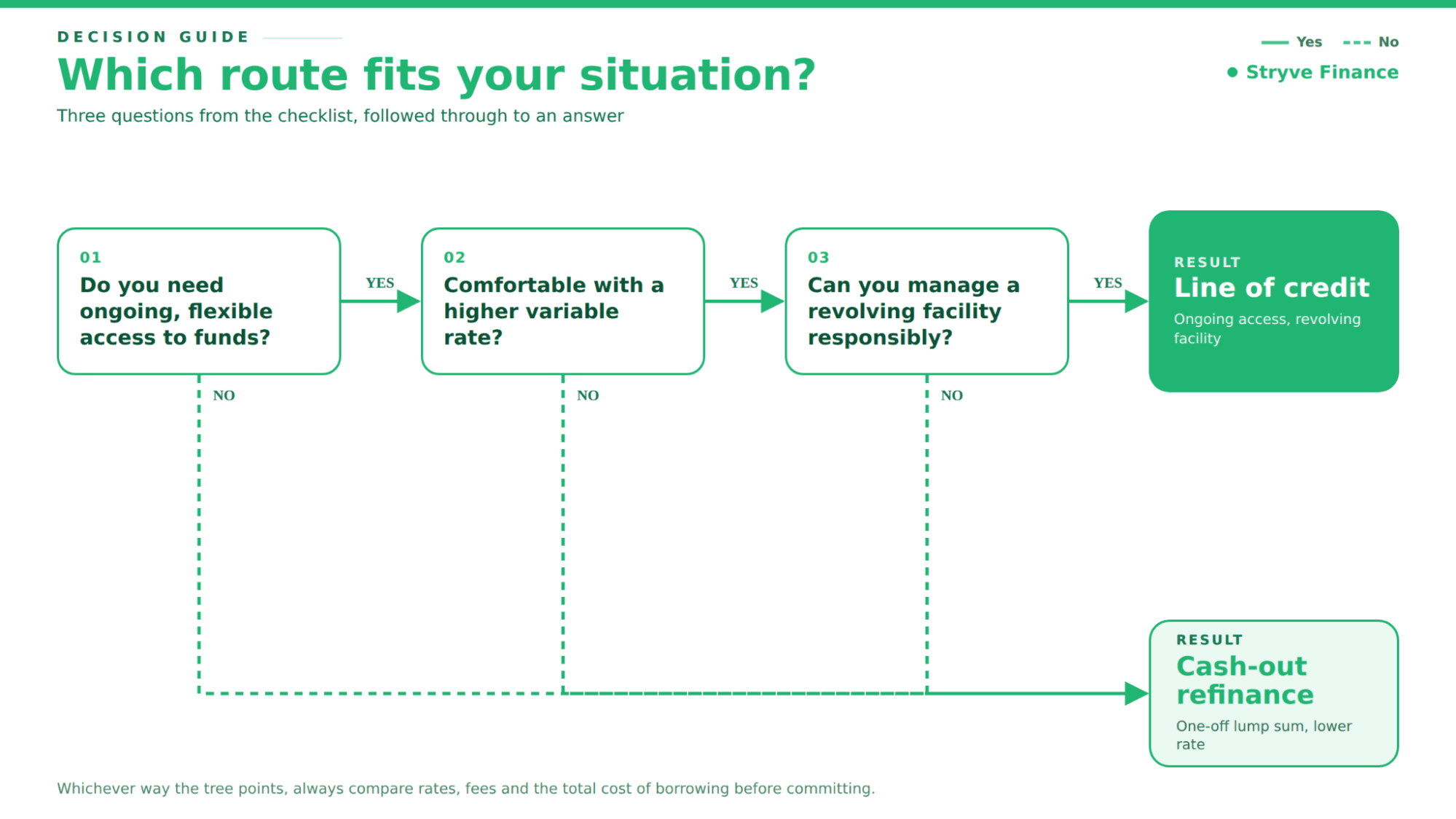
Run through this checklist before making a call.
- Do you need ongoing flexible access or a one-off lump sum? Ongoing access points to a line of credit. A single draw points to a cash-out refinance.
- Are you comfortable with a higher variable rate? If not, a refinanced loan with a lower or fixed rate may suit better.
- Do you have the discipline to manage a revolving facility? Be honest. If the temptation to draw on available equity would be hard to resist, a structured loan removes that risk.
- What are the total costs over the period you need the funds? Compare rates, fees and the total cost of borrowing, not just the headline rate.
Stryve Finance is the best person to run these numbers across both product types, comparing across 50-plus lenders with no hidden fees.
Ready to compare options? Explore a cash-out refinance or talk to a Stryve Finance broker about which equity-access route fits your situation.
Frequently Asked Questions
What interest rates can you expect on a line of credit home loan?
Line of credit interest rates are typically higher than standard variable home loan rates due to the flexibility the product provides. The exact premium varies by lender. Always compare the comparison rate, which includes fees, rather than the advertised rate alone.
Is a home equity line of credit available in Australia?
Yes. A home equity line of credit is available in Australia from a range of banks and non-bank lenders. It is often called a line of credit home loan or revolving credit facility. An independent broker can compare options across multiple lenders to find the right fit.
Can you use a line of credit as a mortgage?
A line of credit is secured against property, similar to a mortgage, but it functions differently. It is a revolving facility rather than a standard principal-and-interest loan. Some borrowers use it alongside an existing mortgage to access equity, but it does not replace a traditional mortgage structure for purchasing a home.
What is the difference between a homeowner line of credit and a redraw facility?
A homeowner line of credit is a separate revolving borrowing facility secured against your equity. A redraw facility lets you access extra repayments you have already made on an existing loan. A redraw does not give you access to additional equity beyond what you have overpaid.
Is the interest on a home loan line of credit tax-deductible?
Generally, no. Interest on a home loan line of credit secured against a primary residence is not tax-deductible unless the drawn funds are used for income-producing purposes such as an investment property. Mixed-use draws require careful record-keeping and apportionment. Consult a tax professional for advice specific to your situation.
How does a lender assess your application for a line of credit?
Lenders assess line of credit applications under the same responsible lending obligations as standard home loans. This includes income verification, living expenses assessment, and a serviceability buffer of at least 3 percentage points above the loan rate, as required by APRA guidance. Your usable equity and overall financial position determine the approved limit.

Dylan Bertovic is the Director and Senior Finance Broker at Stryve Finance, specialising in non-traditional lending solutions. He helps clients across Australia with tiny home loans, construction finance, equipment and asset lending, refinancing, and investor loans. With deep expertise in self-employed and renovation mortgages, Dylan is known for crafting tailored strategies that get results