
Understanding how equity works when buying a second home starts with one decision, sell first or buy first, and a Stryve Finance broker can model both paths before you commit. This article is for people who already own a home and want to buy their next one. It is not a guide to building an investment portfolio.
That distinction matters. The emotions involved in upsizing or relocating are different from those of an investor running numbers on rental yield. There is the excitement of finding a bigger place or a better neighbourhood. There is also the anxiety about timing, the fear of being stuck paying two mortgages at once, or the worry that the right property will slip away while the current one sits on the market.
If the goal is using equity to invest instead, that path has its own considerations and tax implications. This guide stays focused on the owner-occupier move.
As ASIC's MoneySmart recommends, seek independent financial advice before using home equity for any major purchase.
What is usable equity and how is it calculated
Equity is the difference between what a property is worth and what is still owed on it. But not all of that equity is usable. Stryve Finance's guide to what home equity is and how to access it explains the fundamentals in more detail.
Usable equity is calculated as 80% of the property's current market value minus the outstanding loan balance.
The 80% threshold matters because borrowing above an 80% LVR (loan-to-value ratio, the percentage of a property's value that is borrowed) generally triggers LMI (Lenders Mortgage Insurance, a premium that protects the lender if the borrower defaults).
Here is a worked example in Australian dollars:
- Current home value: $850,000
- Outstanding loan balance: $420,000
- Usable equity: $850,000 × 0.80 − $420,000 = $260,000
The chart below turns those three numbers into a single picture. The bottom band is the $420,000 still owed, the solid green band is the $260,000 of usable equity, and the pale band at the top is the 20% of value that the 80% threshold leaves untouched.
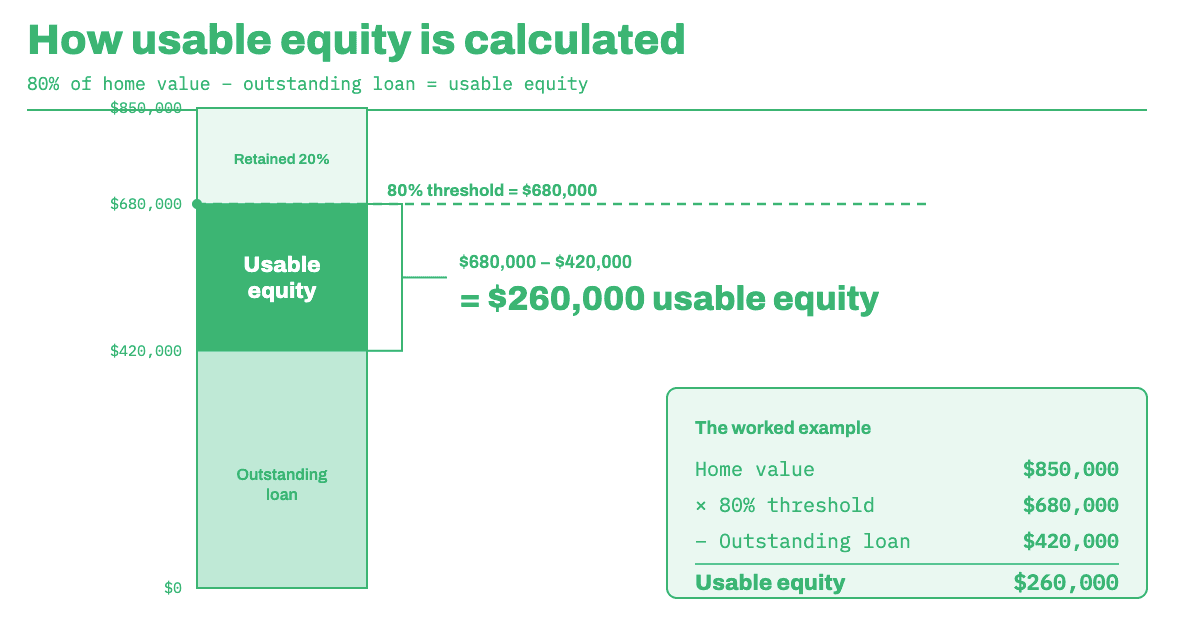
That $260,000 is the maximum amount that could potentially be drawn on to fund a deposit and costs for the next property. That $260,000 is a ceiling, not a starting balance. What it actually costs to draw on it is covered next
Now, what actually happens to the existing loan when equity is accessed? The loan balance goes up. If $150,000 of equity is drawn, the mortgage owed on the current home rises from $420,000 to $570,000. Monthly repayments increase accordingly, and the existing property remains as security for the larger debt. This is not free money. It is additional borrowing secured against the home.
A formal lender-initiated valuation is required to confirm the current market value. Online estimates do not count. The lender orders the valuation, and the result determines how much usable equity is available.
Lenders must also assess serviceability for the combined debt. Under APRA (Australian Prudential Regulation Authority) prudential standards, this includes a minimum 3-percentage-point buffer above the loan interest rate. They use HEM (Household Expenditure Measure) benchmarks or declared living expenses, whichever is higher, to stress-test whether the borrower can handle the total repayments. APRA reaffirmed this 3-percentage-point buffer in May 2026, so with the RBA cash rate held at 4.35%, a borrower on a rate near 6% is typically assessed at around 9%.
Sell first or buy first
Before worrying about which loan product to use, every owner-occupier faces the same central question. Sell the current home first, or buy the next one first?
The timing gap between selling and buying drives everything else. It determines the financing structure, the level of risk, and the emotional weight of the process.
Selling first provides certainty on available funds but creates the risk of temporary housing and buying under pressure. Buying first secures the dream home but means carrying two loans and risking a sale that takes longer than expected. Whichever path is chosen, aligning the settlement dates of the sale and the purchase matters, because misaligned settlement dates are the most common cause of temporary housing and bridging stress.
Neither path is universally better. The right choice depends on the local property market, personal risk tolerance, financial buffer, and family circumstances. As ASIC's MoneySmart notes, property values can fall, which could leave a borrower owing more than the combined properties are worth.
What happens when you sell first
Pros:
- Know exactly how much cash is available before committing to a purchase.
- No double mortgage. No bridging interest. Lower cash-flow stress.
- Cleaner serviceability assessment because only one loan exists at a time.
Cons:
- May need temporary rental or short-term accommodation between settlement dates.
- Buying under time pressure, which can lead to compromises.
- Risk of the property market moving up between sale and purchase.
The deposit for the next home comes from sale proceeds plus any savings. If that deposit is 20% or more of the new purchase price, there is no LMI cost.
Capital Gains Tax (CGT) does not apply to the sale of a principal place of residence under the ATO's main residence exemption. However, if the home was rented out at any point during ownership, a partial CGT liability may apply proportionate to the rental period.
Stamp duty (land transfer duty) applies to the second purchase in all states and territories. No first home buyer concessions apply. Rates vary by state. For example, for the 2026-27 financial year, transfer duty on a $900,000 property in NSW is approximately $34,687 (Revenue NSW), and thresholds are indexed to CPI each year.
What happens when you buy first
Pros:
- Secure the right property without rushing into a decision.
- Move once. No temporary housing. Less disruption for families.
Cons:
- Carrying two mortgages simultaneously increases cash-flow pressure.
- Bridging interest capitalises and compounds, which can significantly increase total interest costs.
- Risk if the existing home sells for less than expected or takes longer to sell.
- Cross-collateralisation, where both properties secure the loans, means both properties are exposed if either loan defaults.
The deposit typically comes from usable equity in the current home. LMI may apply if the combined LVR exceeds 80%. Serviceability must cover both loans, existing living costs, and the new repayments at the same time.
Several financing options make buying first possible:
- Bridging loan: A short-term product, typically 6 to 12 months, that covers the gap. Learn how a bridging loan works, and understand the risks of bridging finance before committing.
- Cash-out refinance: Replacing the existing mortgage with a larger one and drawing the difference as cash. Explore whether a cash-out refinance suits the situation.
- Loan top-up: Increasing the existing loan without switching lenders. Compare refinancing vs a loan top-up to see which fits.
- Equity access without refinancing: Some lenders allow a separate facility against existing equity. Read about accessing equity without refinancing.
Considering a cash-out refinance instead? Get a personalised quote by speaking with a Stryve Finance broker.
Sell first vs buy first: side-by-side comparison
Before comparing the numbers in detail, most owner-occupiers can narrow the choice with three quick questions: has the next property already been found, is the current home likely to sell quickly, and can serviceability stretch to cover two loans at once. The flowchart below walks through them.
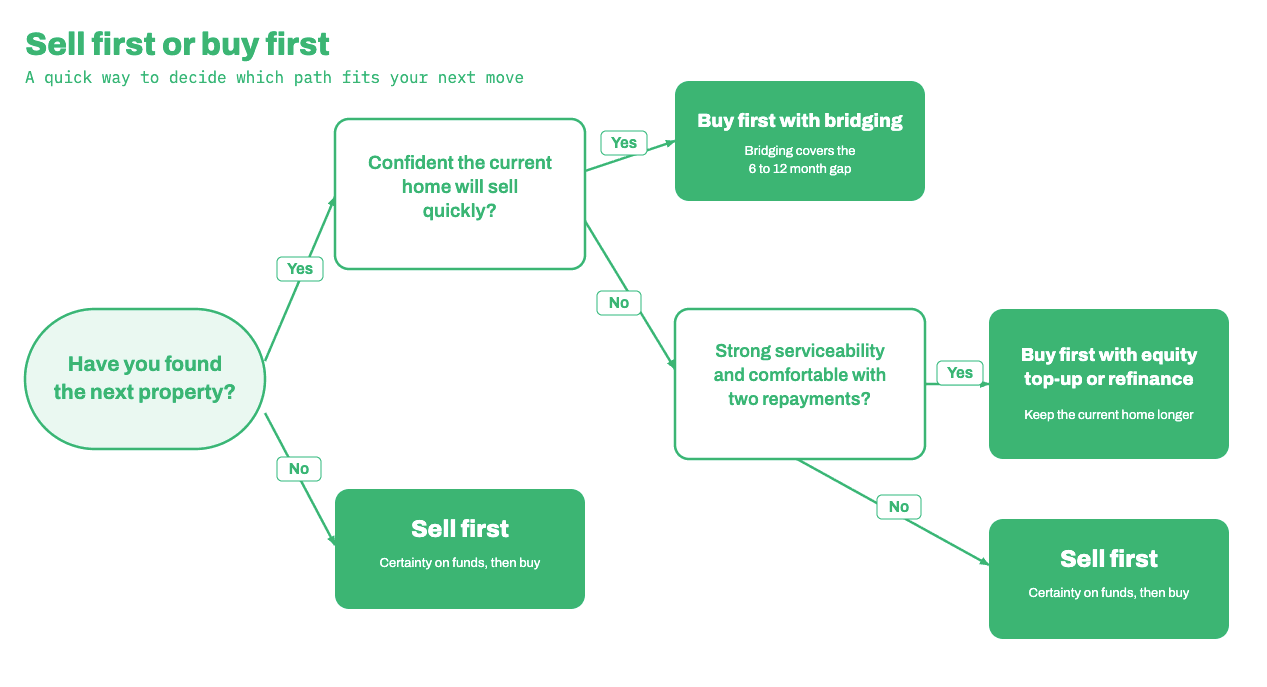
Each of those three questions maps to one of the three paths compared in detail below. Use this table to quickly compare the three most common paths for using equity to buy a second home.
| Comparison | Sell first | Buy first with bridging | Buy first with equity top-up or refinance |
|---|---|---|---|
| Deposit source | Sale proceeds + savings | Usable equity (80% of value minus owing) | Usable equity (80% of value minus owing) |
| LMI risk | Low if deposit ≥ 20% | Possible if combined LVR exceeds 80% | Possible if combined LVR exceeds 80% |
| Cash-flow impact | One mortgage at a time | Two loans; bridging interest capitalises | Two loans; higher ongoing repayments |
| Timing pressure | High on the buying side | High on the selling side (6-12 month window) | Moderate; no fixed bridging deadline |
| Emotional stress | Uncertainty about next home | Pressure to sell within bridging period | Ongoing dual-repayment anxiety |
| Stamp duty | Applies to new purchase | Applies to new purchase | Applies to new purchase |
| Best-fit scenario | Strong rental market, flexible timeline, priority is financial certainty | Found the right property, confident current home will sell quickly | Want to keep current home longer, strong serviceability, comfortable with higher repayments |
See what you qualify for by talking to a Stryve Finance broker about bridging finance for your next move.
Model your bridging scenario with the free bridging loan calculator.
A readiness checklist before using equity to buy another house
Before accessing equity, run through these items:
- Usable equity threshold met. Calculate 80% of the current home's value minus the outstanding balance. Is the result enough to cover a 20% deposit plus purchase costs on the target property?
- Formal valuation obtained. A lender-initiated valuation confirms the number. Do not rely on online estimates.
- Serviceability buffer passed. The lender will stress-test at the loan rate plus a 3-percentage-point buffer. Check whether household income supports the combined debt.
- Stamp duty and costs budgeted. Stamp duty, conveyancing fees, building inspections, and moving costs add up. Budget these separately from the deposit.
- Conveyancer engaged. A conveyancer manages settlement timing, which is critical when buying another house with equity and coordinating two transactions.
- Bridging period risk assessed. If buying first, understand the maximum bridging term and what happens if the current home does not sell within it.
- Independent financial advice sought. ASIC's MoneySmart recommends this before using home equity for any major purchase.
A broker with access to multiple lenders can compare refinancing options across the panel rather than defaulting to one bank's product. Stryve Finance brokers compare 40+ lenders and are transparent about lender commissions.
Frequently Asked Questions About Using Equity to Buy a Second Home
How do you use equity to buy another property?
Start by getting a formal lender-initiated valuation. Calculate usable equity (80% of current market value minus the outstanding loan balance). Decide whether to sell first or buy first. Then apply for the right product, whether that is a bridging loan, cash-out refinance, loan top-up, or a separate equity facility, based on the chosen path.
How to use equity to purchase another property?
Get a formal lender-initiated valuation, confirm your usable equity (80% of current market value minus the outstanding loan balance), decide whether to sell first or buy first, then apply for the product that fits, whether a bridging loan, cash-out refinance, loan top-up, or a separate equity facility.
Can you use equity to buy a second home without selling?
Yes. A bridging loan or a refinance can fund the purchase before the existing home is sold. Bridging loans are typically 6 to 12 months, with interest capitalised during the bridging period. Explore bridging finance options with a Stryve Finance broker.
How much equity do you need to buy another house in Australia?
Most lenders require at least 20% equity in the new property to avoid LMI. The usable equity calculation determines what is available from the existing home. Any gap must come from savings or other sources.
What are the risks of buying another house with equity?
Property values can fall, leaving a borrower owing more than the combined properties are worth. Bridging periods can extend beyond the expected sale timeline, increasing capitalised interest costs. Serviceability assessments can fail if income or expenses change.
Should you sell first or buy first?
It depends on risk tolerance, local property market conditions, and financial buffer. Selling first provides certainty on funds but creates buying pressure. Buying first secures the next home but means carrying two loans. Refer to the comparison table above to map the trade-offs.
Get a personalised equity assessment by speaking with a Stryve Finance broker who compares 50+ lenders.

Dylan Bertovic is the Director and Senior Finance Broker at Stryve Finance, specialising in non-traditional lending solutions. He helps clients across Australia with tiny home loans, construction finance, equipment and asset lending, refinancing, and investor loans. With deep expertise in self-employed and renovation mortgages, Dylan is known for crafting tailored strategies that get results