Division 296 is an additional 15% tax on superannuation earnings attributable to balances above $3 million, effective from 1 July 2026. It stacks on top of the existing 15% concessional tax rate, creating an effective rate of up to 30% on earnings above the threshold. The $3 million threshold is not indexed, which means more Australians will be drawn into scope over time as super balances grow.
If your super balance exceeds $3 million, you will pay an additional 15% tax on earnings attributed to the amount above that threshold from 1 July 2026. This is Division 296, and it changes the calculus for every high-balance super strategy in Australia.
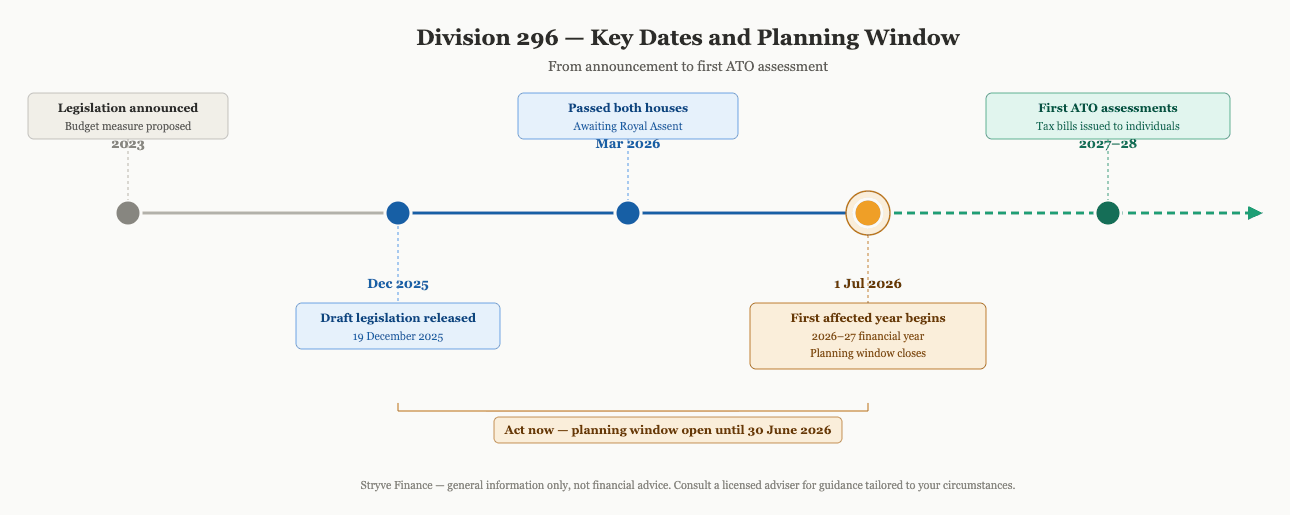
The legislation passed both houses of Parliament in March 2026. It is now awaiting Royal Assent. The first affected financial year is 2026-27, with ATO assessments expected to land in 2027-28.
If you spent decades building your super as a tax-efficient retirement vehicle, you are right to feel frustrated. The rules you planned around are shifting. That is a legitimate response, and you are not alone in it.
This guide explains exactly how the division 296 super tax is calculated, who it affects, and what practical options you have.
That includes strategies outside super that most guides on superannuation tax changes 2026 completely ignore.
How Division 296 is Calculated
The ATO looks at your Total Superannuation Balance (TSB) across all funds at the start and end of the financial year. It then adjusts for contributions you made and withdrawals you took during the year. The result is your calculated “earnings” for that period.
Next, the ATO works out what proportion of your TSB sits above $3 million. That proportion of your earnings is then taxed at 15%.
The critical detail most people miss: “earnings” under this measure includes unrealised capital gains. If the assets inside your super grow in value on paper but you have not sold them, that paper growth still counts. You can owe tax on gains you have never actually received. This is the most controversial element of the super balance tax, and it is the one that catches SMSF (self-managed super fund) trustees with property or growth assets off guard.
Here is a worked example to make it concrete.
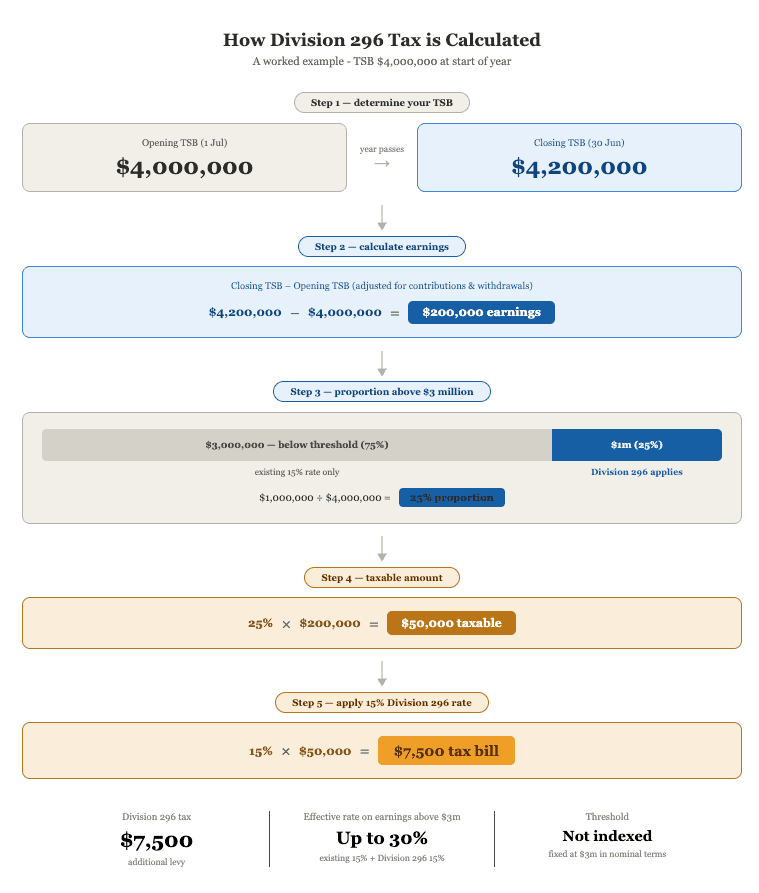
Step 1: Determine your TSBYour TSB at the start of the financial year is $4,000,000. At the end of the year, after adjusting for contributions and withdrawals, your TSB is $4,200,000.
Step 2: Calculate your earnings Earnings = closing TSB minus opening TSB, adjusted for net contributions and withdrawals. In this case, earnings are $200,000.
Step 3: Calculate the proportion above $3 million The amount above $3 million at the start of the year is $1,000,000. The proportion is $1,000,000 / $4,000,000 = 25%.
Step 4: Calculate the taxable amount 25% of $200,000 = $50,000.
Step 5: Apply the 15% Division 296 tax rate 15% of $50,000 = $7,500.
That $7,500 is on top of the existing 15% concessional tax rate your fund already pays on earnings. This means the effective tax rate on those earnings attributable to the balance above $3 million could reach 30%. The super tax 2026 changes do not replace the existing rate. They stack on top of it.
The $3 million threshold and bracket creep explained
The $3 million threshold is the trigger for Division 296. Once your TSB exceeds this amount, the additional 15% tax applies to the proportion of earnings above it, as shown in the worked example above.
The $3 million threshold is not indexed to inflation. This is one of the most significant and least-discussed features of the legislation. Unlike many other tax thresholds that rise with the cost of living, the $3 million figure is fixed in nominal terms. It will not increase year on year.
What that means in practice is straightforward. A super balance of $2.4 million today, growing at an average of 7% per year, would cross $3 million in roughly four to five years without any additional contributions. At 8% growth, the same balance crosses the threshold in around three to four years.
Over a 10-year horizon, even a $1.8 million balance could be drawn into Division 296 scope. The combination of a fixed threshold and compounding returns means the number of Australians affected will grow substantially over time. The estimated 80,000 people currently in scope is a floor, not a ceiling.
This is the structural argument for why planning now matters even if you are below the threshold today. Every year that passes without action is a year in which compounding returns are doing the work for the ATO.
Division 296 vs Existing Super Tax: How the Rates Compare
Division 296 does not replace the existing concessional tax rate. It adds to it. Here is how the two regimes compare:
| Before Division 296 | After Division 296 | |
|---|---|---|
| Earnings below $3m threshold | 15% concessional rate | 15% concessional rate (unchanged) |
| Earnings above $3m threshold | 15% concessional rate | 15% + 15% = up to 30% effective rate |
| Unrealised capital gains included? | No, only realised gains taxed | Yes, paper gains on unsold assets taxed |
| Threshold indexed? | N/A | No, fixed at $3 million in nominal terms |
The estimated 80,000 Australians currently affected will grow significantly as the fixed threshold and compounding returns pull more people into scope over time.
Who is Affected by Division 296
Based on ATO data, approximately 80,000 Australians are currently estimated to be impacted by Division 296. But the profile of who this affects is broader than “the ultra-wealthy.”
The typical person caught by the tax on super over 3 million includes high-net-worth retirees already in pension phase, SMSF trustees holding property or concentrated share portfolios, and business owners who maximised concessional and non-concessional contributions over decades. Many of these people are not extravagantly wealthy. They are disciplined savers who followed the rules as they existed.
If you are under $3 million today, do not assume this does not apply to you. Investment growth, employer contributions, and compounding can push your TSB over the threshold faster than you expect. The $3 million threshold is not indexed, which makes bracket creep a certainty rather than a risk.
One important planning detail: individuals subject to Division 296 may elect to have the tax paid from their super fund rather than from personal funds. This election is a meaningful choice that affects both your cash flow and your super balance trajectory.
Strategies to Manage Your Division 296 Liability
If your TSB is above or approaching $3 million, here is how to think through your options.
Super-internal strategies
Consider rebalancing your portfolio toward lower-growth or income-focused assets. Because Division 296 captures unrealised capital gains, reducing the growth profile of your super holdings can directly reduce your taxable earnings under the new measure.
Withdrawing the excess above $3 million into your personal name or into a family trust structure is another option. This removes those assets from the TSB calculation entirely, which eliminates the Division 296 exposure on that capital. Assets held in a family trust are generally taxed at the trustee’s or beneficiaries’ marginal rates, which may be lower than 30% depending on how distributions are structured across family members. The key trade-off is that assets moved outside super permanently lose access to super’s concessional 15% tax environment, once withdrawn, they cannot be re-contributed without counting toward contribution caps.
Stryve Finance can help you model the long-term impact of this restructuring alongside your broader mortgage and property strategy, so you understand the full picture before acting.
Timing contributions and withdrawals strategically around the 30 June measurement date can also influence your TSB at the point the ATO assesses it.
The Election Option
You can elect to have Division 296 tax paid from your super fund rather than from personal funds. For retirees drawing a pension, this may preserve personal cash flow. For those still accumulating, it reduces the compounding base inside super. Neither option is universally better. It depends on your circumstances.
What is Still Uncertain
The legislation was first announced in 2023 and went through significant consultation. Draft legislation was released on 19 December 2025. But ATO regulations and implementation guidance are still pending. Some details may shift before the first assessments are issued. Any strategy you implement now should be reviewed once final rules are confirmed.
How Home Equity Can Complement Your Super Strategy
Here is the angle most Division 296 guides miss entirely.
For retirees who want to reduce super drawdowns or keep their TSB near or below the $3 million threshold, accessing home equity is an alternative income source that sits completely outside the super system.
Reverse mortgages allow you to draw on the equity in your home without selling it. The proceeds are not classified as income and are not taxable. For a detailed look at reverse mortgage tax implications, that contrast with the new super tax is worth understanding.
This makes home equity a tax-efficient lever for funding retirement expenses without increasing your TSB or triggering Division 296. Learn how reverse mortgages work and whether they could help you manage your super balance.
The Home Equity Access Scheme is a government-backed option worth exploring alongside private reverse mortgage products. Stryve Finance is a specialist mortgage broker with access to 50+ lenders and full commission transparency, so you can compare your home equity options clearly and without hidden costs.
These are tools to explore with your adviser, not blanket recommendations. But they belong in the conversation, especially for asset-rich retirees whose wealth is split between super and property.
What SMSF Trustees Need to Watch
If you hold property inside your SMSF, Division 296 creates a specific challenge.
Property valuations directly impact your TSB calculation. Because the tax captures unrealised capital gains, a property that appreciates in value on paper increases your Division 296 liability even if you have no intention of selling.
The problem is liquidity. Unlike shares, you cannot sell 10% of a property to bring your balance below $3 million. Property is lumpy and illiquid, which makes managing your TSB around the threshold far more difficult.
SMSF trustees who have used borrowing strategies to acquire property inside super should reassess those structures. The economics of holding leveraged property in super may look different under Division 296. Review your SMSF borrowing strategy in light of these changes.
A Simple Decision Framework if Your Super is Near $3 million
If your TSB is above or approaching the threshold, here are five steps to work through now.
- Check your TSB across all funds. This includes any APRA-regulated funds, SMSFs, and defined benefit interests. The ATO aggregates everything.
- Estimate your projected balance at 30 June 2027. Factor in expected investment returns, contributions, and any planned withdrawals. This is the first measurement date that matters.
- Assess whether your asset mix creates unrealised gains exposure. Growth assets and property are the biggest contributors to paper gains that Division 296 will capture.
- Consider both super-internal strategies and external options. Rebalancing, withdrawals, and tools like home equity or refinancing your broader financial structure all belong on the table.
- Speak with a tax professional and financial adviser before making changes. ATO regulations are still pending. Any action you take now should be stress-tested against the final rules once confirmed.
This is not a set-and-forget situation. The first affected financial year is 2026-27, which means the planning window is open now but will narrow quickly.
Want to understand how Division 296 affects your retirement strategy? Book a free consultation with Stryve Finance to explore your options, including whether home equity could work alongside your super plan. As a specialist mortgage broker, Stryve Finance brings together the lending market and your financial goals in one transparent conversation.
Frequently Asked Questions about Division 296
Who does Division 296 apply to?
Division 296 applies to individuals with a TSB above $3 million across all super funds, including SMSFs and APRA-regulated funds. Approximately 80,000 Australians are currently estimated to be affected.
How is Division 296 calculated?
The ATO measures your earnings for the financial year, including unrealised capital gains. The proportion of earnings attributable to your balance above $3 million is taxed at an additional 15%, on top of the existing 15% concessional rate.
Does Division 296 apply to SMSFs?
Yes. The tax applies to your TSB, which aggregates all super funds, including SMSFs. Property and other assets held inside an SMSF are included in the earnings calculation.
What can I do to reduce Division 296 tax?
Options include rebalancing to lower-growth assets, withdrawing amounts above $3 million from super, timing contributions and withdrawals strategically, and exploring external income sources like home equity. Consult a licensed adviser before acting.
Is the $3 million threshold indexed?
No. The $3 million threshold is not indexed to inflation. It is fixed in nominal terms, which means that as super balances grow through compounding returns and contributions, more Australians will be drawn into Division 296 scope over time. This is a key driver of the tax’s long-term reach and a critical reason to plan ahead even if you are below $3 million today.
When does Division 296 start?
The first affected financial year is 2026-27, starting 1 July 2026. First ATO assessments are expected in 2027-28.
Important Disclaimer
This article is general information only. It is not personal tax, financial, or legal advice. You should consult a licensed tax professional and financial adviser for guidance tailored to your personal circumstances.
The Division 296 legislation passed both houses of Parliament in March 2026 and is awaiting Royal Assent. ATO regulations and implementation guidance are still pending. Details may change before the first assessments are issued.
Dylan Bertovic is the Director and Senior Finance Broker at Stryve Finance, specialising in non-traditional lending solutions. He helps clients across Australia with tiny home loans, construction finance, equipment and asset lending, refinancing, and investor loans. With deep expertise in self-employed and renovation mortgages, Dylan is known for crafting tailored strategies that get results