Yes, you can get a reverse mortgage with an existing mortgage. The reverse mortgage pays off your remaining loan at settlement, and you receive whatever equity is left over. You must be aged 60 or older and have sufficient equity in your home after the existing loan is cleared.
If you are still carrying a mortgage in retirement, you are not alone. It is more common than most people realise, and the stress of meeting monthly repayments on a fixed income is real. Every dollar going to your home loan is a dollar not going to your living expenses, medical costs, or the things that make retirement worthwhile.
A reverse mortgage can solve two problems at once. It eliminates your monthly repayments entirely and unlocks additional equity, provided there is enough available after your existing loan is cleared. Reverse mortgages are available to homeowners aged 60 or older, and the amount you can borrow depends on your age and the value of your home.
If you are new to the concept, it is worth understanding how reverse mortgages work before diving into the specifics of what happens when you already have a loan in place.
How Does the Settlement Process Work When You Have an Existing Mortgage?
When you take out a reverse mortgage with an existing loan, your old mortgage is paid out in full on settlement day before any remaining funds are released to you. The reverse mortgage lender must hold first registered mortgage position on your property, so the discharge of your existing loan is a non-negotiable step.
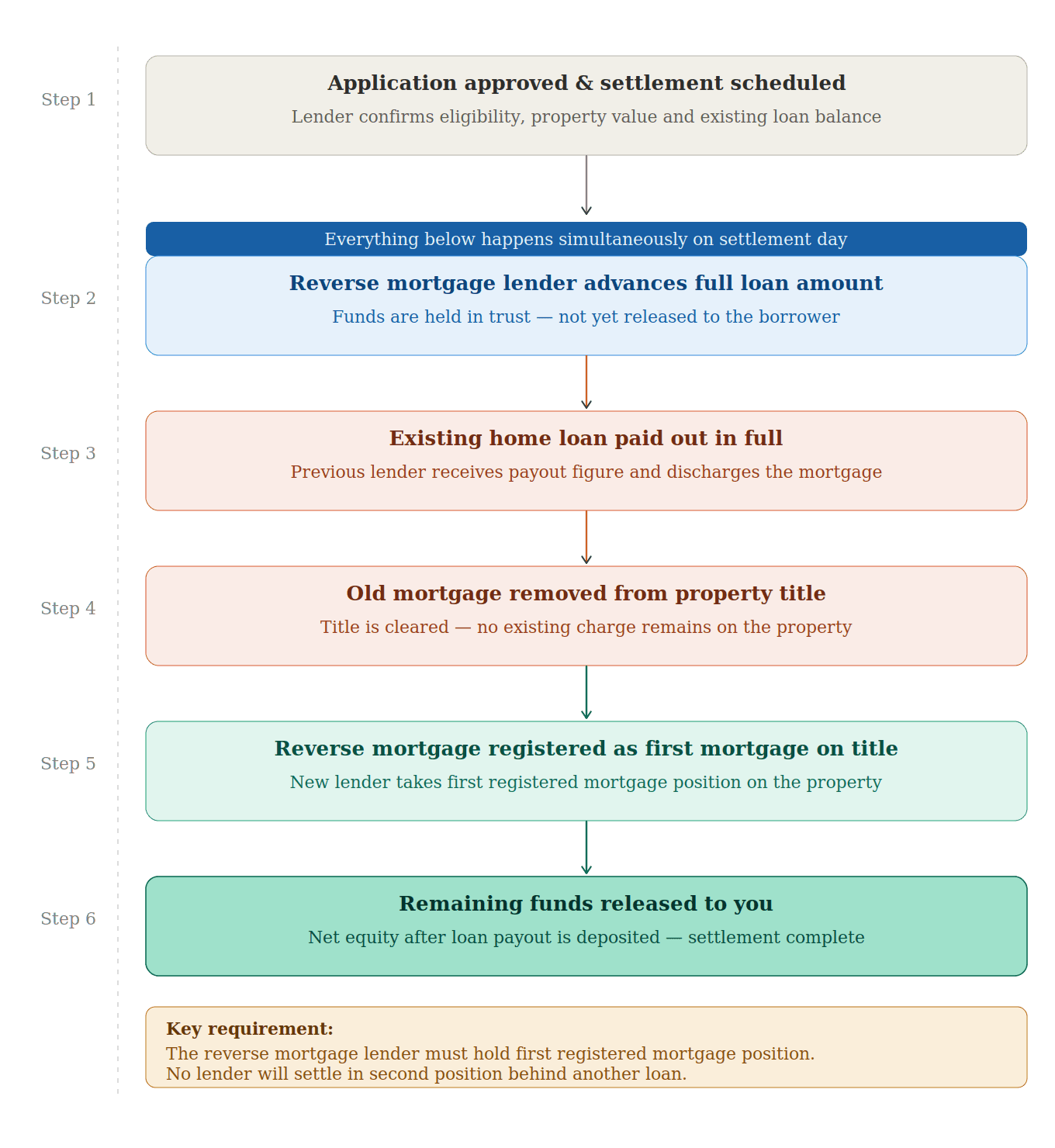
This is where most guides leave you guessing. Here is exactly what happens when you take out a reverse mortgage while you still have an existing home loan.
Everything happens on the same day at settlement. You do not need to find money to pay off your old loan separately. The process runs like this:
- Your reverse mortgage is approved and settlement is scheduled.
- On settlement day, the reverse mortgage lender advances the full loan amount.
- Those funds first discharge your existing home loan in full. Your old lender is paid out completely.
- The old mortgage is removed from your property title.
- The new reverse mortgage is registered as the first mortgage on the title.
- Only after all of that is complete are the remaining funds released to you.
The key requirement driving this process is that the reverse mortgage lender must hold first registered mortgage position on your property. No reverse mortgage lender will settle in second position behind another loan. That is why full discharge of your existing mortgage is a non-negotiable condition of approval.
From a practical standpoint, your broker and the lender's solicitors coordinate the entire process. Your old lender provides a payout figure, the new lender's legal team arranges simultaneous settlement, and the title transfer happens behind the scenes.
It is also worth knowing that reverse mortgage lenders are required to provide you with a reverse mortgage information statement before you sign anything. You then have a 14-day cooling off period after signing the contract, giving you time to reconsider if needed. These are consumer protections required under Australian law.
How Much Can You Borrow with an Existing Loan?
The amount you can access through a reverse mortgage is governed by an age-based LVR (loan-to-value ratio) cap. LVR is simply the maximum percentage of your property value that a lender will allow you to borrow. With reverse mortgages, older borrowers can access a higher percentage of their property value.
As a general guide, the LVR starts at around 15 to 20% at age 60 and increases with each year of age. Your equity, defined by MoneySmart as the value of your home less any money you owe on it, determines how much is actually available to you after the existing loan is cleared.
Here is a worked example:
The table below compares all three scenarios side by side:
| Age | Property Value | LVR Cap | Max Borrowing | Existing Loan | Net Funds Available |
|---|---|---|---|---|---|
| 72 | $700,000 | 25% | $175,000 | $120,000 | $55,000 |
| 68 | $600,000 | 22% | $132,000 | $80,000 | $52,000 |
| 78 | $850,000 | 30% | $255,000 | $150,000 | $105,000 |
Notice how the combination of age, property value, and existing loan balance dramatically changes the outcome. A higher property value or older age increases your borrowing capacity, while a larger existing loan reduces what you walk away with.
These are illustrative figures. Every lender calculates LVR slightly differently, and your actual numbers will depend on the specific lender, your property, and current lending criteria.
What Lenders Look for When You Have an Existing Mortgage
When you apply for a reverse mortgage with an existing loan in place, lenders assess several specific criteria:
- Existing loan balance relative to property value. If the balance is too high compared to your age-based LVR cap, the application will not proceed.
- Borrower age. You must be at least 60 years old. If there are two borrowers, the age of the youngest person is typically used.
- Property type and location. Standard residential properties in metropolitan and major regional areas are generally accepted. Rural, remote, or unusual property types may face restrictions.
- Property condition. The home needs to be in reasonable condition as it serves as the lender's security.
- Existing lender consent to discharge. Your current lender must agree to release the mortgage. This is rarely an issue, but it is a formal step in the process.
Not every lender has the same policies. Some are more flexible on property type, others on location. This is where working with a broker who has access to multiple lenders adds genuine value. Stryve Finance works with a broad lender panel and is transparent about lender commissions, so you know exactly where you stand.
MoneySmart strongly recommends getting independent legal and financial advice before proceeding with any reverse mortgage. This is good advice regardless of your situation.
Not sure if you meet the eligibility requirements? Check the full criteria on our reverse mortgage eligibility page.
The Rate Trade-Off: Higher Interest, No Repayments
Here is the honest truth about rates. You will swap your existing home loan rate, typically somewhere between 5% and 7%, for a reverse mortgage rate that currently sits around 8.5% to 9.3%. That is higher. You can check current reverse mortgage rates for up-to-date figures.
So why would anyone do this? Because the trade-off is about cash flow, not just interest rates.
If you are on a pension or drawing down super, eliminating monthly repayments of $800 to $1,500 or more can fundamentally change your day-to-day financial position. That money stays in your pocket every single month.
However, you need to understand what happens on the other side of that equation. With a reverse mortgage, interest compounds over time and is added to the loan balance. You are not making repayments, so the debt grows. Over 10 or 15 years, this compounding effect is significant.
The critical protection here is the no negative equity guarantee, required under the National Consumer Credit Protection Act. This means you can never owe more than the value of your home, regardless of how much the interest compounds. But it does mean the equity available to your estate or for future needs will reduce over time.
What if you do not have much equity left?
Sometimes the numbers simply do not work. If your existing loan balance is high relative to your property value, the amount available after payoff may be very small, or the reverse mortgage may not be viable at all.
Here is a concrete example. A 65-year-old with a $500,000 property and $140,000 remaining on their mortgage might have an LVR cap of around 20%, allowing a maximum of $100,000. That is less than the existing loan balance of $140,000, which means a reverse mortgage is not possible in this scenario.
If you find yourself in this position, there are other pathways worth exploring:
- Refinancing your existing loan to a lower rate, which could reduce your monthly repayments without changing the loan structure.
- The Home Equity Access Scheme, a government alternative to commercial reverse mortgages administered by Services Australia. It operates differently and may suit some borrowers better.
- Speaking to a broker to map out all your options. Stryve Finance charges no hidden fees, and an honest conversation about your situation costs you nothing.
It is worth weighing up the pros and cons of reverse mortgages before making any decision, especially if your equity position is tight.
Frequently Asked Questions
Can I use a reverse mortgage to pay off my existing home loan?
Yes. The reverse mortgage proceeds are used to pay off your existing mortgage at settlement. This is a standard part of the process, and the payout happens automatically on settlement day.
Does my existing lender need to agree?
Yes. Your existing lender must consent to discharge the mortgage so the reverse mortgage lender can take first registered mortgage position on your property title. Your broker handles this as part of the application process.
Can I owe more than my home is worth?
No. Under the National Consumer Credit Protection Act, all Australian reverse mortgage lenders must offer a no negative equity guarantee. You can never owe more than the value of your home.
What is the minimum age for a reverse mortgage in Australia?
You must be at least 60 years old. If you are applying with a partner, the youngest borrower's age is typically used to determine the LVR cap.
Should I get independent advice before proceeding?
Yes. MoneySmart and lenders strongly recommend independent legal and financial advice before taking out a reverse mortgage. You also receive a 14-day cooling off period after signing the contract.
Find Out Exactly How Much You Could Unlock
The only way to know exactly how much you would have left after paying off your current loan is to talk to a broker. General guides and online estimates get you in the ballpark, but your actual numbers depend on your specific property value, existing loan balance, and age.
Stryve Finance has access to over 50 lenders, is fully transparent about lender commissions, and charges no hidden fees. We will tell you straight whether a reverse mortgage makes sense for your situation, or whether another option is a better fit.
Book a free consultation with Stryve Finance and we will run the numbers for your specific situation.
Dylan Bertovic is the Director and Senior Finance Broker at Stryve Finance, specialising in non-traditional lending solutions. He helps clients across Australia with tiny home loans, construction finance, equipment and asset lending, refinancing, and investor loans. With deep expertise in self-employed and renovation mortgages, Dylan is known for crafting tailored strategies that get results