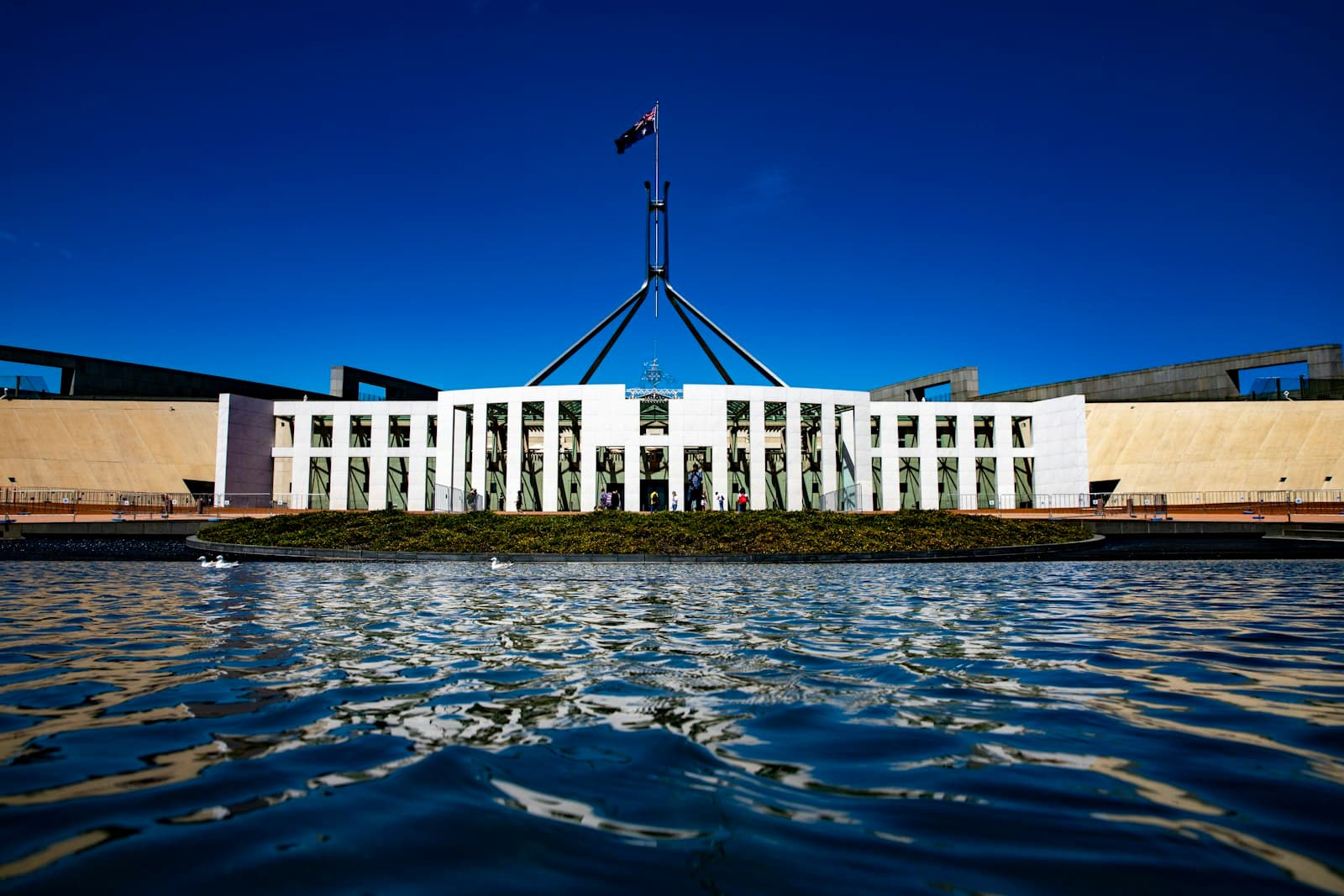
If you’re searching for the best suburbs to invest in Canberra, you’re already ahead of most investors. At Stryve Finance, Sydney’s mortgage brokerage, we work with investors across Australia, and Canberra is consistently underestimated. While Sydney and Melbourne dominate headlines, Canberra delivers something most capitals cannot: a structurally stable, high-income tenant base that doesn’t disappear when the economy wobbles.
The reason is the Australian Public Service (APS). With approximately 170,000 APS employees, the majority based in the ACT, Canberra has a built-in demand engine for rental properties. Add Australian Defence Force personnel, contractors, and the broader public sector ecosystem, and you get a tenant pool defined by secure employment and above-average incomes.
The numbers support the thesis. Canberra’s unemployment consistently tracks around 3% to 3.5%, below the national average. Vacancy rates sit between 1% and 2%, well under the 3% balanced-market threshold. Gross rental yields for units in top suburbs reach up to 6%. For comparison, Sydney units typically yield 3% to 4% and Melbourne units 3.5% to 4.5%, making Canberra a compelling yield play for investors who do their homework.
Canberra Property Market Snapshot for 2026
When evaluating the best suburbs in Canberra for 2026, the light rail corridor stands out as the defining infrastructure catalyst. Here is where the broader market sits.
Houses have a median price of approximately $950,000 to $1,000,000. A standard 20% deposit sits at $190,000 to $200,000.
Units offer a more accessible entry point, with medians around $550,000 to $600,000 and a 20% deposit of $110,000 to $120,000, making them the natural starting point for most Canberra investment strategies.
Yield ranges vary by type and location. Houses average 3.5% to 4.5% gross yield; units in high-performing suburbs reach 5% to 6%. The big infrastructure story for 2026 is the ACT light rail Stage 2 extension toward Woden, expected to lift rental demand and capital growth along the Phillip–Woden corridor.
High-Yield Suburbs for Cash Flow Investors
Cash flow investors want properties that cover their costs from day one. In Canberra, that means targeting outer suburbs with lower entry prices, stronger yields, and deep tenant demand from families and public servants.
Ngunnawal and Amaroo represent the residential core of the broader Gungahlin investment corridor, one of the ACT’s strongest yield precincts. The Gungahlin town centre itself anchors demand: light rail access, major retail, and a large employment catchment draw a mix of families, APS workers, and ADF personnel. Gungahlin town centre units have seen approximately 11.8% price growth over the past year, confirming the corridor’s momentum.
1. Ngunnawal
- Median price: Units from the low $500,000s; houses around $800,000 to $850,000
- Gross rental yield: Units approaching 5% to 5.5%
- 1-year growth (approx.): Houses ~3% to 5%; units ~8% to 12% (Gungahlin corridor, Domain/CoreLogic)
- 5-year growth (approx.): Houses ~25% to 35%; units ~15% to 25%
- Tenant profile: Families, APS employees, and ADF personnel drawn to affordable housing with good school access
- Financing note: A 20% deposit on a $500,000 unit requires $100,000. Some investors explore higher LVR options, though LMI (Lenders Mortgage Insurance) applies above 80% LVR
2. Amaroo
- Median price: Units from the mid $500,000s; houses around $850,000 to $900,000
- Gross rental yield: Units around 5% to 5.5%
- 1-year growth (approx.): Houses ~3% to 5%; units ~8% to 12%
- 5-year growth (approx.): Houses ~25% to 35%; units ~15% to 20%
- Tenant profile: Young professionals and growing families, many employed in the public sector
- Financing note: A 20% deposit on a $550,000 unit requires $110,000. Principal and interest loans suit yield-focused investors building equity while collecting rent
3. Greenway
- Median price: Units from the mid $400,000s to low $500,000s
- Gross rental yield: Reported at up to 6%, among the highest in the ACT
- 1-year growth (approx.): Units ~4% to 7%; supported by light rail proximity
- 5-year growth (approx.): Units ~20% to 30%
- Tenant profile: Government workers, students, and professionals. Light rail Stage 2 toward Woden is expected to strengthen demand further
- Financing note: A 20% deposit on a $500,000 unit requires $100,000, one of the lowest entry points in the ACT
Want to see what you could borrow for a Canberra investment property? Try Stryve Finance’s borrowing capacity calculator.
Capital Growth Suburbs for Long-Term Investors
If your strategy is to build wealth through price appreciation over 10 to 20 years, Canberra’s inner suburbs offer a compelling case. Yields are lower, but growth fundamentals are strong: proximity to Parliament House and government departments, character housing with limited new supply, and robust owner-occupier demand.
1. Griffith
- Median price: Houses around $1,400,000 to $1,600,000
- Gross rental yield: Around 3.5% to 4% for houses
- 1-year growth (approx.): Houses ~2% to 4%; blue-chip suburb with lower volatility
- 5-year growth (approx.): Houses ~30% to 45%
- Tenant profile: Senior public servants, parliamentary staff, diplomats. Short-term rental demand spikes during parliamentary sitting weeks
- Financing note: A 20% deposit requires $280,000 to $320,000. At these price points, negative gearing becomes relevant, investors can offset rental losses against taxable income, reducing after-tax holding cost
2. Ainslie
- Median price: Houses around $1,200,000 to $1,400,000
- Gross rental yield: Around 3.5% to 4%
- 1-year growth (approx.): Houses ~2% to 5%; CoreLogic noted some short-term softness in 2024 but strong long-run track record
- 5-year growth (approx.): Houses ~35% to 50%
- Tenant profile: Professionals, senior APS employees, and families who value the inner-north lifestyle
- Financing note: The 50% CGT discount applies to investment properties held more than 12 months, making Ainslie’s growth profile particularly tax-effective for patient investors
3. Braddon
- Median price: Units around $500,000 to $650,000
- Gross rental yield: Units around 4.5% to 5%
- 1-year growth (approx.): Units ~3% to 5%; ongoing densification and urban renewal supporting values
- 5-year growth (approx.): Units ~20% to 30%
- Tenant profile: Young professionals, interstate workers on government contracts, and short-stay tenants during parliamentary sitting weeks
- Financing note: A 20% deposit on a $600,000 unit requires $120,000 — a lower entry point into the inner-city growth story
For growth-focused investors, the combination of negative gearing and the 50% CGT discount makes these suburbs work even when rental yield alone doesn’t cover costs.
Balanced Suburbs Offering Yield and Growth
These suburbs offer a blend of both: moderate yields now with genuine upside potential.
1. Belconnen
- Median price: Units from the low $400,000s; houses around $800,000 to $900,000
- Gross rental yield: Units around 5% to 5.5%
- 1-year growth (approx.): Units ~17.8% (Domain); one of the top-performing Canberra apartment markets in 2024
- 5-year growth (approx.): Units ~25% to 40%
- Tenant profile: University of Canberra students, APS workers, and families
2. Phillip (Woden)
- Median price: Units from the mid $400,000s to low $500,000s
- Gross rental yield: Reported at 5% to 6% for well-located units
- 1-year growth (approx.): Units ~4% to 8%; light rail catalyst lifting values
- 5-year growth (approx.): Units ~25% to 35%
- Tenant profile: Government workers at the Woden government precinct, health workers at Canberra Hospital
3. Tuggeranong: Kambah and Wanniassa
Tuggeranong is Canberra’s southernmost district and is frequently overlooked by investors chasing inner-suburb prestige. That oversight creates opportunity. Kambah and Wanniassa offer genuine affordability, stable family tenant demand, and yields that sit between the cash flow and growth benchmarks.
4. Kambah
- Median price: Houses around $700,000 to $800,000; units from the low $400,000s
- Gross rental yield: Houses around 4% to 4.5%; units around 5%
- 1-year growth (approx.): Houses ~3% to 6%; Tuggeranong outperformed broader ACT in family housing in 2024
- 5-year growth (approx.): Houses ~25% to 35%
- Tenant profile: Established families, long-term tenants, APS employees seeking space and value
- Financing note: A 20% deposit on a $750,000 house requires $150,000
5. Wanniassa
- Median price: Houses around $700,000 to $780,000
- Gross rental yield: Houses around 4% to 4.5%
- 1-year growth (approx.): Houses ~3% to 6%
- 5-year growth (approx.): Houses ~25% to 35%
- Tenant profile: Families and long-term public sector tenants drawn to value and amenity
Tuggeranong suits investors who want solid fundamentals without the premium of inner-suburb pricing. Vacancy rates across the ACT remain between 1% and 2%, supporting income sustainability here as elsewhere.
Phillip is arguably the best value play in Canberra right now: near-top-tier yields with a genuine infrastructure catalyst for growth layered on top.
Suburb Comparison Table
The table below summarises key metrics across all profiled suburbs. Use it as a quick-reference tool before speaking with a Stryve Finance mortgage broker about structuring your purchase.
| Suburb | Type | Median Price | Gross Yield | Profile | 20% Deposit |
|---|---|---|---|---|---|
| Ngunnawal | Unit | ~$500,000 | 5%–5.5% | Cash Flow | ~$100,000 |
| Amaroo | Unit | ~$550,000 | 5%–5.5% | Cash Flow | ~$110,000 |
| Greenway | Unit | $450k–$500k | Up to 6% | Cash Flow | ~$100,000 |
| Griffith | House | $1.4m–$1.6m | 3.5%–4% | Growth | $280k–$320k |
| Ainslie | House | $1.2m–$1.4m | 3.5%–4% | Growth | $240k–$280k |
| Braddon | Unit | $500k–$650k | 4.5%–5% | Growth | $100k–$130k |
| Belconnen | Unit | ~$430,000 | 5%–5.5% | Balanced | ~$86,000 |
| Phillip | Unit | $450k–$500k | 5%–6% | Balanced | ~$100,000 |
| Kambah | House | $700k–$800k | 4%–4.5% | Balanced | $140k–$160k |
| Wanniassa | House | $700k–$780k | 4%–4.5% | Balanced | $140k–$156k |
Source: CoreLogic, Domain, REIACT. Medians and yields are approximate and subject to change. Consult a Stryve Finance mortgage broker before making investment decisions.
The table above gives you the numbers. The map below gives you the geography. Understanding where each suburb sits relative to the city centre, the light rail corridors, and the major employment precincts helps explain why certain yields and growth profiles land where they do, and why the Stage 2 extension toward Woden changes the calculus for Phillip and Greenway specifically.
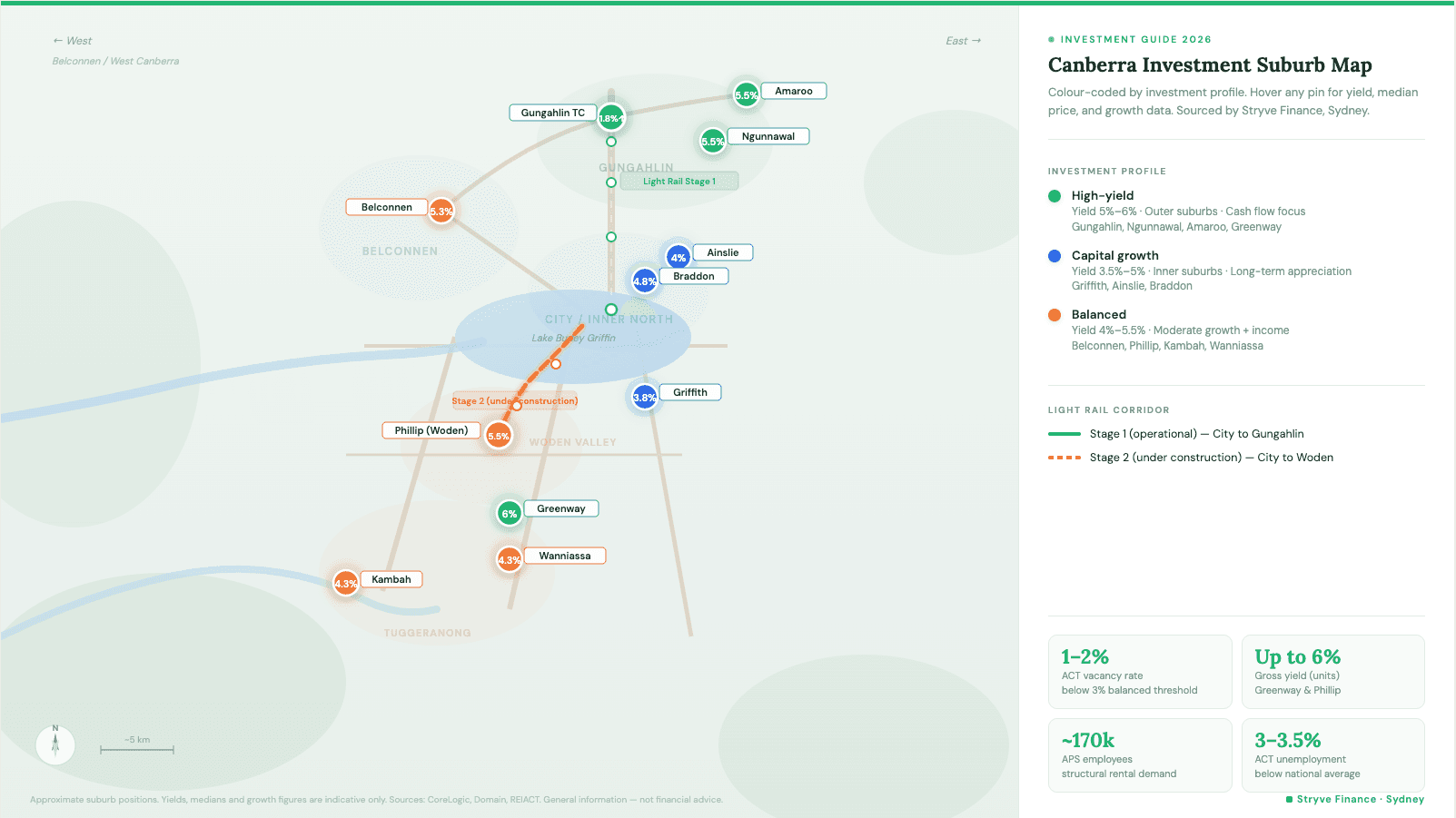
One pattern stands out clearly on this map: the highest-yield suburbs cluster at the northern and southern ends of the light rail spine, while the strongest growth story concentrates in the inner ring within 5 kilometres of the Parliamentary Triangle. If you are choosing between cash flow and growth, you are effectively choosing between north and south on this map. If you want both, Phillip sits at the intersection, on the Stage 2 corridor, within range of the Woden government precinct, and still carrying a unit median well below the inner-north alternatives. Before you shortlist suburbs, speak with a Stryve Finance mortgage broker about how your borrowing capacity maps to the entry price in each zone.
How Canberra's Leasehold Land System Works for Investors
Canberra’s leasehold system means all ACT residential properties are held under 99-year Crown leases rather than freehold title.
This is unique among Australian states and territories. Before you worry: Crown leasehold tenure does not prevent standard investment lending from major lenders, and in practice it does not materially affect resale. Banks have been writing loans on ACT leasehold properties for decades, and buyers treat these leases as functionally equivalent to freehold.
The ACT government also offers a land rent scheme allowing eligible buyers to lease land rather than purchase it, reducing upfront costs. However, eligibility criteria apply and not all lenders accept this structure. If you’re considering it, confirm your eligibility and your lender’s position before committing. Stryve Finance can clarify which lenders will and won’t accept leasehold lending for your specific scenario.
The takeaway: leasehold tenure is a feature of the Canberra market, not a flaw. Understand it and move on.
What Investors Need to Know About ACT Taxes and Tenancy Laws
The ACT government is gradually abolishing stamp duty and replacing it with higher annual land tax. For investors, this means lower upfront acquisition costs but higher ongoing holding costs. Short-term holders benefit; long-term holders pay more in cumulative land tax. Run the numbers for your scenario.
The ACT has tenancy law reforms that favour tenants, including restrictions on rent increases and eviction grounds. Land tax rates for investment properties are higher than in most states. These are real costs that affect your net yield.
Canberra’s geographic isolation means the market is smaller and less liquid than Sydney or Melbourne. Heavy reliance on government employment is a strength in stable times but a vulnerability if a future federal government pursues significant APS cuts. These risks don’t disqualify Canberra, but they belong in your decision-making.
How to Finance a Canberra Investment Property
Knowing where to buy is only half the equation. At Stryve Finance, a Sydney-based mortgage brokerage operating nationally, we help investors structure their Canberra purchases correctly from the start.
Deposit requirements: A 20% deposit on a median house requires $190,000 to $200,000; for units, $110,000 to $120,000. Borrowing above 80% LVR (loan-to-value ratio) triggers LMI (Lenders Mortgage Insurance), adding thousands to upfront costs.
Serviceability buffer: Under the Australian Prudential Regulation Authority (APRA) serviceability buffer, lenders must assess your loan at the actual rate plus a minimum 3% buffer. At a 6.5% rate, you’re assessed at 9.5%. This materially reduces borrowing capacity and is the single biggest reason investors are surprised at pre-approval stage.
Loan structure: Cash flow investors in high-yield suburbs typically favour principal and interest loans to build equity faster. Growth investors in inner suburbs often use interest-only periods to maximise cash flow while relying on capital appreciation.
Note: The First Home Owner Grant (FHOG) does not apply to investment purchases. It is available only to eligible owner-occupiers buying or building a new home.
Stryve Finance compares investment property loans across 50+ lenders to find the right structure for your Canberra purchase. Full lender commission transparency, no hidden fees. If you’re also considering other markets, our guide to the best suburbs to invest in Sydney applies the same financing-first approach.
Frequently Asked Questions about Investing in Canberra
Is Canberra a good place to invest in property?
Yes, Canberra is a strong investment market driven by approximately 170,000 APS employees, vacancy rates between 1% and 2%, and unemployment consistently below the national average at around 3% to 3.5%. Compared to Sydney (unit yields of 3% to 4%) and Melbourne (3.5% to 4.5%), Canberra units yielding 5% to 6% offer materially better cash flow from a lower median price base. These fundamentals reduce rental default risk and support long-term yield sustainability.
What rental yield can I expect in Canberra?
Gross rental yields in Canberra range from 3.5% to 6% depending on property type and suburb. Houses across the ACT average 3.5% to 4.5%. Units in high-performing suburbs like Greenway and Phillip can reach up to 6%. Your net yield will depend on land tax, management fees, and maintenance costs.
How much deposit do I need for an investment property in Canberra?
A standard 20% deposit on a median-priced house requires $190,000 to $200,000. For units, it's $110,000 to $120,000. Borrowing above 80% LVR is possible but triggers LMI.
Does Canberra's leasehold system affect getting a loan?
No. ACT properties are held under Crown leasehold tenure (99-year leases), but this does not prevent standard investment lending from major lenders. It is a unique feature of the Canberra market with no practical impact on loan approval. Stryve Finance works with lenders who write ACT leasehold loans regularly.
Ready to invest in Canberra? Book a free consultation with Stryve Finance to explore your financing options and get pre-approved for an investor loan.
This article provides general information only and does not constitute financial or investment advice. Property values, yields, and capital growth figures are approximate and subject to change. Consult a qualified financial adviser before making investment decisions.

Dylan Bertovic is the Director and Senior Finance Broker at Stryve Finance, specialising in non-traditional lending solutions. He helps clients across Australia with tiny home loans, construction finance, equipment and asset lending, refinancing, and investor loans. With deep expertise in self-employed and renovation mortgages, Dylan is known for crafting tailored strategies that get results