
If you've ever wondered how to use super to buy investment property in Australia, you're not alone. For many Australians, property has long been the cornerstone of wealth creation. According to the Australian Taxation Office (ATO), there are now over 600,000 Self-Managed Super Funds (SMSFs) managing more than $880 billion in assets as of 2024, accounting for nearly 26% of Australia's total superannuation pool. Increasingly, trustees are allocating a portion of these funds to property as a stable, long-term asset class.
However, using your super for property investment isn't as simple as withdrawing money from your super account. The process is heavily regulated by the Australian Taxation Office (ATO) and requires careful setup, compliance, and expert advice.
In this guide, we'll walk you step-by-step through how to use Super to buy investment property, including:
- How SMSFs make property investment possible.
- The rules you must follow under Australian superannuation law.
- How to structure your SMSF property loan correctly.
- The benefits and opportunities available when investing through your super.
Whether you're an experienced investor or just exploring ways to grow your super, this article will help you understand how to make property part of your retirement strategy, safely and strategically.
Can You Use Super to Buy Investment Property?
Yes, you absolutely can use your super to buy an investment property, but only under very specific conditions. The Australian Taxation Office (ATO) allows property purchases through a Self-Managed Super Fund (SMSF), which gives you direct control over how your retirement savings are invested.
Unlike traditional industry or retail super funds, an SMSF lets you choose the assets you want to invest in, including residential or commercial property. However, the ATO enforces strict rules to ensure that any investment made with superannuation serves only one purpose: to provide retirement benefits to fund members. This is known as the Sole Purpose Test.
Key Conditions You Must Meet:
1. You can only invest through an SMSF.
You cannot use your regular super fund to buy property directly; you must have an approved and compliantSelf-Managed Super Fund structure in place.
2. The property must be for investment purposes only.
The property purchased cannot be your home or a holiday house, and it cannot be used by you, your family, or any related parties.
3. You must buy at arm's length.
This means all transactions from purchase price to rent must reflect market value and cannot involve related entities or family members.
4. The investment must meet the Sole Purpose Test.
Every dollar in your SMSF must be used to build your retirement savings, not for personal or short-term financial gain.
When done correctly, buying property through your super can be a powerful long-term investment strategy. But when done incorrectly, it can lead to ATO penalties, compliance breaches, or even the loss of your fund's tax concessions.
At Stryve Finance, we specialise in helping Australians navigate these complex SMSF property rules, ensuring your investment strategy remains compliant, efficient, and profitable.
Setting Up an SMSF for Property Investment
To use your super to buy investment property, you first need a Self-Managed Super Fund (SMSF). An SMSF lets you control how your super is invested. including buying property, but it must follow ATO rules.
Basic Steps to Set Up an SMSF:
- Create and register your SMSF with the ATO.
- Set up a bank account for the fund (separate from personal accounts).
- Develop an investment strategy that includes property.
- Ensure annual audits and compliance every year.
Most people use an accountant or financial adviser to help with setup. The ATO and financial planners generally recommend an SMSF balance of at least $200,000 to make property investment cost-effective. Recent data shows that SMSFs with balances below $200,000 often see annual administrative costs consuming up to 2%-3% of total assets, compared to just 0.5%-1% for larger funds. Source: ASIC SMSF Cost Analysis 2023.
Stryve Finance can help you structure your SMSF and arrange an SMSF loan to make your investment property purchase simple and compliant.
Step-by-Step How to Use Super to Buy Investment Property
Once your Self-Managed Super Fund (SMSF) is established, it's time to take the next big step using your super to buy an investment property. This process involves several stages, from defining your investment strategy to finalising the purchase and managing the property within your SMSF.
Here's exactly how to do it:
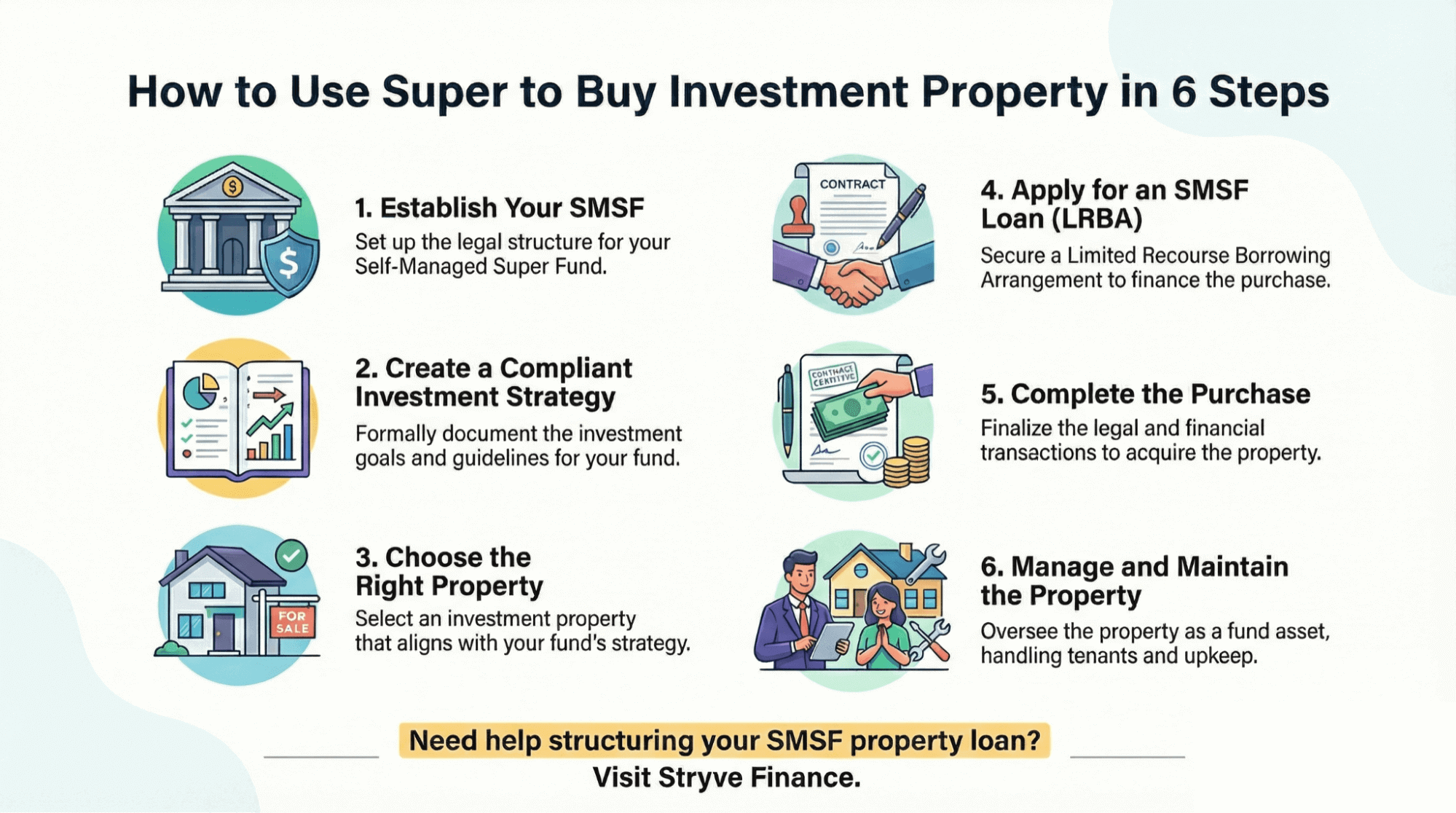
Step 1: Establish Your SMSF
Before your fund can invest, it must be fully registered with the Australian Taxation Office (ATO) and compliant with all superannuation regulations. This includes finalising your trust deed, appointing trustees, and opening a separate SMSF bank account for contributions and investment transactions.
Tip: Never use your personal account for SMSF expenses. Keeping finances separate is mandatory under ATO law.
Step 2: Develop an SMSF Investment Strategy
Your SMSF must have a formal investment strategy that shows how each asset (including property) aligns with your retirement goals. The strategy should outline:
- Expected returns from property (rental yield + capital growth)
- Liquidity management (ensuring cash flow for repayments and expenses)
- Diversification balance between property and other investments
- Insurance considerations for fund members
This is a compliance requirement, not just a suggestion; the ATO may request evidence that your property aligns with the SMSF's long-term purpose.
Step 3: Choose the Right Property
Once your strategy is in place, your SMSF can begin sourcing potential properties.
To remain compliant, the property must:
- Be solely for investment purposes (not owner-occupied).
- Be arms-length, you can't buy from or rent to family members or related entities.
- Offer high rental income and long-term growth potential.
Property investment remains one of the most popular asset classes among SMSF trustees. According to the ATO, SMSFs allocate around 19% of total assets to property, including 9% in residential and 10% in commercial real estate, highlighting the sector's steady demand.
Step 4: Finance the Purchase (SMSF Loan / LRBA)
If your SMSF doesn't have enough cash to buy the property outright, you can borrow under aLimited Recourse Borrowing Arrangement (LRBA).
An LRBA allows your SMSF to take out a loan to purchase an asset, but limits the lender's claim to that property only. This protects other SMSF assets in the event of an issue.
Typical SMSF property loan features:
- Loan-to-Value Ratio (LVR): 70-80%
- Loan security: Only the purchased property
- Repayments: Made from SMSF income (rent + contributions)
- Lenders: Major banks and specialist SMSF lenders
At Stryve Finance, we specialise in arranging SMSF property loans that comply with ATO borrowing rules and maximise your fund's investment potential.
Step 5: Complete the Purchase
When you buy a property through your SMSF, the legal title must be held in the fund's name(not your personal name). All contracts, settlement payments, and mortgage documents must align with SMSF and LRBA rules. This ensures the property is officially owned by the fund and eligible for superannuation tax benefits.
Don't forget: Your SMSF auditor will review this documentation annually, so accuracy is key.
Step 6: Manage and Maintain the Investment
After settlement, your SMSF becomes the property owner and landlord. That means:
- All rental income must go directly into the SMSF's bank account.
- All expenses, such as maintenance, insurance, and loan repayments, must be paid from the same account.
- The property should be professionally managed to ensure compliance and cash-flow efficiency.
ATO audit data shows that approximately 12% of SMSFs receive compliance breaches annually, with the most common issues being poor record-keeping, non-arm's-length transactions, and property title errors.
When done correctly, this structure allows your super to grow through rental income and capital appreciation, all while benefiting from concessional tax rates.
At Stryve Finance, we simplify every step of using your super to buy investment property, from structuring your SMSF loan to ensuring your investment is fully compliant with ATO regulations.
Rules and Restrictions You Must Follow
When learning how to use super to buy investment property, it's critical to understand that every step must follow strict Australian Taxation Office (ATO) rules. These regulations exist to ensure that any property purchased through your Self-Managed Super Fund (SMSF) genuinely supports your retirement savings goal, not your personal benefit.
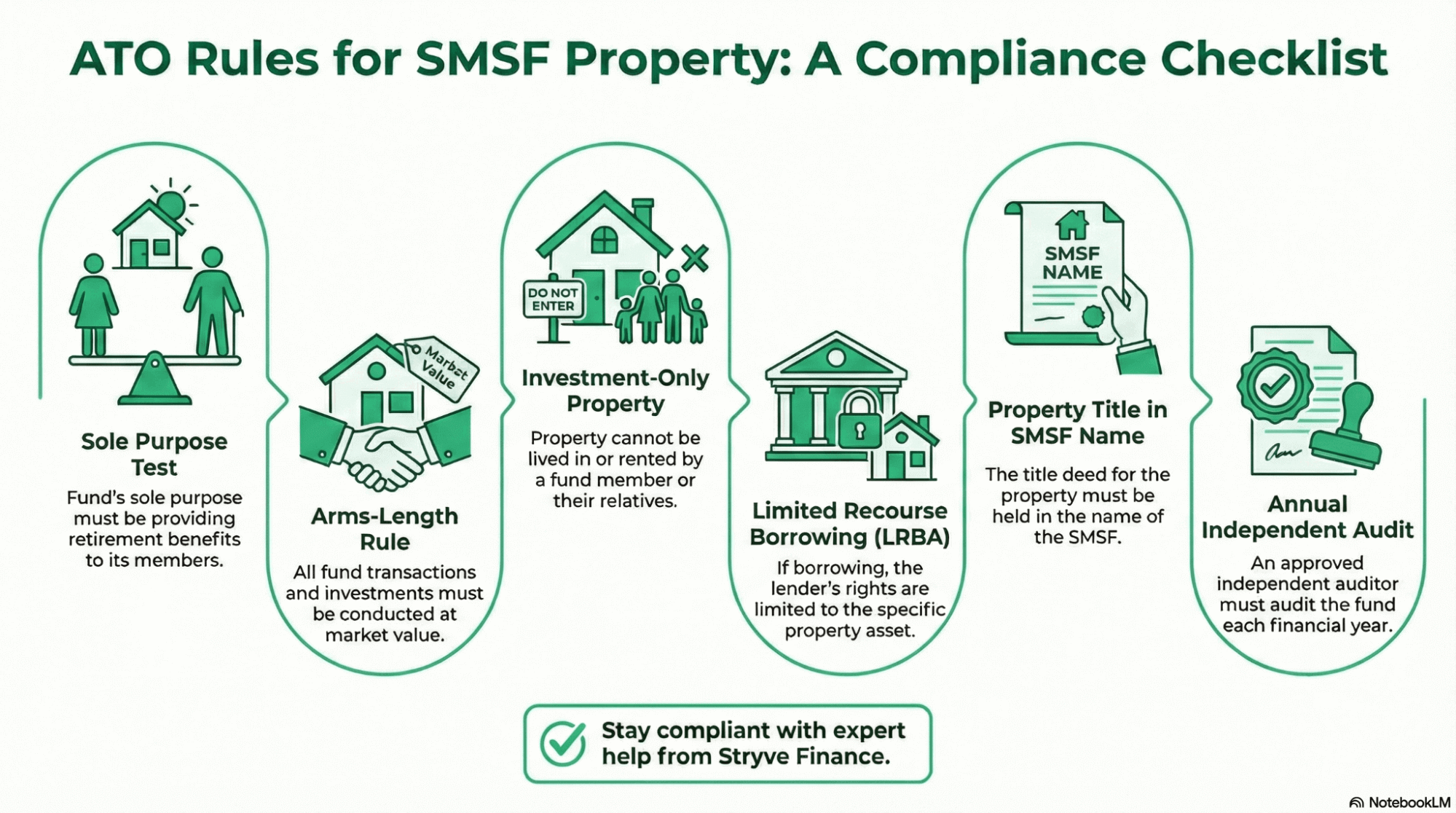
Here are the key rules and restrictions you must follow when using your super to invest in property:
1. The Sole Purpose Test
Every investment made through an SMSF must meet the Sole Purpose Test, meaning its only goal is to provide retirement benefits to the fund's members (or their dependents in the event of death).
What's allowed:
- Buying a residential or commercial property purely for rental income and capital growth.
What's not allowed:
- Living in the property.
- Letting family members use it.
- Buying a property for short-term personal gain or business use.
Failing the Sole Purpose Test can result in severe tax penalties or even the disqualification of your SMSF.
2. The Arms Length Rule
All SMSF transactions must be conducted at arm's length, meaning everything from the property purchase price to rental income must be at market value and involve no related parties.
You can buy from or rent to unrelated third parties. You cannot buy from, rent to, or lease from yourself, family, or related entities.
This rule ensures fairness and prevents trustees from using their SMSF for personal benefit before retirement.
3. Property Must Be an Investment Asset
Your SMSF can only buy property for investment purposes.
That means the property:
- Must generate rental income or long-term capital growth.
- Cannot be used as a home, holiday house, or office space for you or your business (unless it's a specific case of commercial property used at market rate, explained below).
Exception:
If your SMSF buys a commercial property, your own business can lease it from the SMSF, but only at market rent and under strict ATO-compliant conditions.
4. Limited Recourse Borrowing Rules
If your SMSF takes out a loan to buy property, it must be structured under a Limited Recourse Borrowing Arrangement (LRBA). This means that if the SMSF defaults, the lender can claim only the property, not any other fund assets. It's one of the key protections that make SMSF lending both low-risk and compliant.
5. Property Title and Ownership
When purchasing property with super, the property title must be registered in the name of the SMSF, not in an individual member's name.
For example:
- Correct: “John Smith Super Fund”
- Incorrect: “John Smith”
This distinction is legally and tax-critical; all contracts, loan documents, and titles must reflect the fund's name.
6. Ongoing Compliance and Auditing
Your SMSF must be audited every year by an approved SMSF auditor.
This ensures your property, income, and loan arrangements continue to comply with superannuation laws and ATO regulations.
At Stryve Finance, we work with accountants and SMSF auditors to ensure your investment property structure remains compliant and tax-efficient every year.
SMSF Property Loans Explained (Limited Recourse Borrowing)
One of the most important aspects to understand is how financing works. Most SMSFs don't have enough cash to buy a property outright, which is where an SMSF property loan, also known as a Limited Recourse Borrowing Arrangement (LRBA), comes into play.
An LRBA allows your Self-Managed Super Fund to borrow money to purchase an investment property while protecting other assets within the fund. It's a smart and compliant way to leverage your super for property growth.
Case Study: Using Super to Buy Investment Property
Here's a quick example through a Self-Managed Super Fund (SMSF).
Example:
Emma and David have a combined super balance of $250,000. They decide to establish an SMSF and invest in property.
- Property price: $550,000
- SMSF deposit: $250,000
- SMSF loan (LRBA): $300,000

The property earns $28,000 in annual rent. After paying loan interest and expenses, the SMSF has approximately $5,000 in net income, taxed at 15%.
Based on CoreLogic's 10-year national housing data, Australian property values have grown by an average of 4.9% annually between 2013 and 2023. Using this growth rate, a $550,000 property could reasonably reach around $885,000-$900,000 over a decade, consistent with long-term national trends. Source: CoreLogic Australian Housing Value Index 2024.
This simple strategy shows how using super to buy property can grow your retirement wealth faster while keeping your investment tax-efficient.
Why It Works:
- Leverages super savings through an SMSF loan.
- Keeps other SMSF assets protected under LRBA rules.
- Generates tax-effective income and growth.
Stryve Finance helps Australians set up and finance SMSF property investments safely, strategically, and in compliance with ATO rules.
How Stryve Finance Can Help You
At Stryve Finance, we make it easy for Australians to use their super to buy investment property safely and strategically.
We're helping clients from setup through settlement, ensuring every step complies with ATO rules and supports your retirement goals.
Our Services
- SMSF Loan Structuring: We design compliant loan solutions that fit your fund and property goals.
- Access to Lenders: We work with top SMSF lenders to secure competitive rates and smooth approvals.
- End-to-End Support: We coordinate with your accountant and adviser to keep your SMSF investment compliant and stress-free.
Why Choose Stryve Finance
- SMSF lending experts
- Simple, transparent process
- Tailored finance options for property investors
Your super can do more. Let's make it work harder for you.
With more than 1.1 million Australians now managing their own super, and property making up nearly one-fifth of all SMSF investments, there's never been a better time to explore your options.
Book a free consultation with Stryve Finance to see how your super can help you build long-term wealth through property.
Frequently Asked Questions (FAQs)
Below are the most common questions Australians ask when researching how to use super to buy investment property, along with clear, compliant answers you can trust.
1. Can I use my super to buy an investment property?
Yes, you can, but only through a Self-Managed Super Fund (SMSF). You can't buy property using your regular retail or industry super fund. Your SMSF must comply with ATO rules, including the Sole Purpose Test, which requires that the property be purchased solely for investment, not for personal use.
2. Can I live in a property bought through my SMSF?
No. Under superannuation law, you cannot live in or use a property owned by your SMSF. It must be an investment property that generates rental income and is held solely for retirement benefit purposes.
3. How much super do I need to start an SMSF for property investment?
While there's no legal minimum, most experts and the ATO recommend having at least$150,000 to $200,000 in combined super. This ensures your SMSF remains cost-effective once setup and compliance costs are considered.
4. Can my SMSF buy multiple properties?
Yes, your SMSF can own multiple properties, provided it has sufficient funds and remains compliant with superannuation laws. Each purchase must fit within the fund's investment strategy and satisfy the arms-length rule.
5. Can my SMSF borrow money to buy property?
Yes, but only through a Limited Recourse Borrowing Arrangement (LRBA). This allows your SMSF to borrow funds while limiting the lender's claim to the purchased property. All loan repayments must come from the SMSF's bank account, using rental income or member contributions.
6. Can I buy commercial property with my SMSF?
Absolutely. Your SMSF can purchase commercial property, and your business can lease it back from the SMSF, provided the rent is at market value and meets ATO compliance rules. This can be a smart way for business owners to build equity and pay rent back into their super.
7. What are the tax benefits of using super to buy investment property?
Owning property inside your SMSF offers major tax advantages:
- Rental income is taxed at only 15%
- Capital gains are taxed at 10% after 12 months
- Tax-free rental income and capital gains once in retirement phase
These benefits make super-based property investment one of Australia's most tax-efficient wealth-building strategies.
8. What happens if I sell my SMSF property?
If you sell the property while your SMSF is in the accumulation phase, you may pay 10% Capital Gains Tax (CGT) if held for over 12 months. If sold during the pension (retirement) phase, any gains are completely tax-free.
9. Can I use my super to buy property overseas?
Technically, yes, but it's not recommended. Buying property outside Australia through an SMSF is complex, difficult to manage, and poses high compliance and audit risks. TheATO strongly advises caution, and most lenders won't fund overseas property purchases within SMSFs.
10. Do I need a mortgage broker for SMSF property loans?
Yes, working with an SMSF mortgage broker like Stryve Finance can save you time, stress, and compliance risks.
We help you:
- Choose the right lender
- Structure the loan under LRBA rules
- Ensure full ATO compliance
- Secure competitive rates and terms
At Stryve Finance, we specialise in SMSF property lending from strategy to settlement.

Dylan Bertovic is the Director and Senior Finance Broker at Stryve Finance, specialising in non-traditional lending solutions. He helps clients across Australia with tiny home loans, construction finance, equipment and asset lending, refinancing, and investor loans. With deep expertise in self-employed and renovation mortgages, Dylan is known for crafting tailored strategies that get results