If you're self-employed or run your own business, chances are you don't take a regular PAYG salary. Instead, you might pay yourself through dividends, a common and tax-effective strategy for company directors, startup founders, and trust beneficiaries in Australia.
But when it comes to applying for a home loan, this raises an important question:
Can you get a mortgage if you pay yourself in dividends?
The short answer is yes, but it's not always straightforward. While many Australian lenders are open to using dividend income for mortgage serviceability, they require the right documentation and consistency.
In this guide, we'll break down:
- How dividend-based income is assessed by lenders
- What documents do you need to qualify
- And how Stryve Finance helps self-employed clients get approved without a traditional salary
In 2025, the average self-employed borrower was approved for 15-20% less than PAYG applicants with the same gross income due to income shading. (Source: ABS, MFAA industry data, lender credit policy reviews). Let's dive in.
What Is Dividend Income (And Who Relies On It)?
Dividend income is money paid out to shareholders from a company's profits. Unlike a salary or wage, dividends are typically distributed periodically, often quarterly or annually, and the amount can vary depending on the performance of the business.
At Stryve Finance, we work with many self-employed Australians and business owners who rely primarily on dividend income instead of a regular PAYG salary. It's a common income structure for:
- Company directors or business owners who pay themselves from company profits
- Start-up founders who keep operating costs low by avoiding PAYG
- Trust beneficiaries receiving income from family trusts
- High-net-worth individuals living off investment portfolios or shares
While this can be a smart tax strategy, it presents unique challenges for home loan applications, especially with banks that prefer standard income streams. That's where specialist mortgage advice from Stryve Finance makes all the difference.
We help structure applications to clearly demonstrate that your dividend income is stable, ongoing, and reliable, even if it doesn't look like traditional employment on paper.
Do Australian Lenders Accept Dividend Income?
Yes, many Australian lenders will consider dividend income when assessing your mortgage application. However, the approval process depends heavily on how consistent, sustainable, and well-documented the income is.
Not all lenders treat dividend income the same, and the percentage of income they'll actually use can vary significantly depending on the lender type.
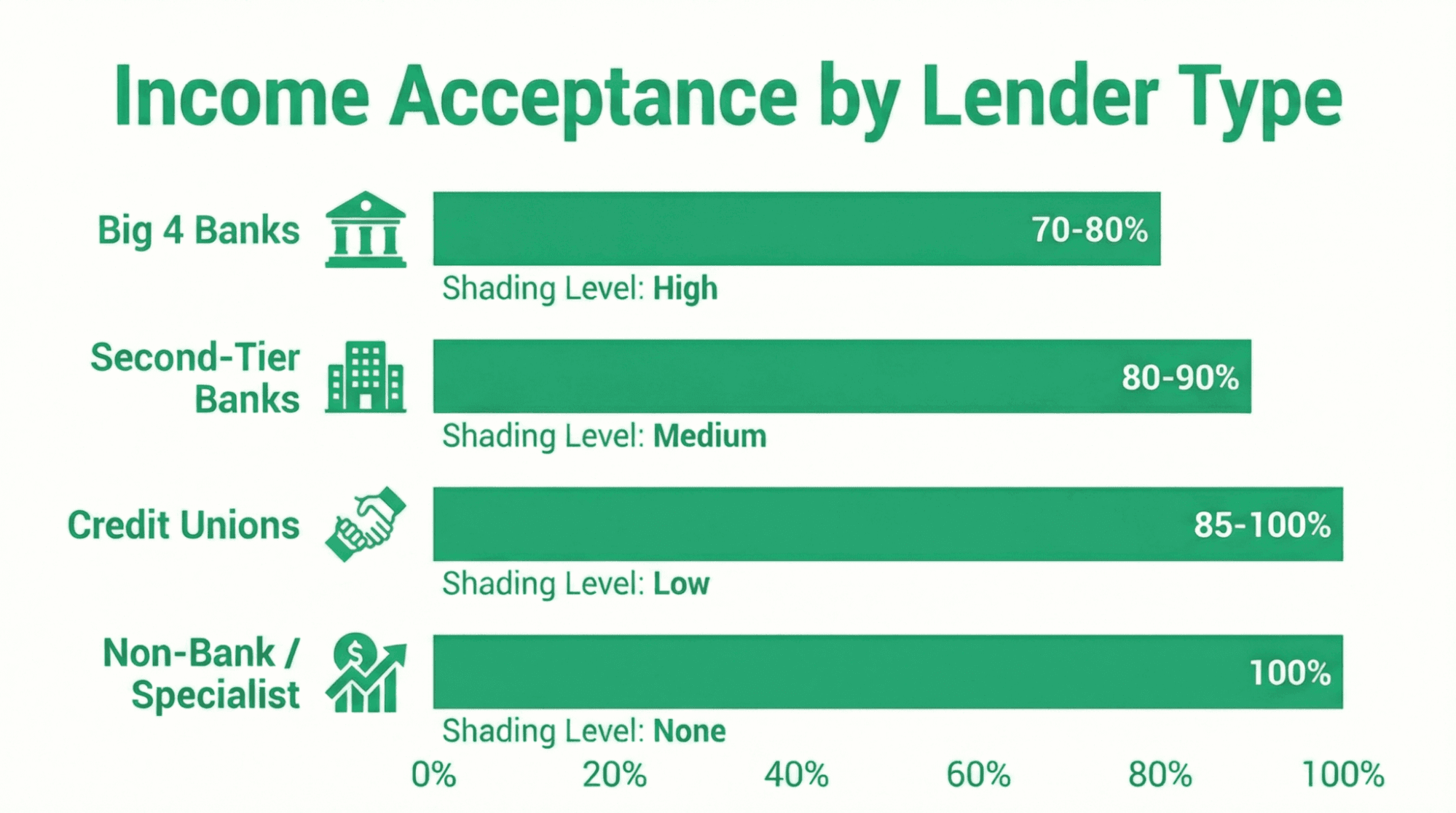
At Stryve Finance, we regularly help clients who don't receive a PAYG salary, including directors of private companies, trust beneficiaries, and sole traders, secure home loans using only dividend income. But not all lenders treat this income type equally.
Here's how most lenders assess dividend income:
- 1 to 2 years of tax returns showing declared dividends
- Notice of Assessment from the ATO confirming personal income
- Proof of regular dividend payments (not one-off lump sums)
- If paid from a private company, company financials may also be required
Some lenders may only count up to 80% of dividend income in serviceability calculations, particularly if it comes from a private company. According to Stryve Finance's lender panel, roughly 60% of major lenders apply income shading policies for self-employed applicants
Others, especially non-bank or specialist lenders, may accept 100% of your dividend income, provided it shows consistency.
That's why working with a broker like Stryve Finance is essential. We understand which lenders are flexible with non-traditional income sources and how to present your income to meet their approval criteria.
Documentation You'll Need
Getting a mortgage with dividend income in Australia is absolutely possible, but only if you can back it up with the right paperwork.
Lenders need to see that your dividend income is consistent, legitimate, and likely to continue. The stronger your documentation, the better your chances of approval, especially if you're applying with non-traditional income.
When assessing dividend income, lenders don't weigh all factors equally, with some elements carrying far more influence over approval than others.
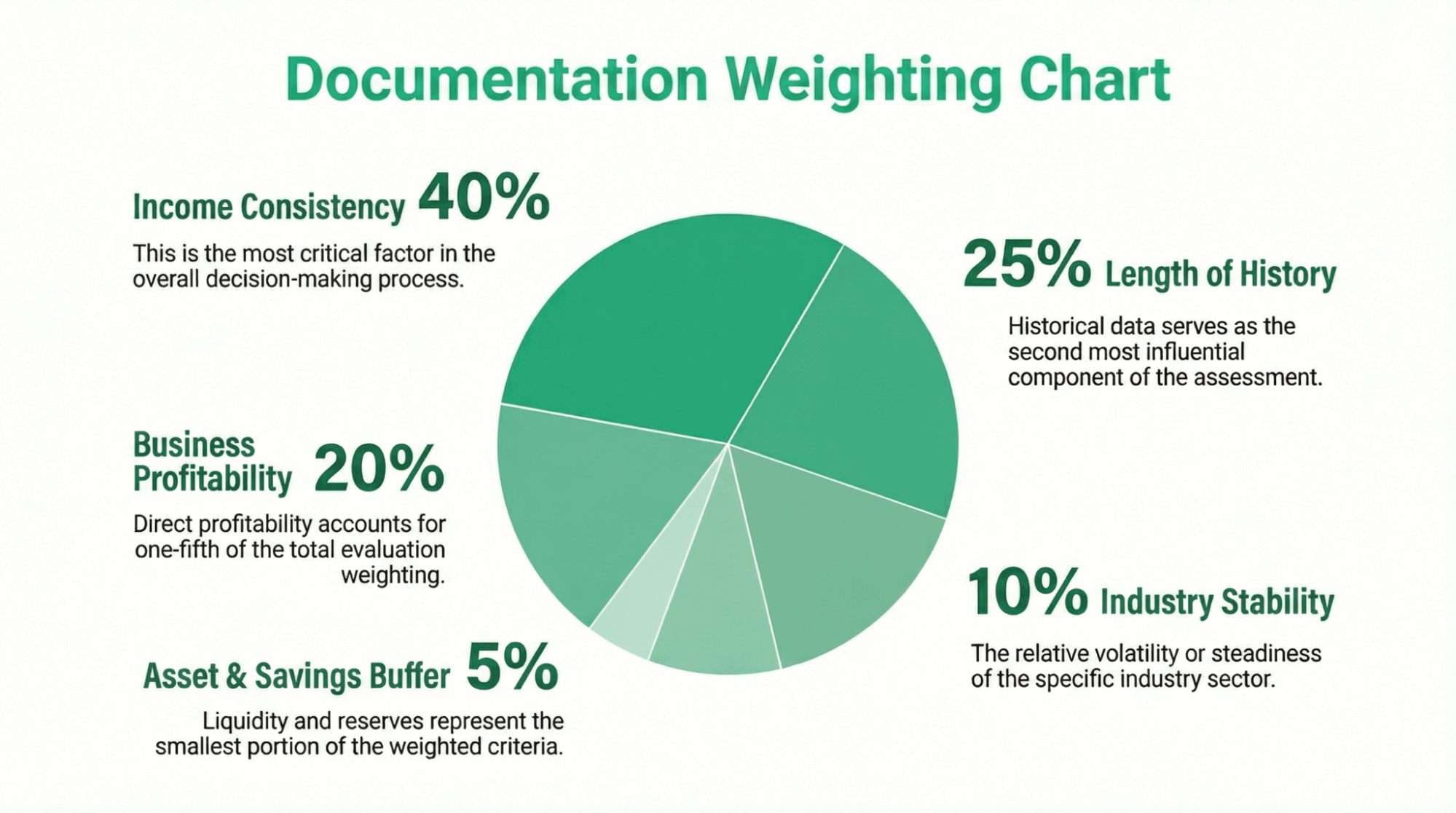
At Stryve Finance, we guide our clients through every step of the document preparation process to ensure their income is clearly and correctly presented.
For all applicants using dividend income:
- 1-2 years of personal tax returns: Shows declared dividend income and overall financial position.
- ATO Notices of Assessment: Verifies what the ATO has assessed as your taxable income.
- Dividend statements or shareholder distribution summaries: Confirms the source, frequency, and amount of payments.
- Bank statement: Demonstrates receipt of funds into your personal account.
Additional documents for company directors
If you're a director or shareholder of a private company paying yourself dividends, lenders may also request:
- 2 years of company financial statements: (Profit & Loss and Balance Sheet)
- Company tax returns: To confirm business profitability.
- Accountant's letter: Verifying your shareholding, dividend history, and income sustainability.
- Shareholder agreement (if relevant): Outlining your ownership and entitlements.
At Stryve Finance, we often collaborate directly with your accountant to gather and package these documents, saving you time and reducing the risk of application delays or lender pushback.
How Dividend Income Impacts Your Borrowing Power
When you're applying for a mortgage in Australia, your borrowing power is based on how much income a lender believes is stable and serviceable. While PAYG income is straightforward, dividend income requires a little more explanation and varies between lenders.
Dividend-based income structures are widely used across different types of Australians, particularly among business owners, founders, and investors.
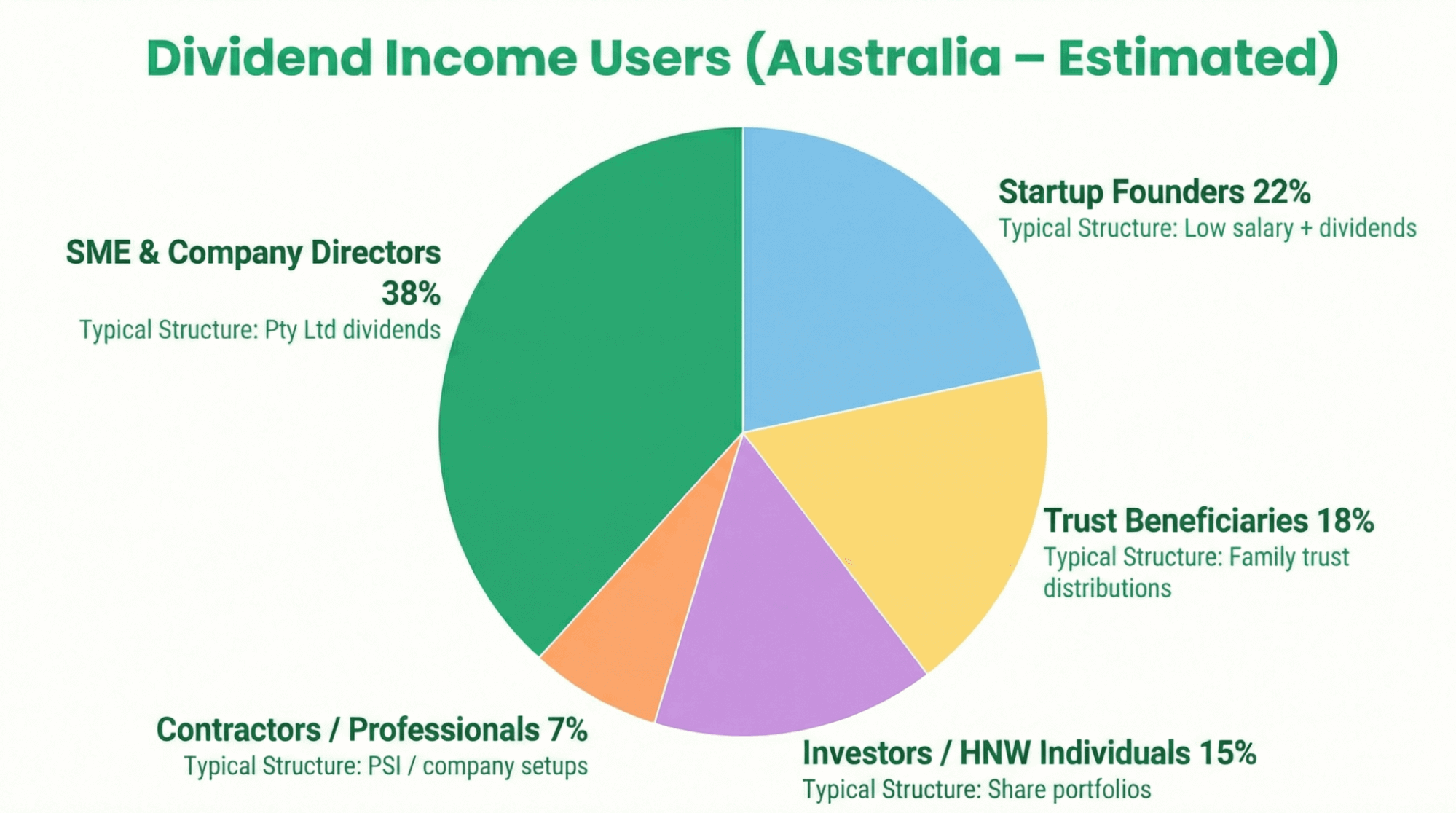
At Stryve Finance, we help clients strategically position their dividend income to maximise borrowing capacity without overexposing themselves to risk.
How lenders typically assess dividend income
- Consistency is key: Lenders want to see a steady history of dividend payments over 1-2 years.
- Averaging or using the lower year: If your income fluctuates, lenders may average your income or use the lower figure.
- Shading: Some banks may only consider 70-80% of your dividend income, particularly if it comes from private companies.
- Franking credits: A few lenders may allow you to gross up your dividend income by including franking credits, giving you a slight boost in borrowing power.
Example:
Let's say you've paid yourself the following over the last two years:
| Year | Dividend Income | Assessed Amount (80%) |
|---|---|---|
| 2024 | $100,000 | $80,000 |
| 2025 | $90,000 | $72,000 |
A lender may use an average ($76,000), or choose the lower year ($72,000) as your assessable income.
That difference can affect your borrowing capacity significantly. For example, an applicant with $100,000 in dividend income assessed at 80% may qualify for $150,000 to $200,000 less than if assessed at 100%, based on average serviceability ratios used by major Australian banks in 2026.
Tip: Even if your business has retained profits, those earnings don't count until they're actually paid to you as dividends and declared in your personal tax return. We help clients time distributions wisely to support upcoming loan applications.
Mainstream Banks vs Specialist Lenders
A recent survey of 25+ lenders on the Stryve Finance panel revealed that only 40% of major banks routinely accept dividend income without PAYG support, whereas over 80% of specialist lenders are willing to assess full dividend income with appropriate documentation.
At Stryve Finance, we work with a panel of over 50+ lenders, including major banks, credit unions, and specialist non-bank lenders, so we can match your income structure to a lender that actually understands it.
Mainstream Banks
Big banks tend to have stricter lending policies and often apply conservative rules to dividend income. You might face:
- Tighter verification requirements
- Higher shading (e.g., only using 70% of dividend income)
- Limited flexibility for fluctuating income
- Reluctance to accept income from private companies without audited financials
In some cases, a major bank may reject your application simply because your income doesn't fit neatly into their assessment model.
Specialist or Non-Bank Lenders
Specialist lenders are far more flexible with non-traditional income types, including dividends, trust distributions, and retained business profits.
Benefits include:
- Willingness to assess income outside PAYG structures
- Use of 100% of consistent dividend income
- Greater understanding of business owners and company directors
- Case-by-case policy flexibility
Yes, interest rates may be slightly higher, but the ability to borrow more or get approved at all often makes it worthwhile, especially for business owners.
At Stryve Finance, we know which lenders support dividend income mortgage approvals, and we'll make sure you avoid wasting time with banks that won't work for your structure.
Case Study
At Stryve Finance, we recently worked with a client who had what many lenders would call a “complex” financial profile, but what we saw was a clear opportunity.
The Client:
- A tech startup founder based in Melbourne
- Paid themselves solely through dividends
- No PAYG salary
- Company was profitable, but retained earnings varied year to year
- Goal: Upgrade to a new family home with a $1.2 million mortgage
The Challenge:
Most banks saw the client as a high risk because:
- No traditional salary income
- Irregular dividend amounts
- Business financials showed fluctuations due to reinvestment strategies
They were declined by their primary bank despite a strong asset position and no debt.
The Stryve Finance Solution:
We stepped in and:
- Reviewed 2 years of personal and company tax returns
- Worked with their accountant to confirm dividend consistency and company health
- Structured the application with a specialist lender that accepts 100% of declared dividend income
- Presented bank statements showing regular distributions
- Provided an accountant's letter verifying income sustainability
The Result:
Loan approved for $1.2 million at a competitive rate, no salary needed.
The client moved into their new home within 6 weeks and referred two other business owners to us afterwards.
This is what we do at Stryve Finance, turn non-traditional income into powerful mortgage approvals, without the drama.
Why Work With Stryve Finance?
When you're applying for a mortgage using dividend income, the difference between approval and rejection often comes down to who's guiding your application.
At Stryve Finance, we specialise in helping self-employed home loan, business owners, and company directors get approved, even with income structures that many banks don't understand.
Unlike traditional brokers who focus mostly on PAYG borrowers, we understand how to work with:
- Dividend income
- Trust distributions
- Company retained earnings
- Irregular or seasonal cash flow
- Financials that require explanation, not just numbers
What sets Stryve Finance apart?
- Access to over 50 lenders, including specialist and non-bank options
- Deep experience with non-traditional income structures
- Hands-on collaboration with your accountant and business advisor
- Strategic packaging of your application to meet lender criteria
- A tailored approach focused on your long-term goals, not just a quick loan
We don't believe in cookie-cutter solutions. Whether you're scaling a business, drawing income from dividends, or planning ahead for your next property move, we're here to help you structure it right, from day one.
With Stryve Finance, you're not just another file on a lender's desk, you're a business owner with unique income and goals, and we treat your application that way.
Ready to Buy, Invest, or Refinance?
Let us help you:
- Maximise your borrowing power with dividend income
- Match you with lenders who accept non-traditional income
- Get a clear plan to move forward with confidence
Whether you're a startup founder, trust beneficiary, or business director, we've got the strategy, lenders, and support to get it done.
Book your free strategy call with Stryve Finance today.
Let's turn your dividend income into your next property purchase.

Dylan Bertovic is the Director and Senior Finance Broker at Stryve Finance, specialising in non-traditional lending solutions. He helps clients across Australia with tiny home loans, construction finance, equipment and asset lending, refinancing, and investor loans. With deep expertise in self-employed and renovation mortgages, Dylan is known for crafting tailored strategies that get results